
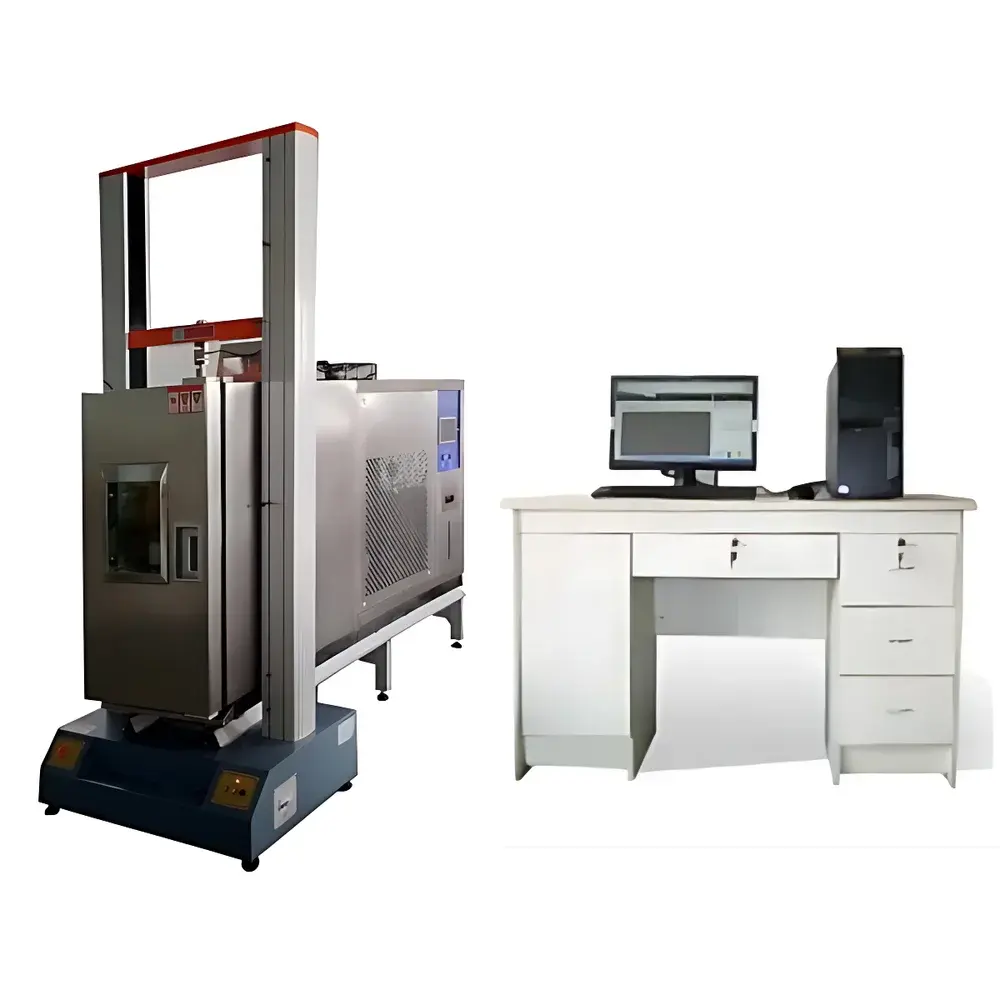
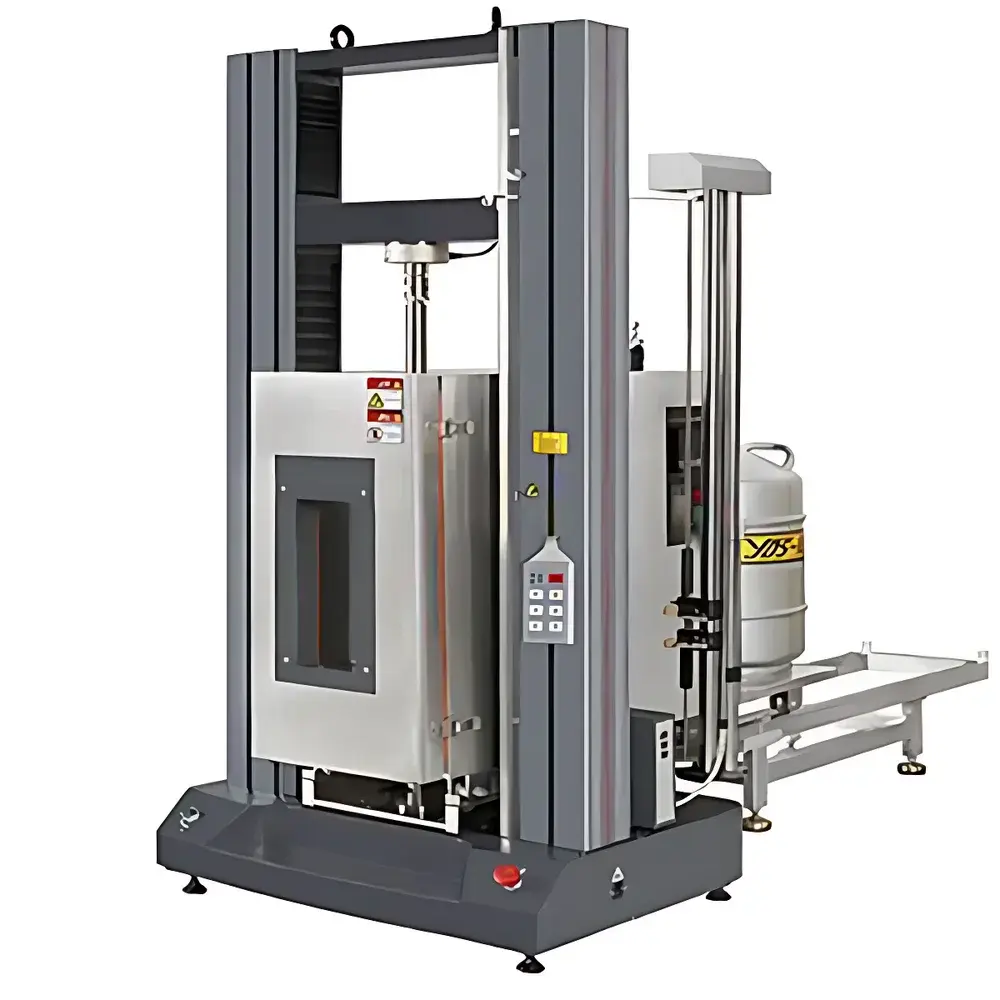
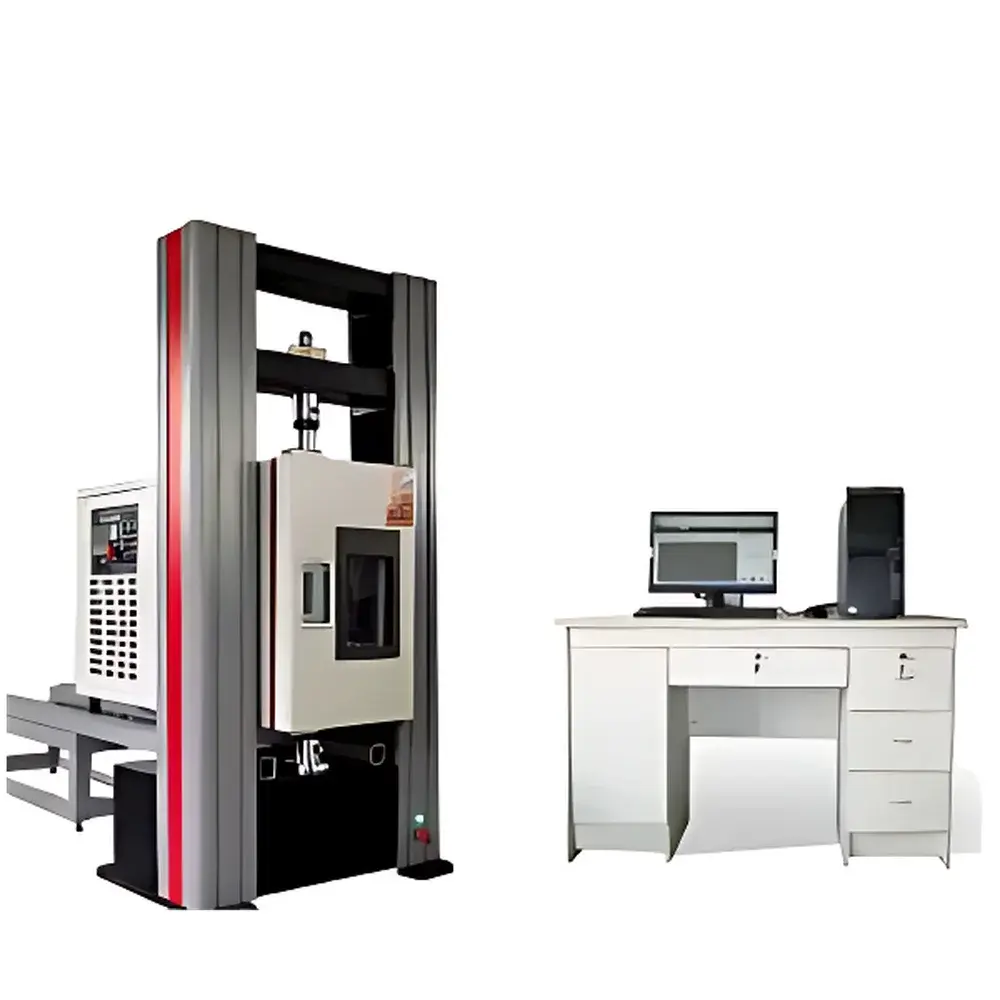
Tuofeng TFW-174 High-Low Temperature Electronic Universal Testing Machine
| Brand | Tuofeng |
|---|---|
| Origin | Shanghai, China |
| Manufacturer Type | Direct Manufacturer |
| Country of Origin | China |
| Model | TFW-174 |
| Instrument Type | Electronic Universal Testing Machine |
| Max Test Load | 5–100 kN (configurable) |
| Accuracy Class | 0.5 |
| Force Measurement Range | 0.4–100% FS |
| Force Indication Error | ±0.5% of reading |
| Force Resolution | 1/500,000 of full scale, unsegmented |
| Deformation Measurement Range | 0.2–100% FS |
| Deformation Error | ±0.5% of reading |
| Deformation Resolution | up to 1/300,000 |
| Displacement Error | ±0.5% of reading |
| Column Spacing (internal) | 840 mm |
| Crosshead Travel (standard) | 1000 mm |
| Host Dimensions (W×D×H) | 1250 × 560 × 2400 mm |
| Power Supply | AC 220 V / 50 Hz, ±10%, 750 W |
| Host Weight | ~380 kg |
| Environmental Chamber Temp Range | −40 °C to +100 °C |
| Chamber Heating Power | 1500 W |
| Chamber Internal Dimensions (W×D×H) | 360 × 300 × 500 mm |
| Chamber Control | Programmable PID with Pt100 sensors |
| Temp Uniformity (100 mm axial) | ±2 °C |
| Temp Stabilization Time | ≤5 min (both above and below 0 °C) |
| Chamber Construction | 304 stainless steel exterior, 316 mirror-finish interior, ceramic fiber insulation |
| Safety Systems | Leakage current protection, overcurrent circuit breaker |
Overview
The Tuofeng TFW-174 High-Low Temperature Electronic Universal Testing Machine is a precision-engineered electromechanical system designed for static mechanical property evaluation of metallic and non-metallic materials across a broad thermal spectrum—from −40 °C to +100 °C. It integrates a high-rigidity dual-column load frame with a programmable environmental chamber, enabling standardized tensile, compression, flexural, tear, peel, and shear testing under controlled temperature conditions. The system operates on the principle of servo-controlled displacement actuation, where a precision ball-screw-driven crosshead applies calibrated force while synchronized load cells and extensometer-grade strain transducers capture real-time force-deformation responses. Its modular architecture supports seamless integration with ISO 5893, ASTM E8/E21/E83/E111, GB/T 228.1–2021, JIS Z 2241, and DIN 50125-compliant test protocols—making it suitable for R&D validation, quality control release, and regulatory submission testing in regulated environments.
Key Features
- High-accuracy force measurement system compliant with ISO 7500-1 Class 0.5, featuring a resolution of 1 part in 500,000 of full scale across the entire range (5–100 kN), with no range switching required.
- Integrated environmental chamber with programmable ramp-and-soak temperature control, utilizing dual-mode regulation (compressor cooling + NiCr heating elements) and Pt100 platinum resistance thermometers for traceable thermal feedback.
- Rigid C-frame structure with 840 mm internal column spacing and 1000 mm crosshead travel—optimized for specimen alignment and dimensional stability during elevated-temperature tests.
- Real-time data acquisition at ≥1 kHz sampling rate, supporting simultaneous recording of load, displacement, and extensometer-derived strain signals with timestamped synchronization.
- Thermally isolated chamber design incorporating 316 mirror-finish stainless steel interior walls and multi-layer ceramic fiber insulation, ensuring uniform temperature distribution (±2 °C over 100 mm axial zone) and minimal thermal drift during long-duration creep or stress-relaxation tests.
- Dual safety architecture including electromagnetic leakage protection, thermal overload cutoffs, and hardware-limit switches—certified for operation within ambient conditions of +5 °C to +35 °C per IEC 61000-6-2 EMC requirements.
Sample Compatibility & Compliance
The TFW-174 accommodates standard and custom specimens per ASTM E8 (tension), E9 (compression), E292 (notched tensile), and ISO 6892-1 (ambient/low-temp tensile). Specimen mounting utilizes interchangeable grips—including wedge-action, pneumatic, and hydraulic variants—with optional cryogenic or high-temp fixtures rated for continuous operation at −40 °C and +100 °C. The chamber features dual 50 mm-diameter access ports with retractable thermal barriers, permitting uninterrupted load train continuity during temperature-cycled testing. All calibration procedures adhere to ISO/IEC 17025-accredited metrological practices, and system validation reports include as-found/as-left force calibration curves, temperature mapping data, and repeatability assessments per ISO 13384-1. The platform satisfies GLP audit requirements for raw data integrity, with electronic signatures and 21 CFR Part 11–compliant audit trails available via optional software modules.
Software & Data Management
The Windows-based control and analysis suite provides intuitive test setup, real-time visualization, and automated reporting. Users define multi-step thermal-mechanical profiles—including pre-conditioning holds, ramp rates, dwell periods, and post-test cooldown sequences—via graphical programming interface. Raw data streams are stored in vendor-neutral HDF5 format with embedded metadata (operator ID, calibration certificate IDs, environmental chamber logs). Post-processing functions include modulus calculation (secant, tangent, chord), yield point determination (0.2% offset, automatic inflection), and fracture energy integration. Export options include PDF test reports (customizable templates), CSV/Excel datasets, and XML files compatible with LIMS and ELN systems. Software updates follow a documented change control process aligned with GAMP 5 guidelines.
Applications
This system serves critical roles in polymer thermo-mechanical characterization (e.g., glass transition effects on tensile modulus), aerospace alloy qualification (e.g., Ti-6Al-4V ductility loss at sub-zero temperatures), elastomer low-temperature brittleness assessment (per ASTM D746), adhesive bond strength vs. thermal cycling, and ceramic matrix composite interlaminar shear behavior. It is routinely deployed in ISO/IEC 17025-accredited labs for third-party certification, in university materials science departments for graduate-level deformation mechanics research, and in manufacturing QA/QC labs for incoming raw material verification against ASTM D638, ISO 527, or GB/T 1040. Its dual-capability design eliminates the need for separate ambient and environmental test stations—reducing footprint, cross-contamination risk, and operator training overhead.
FAQ
What temperature ranges does the environmental chamber support, and how is thermal uniformity verified?
The chamber operates from −40 °C to +100 °C, with temperature uniformity validated per IEC 60068-3-5 using nine-point mapping; axial deviation is limited to ±2 °C over any 100 mm segment.
Is the system compliant with FDA 21 CFR Part 11 for electronic records and signatures?
Yes—when configured with the optional Validation Package, the software includes role-based access control, biometric or PKI-based e-signatures, immutable audit trails, and electronic record archiving compliant with 21 CFR Part 11 Subpart B.
Can the machine perform cyclic loading tests (e.g., fatigue) at elevated temperatures?
While primarily optimized for quasi-static tests per ISO 6892-2, the system supports low-frequency sinusoidal or trapezoidal waveforms up to 5 Hz with closed-loop strain control—suitable for preliminary thermal-mechanical fatigue screening when paired with high-temperature extensometry.
What calibration documentation is supplied with delivery?
Each unit ships with a NIST-traceable force calibration certificate (covering all load cells), chamber temperature mapping report, and mechanical alignment verification record—all valid for 12 months under normal usage conditions.
How is thermal expansion of the load train compensated during high-temperature testing?
The system employs real-time thermal drift compensation algorithms that reference chamber temperature readings and pre-characterized thermal elongation coefficients of the load frame and grip assemblies—ensuring displacement accuracy remains within ±0.5% FS across the full thermal range.



