
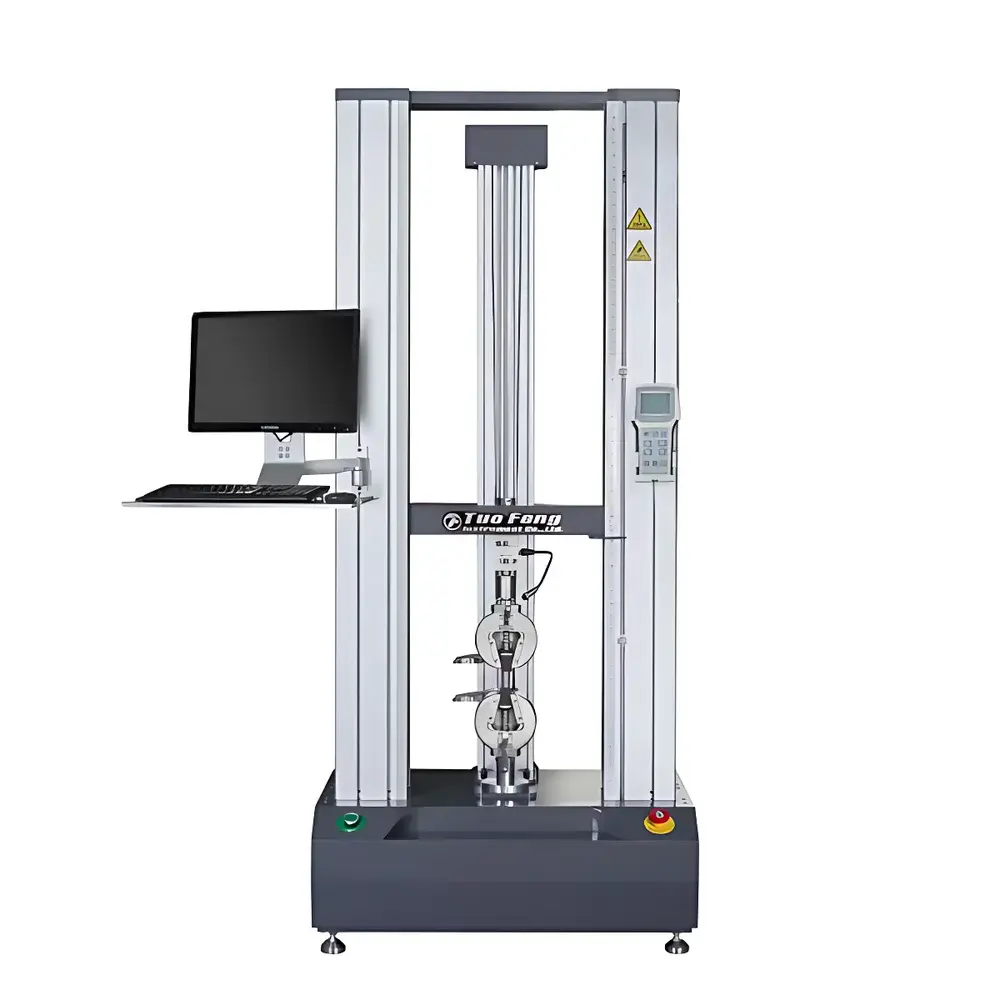
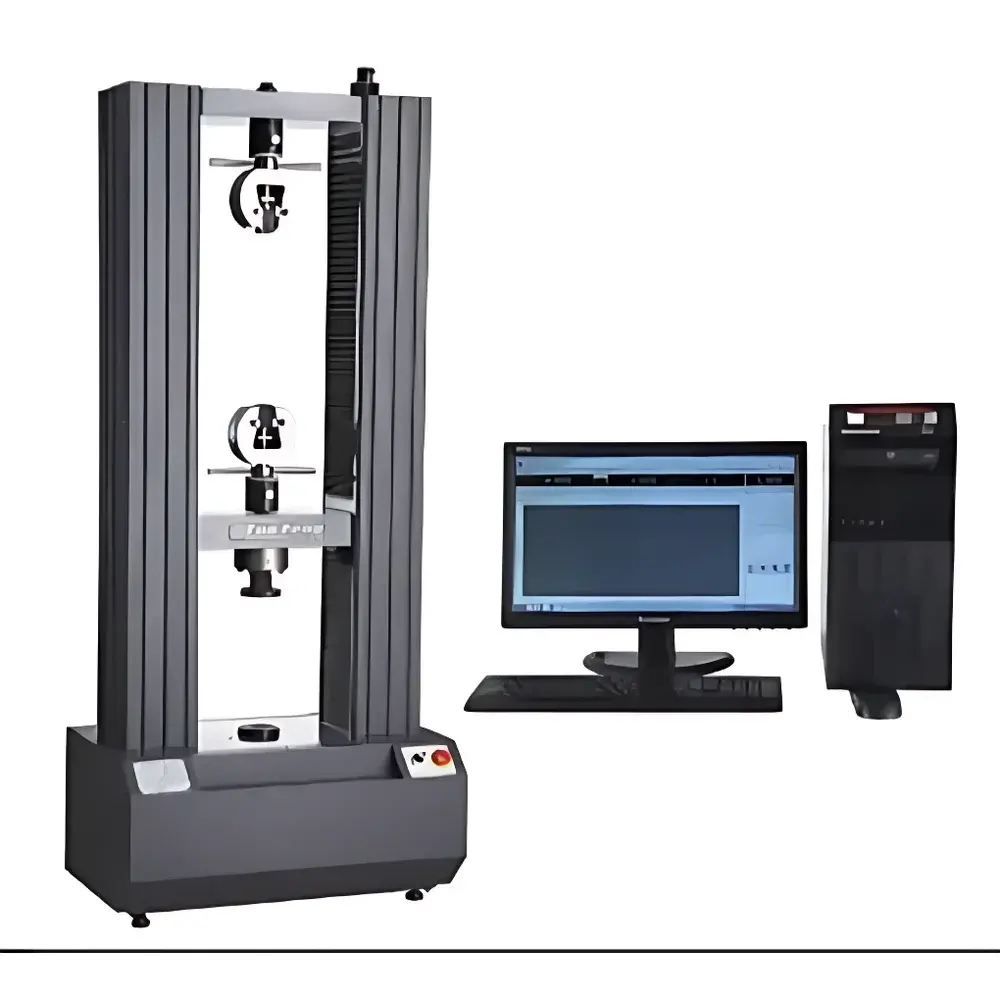
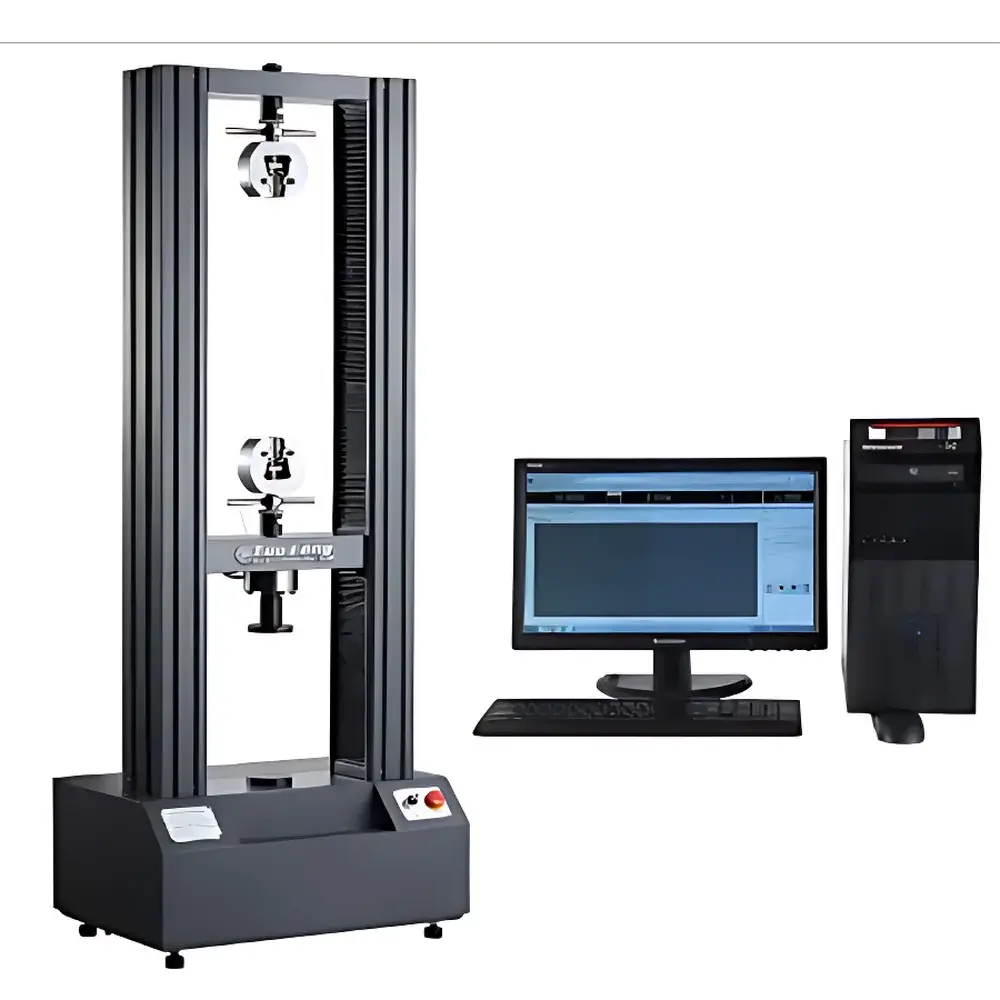
Tuofeng TFW-179 Microcomputer-Controlled Electromechanical Universal Testing Machine
| Brand | Tuofeng |
|---|---|
| Origin | Shanghai, China |
| Manufacturer Type | Direct Manufacturer |
| Instrument Type | Electromechanical Universal Testing Machine |
| Model | TFW-179 |
| Compliance | GB/T 16491–2008, JJG 475–2008, ASTM E4, ISO 7500-1, DIN 51221, JIS B 7721 |
| Accuracy Class | 0.5 |
| Force Range | 0.2–100% of Full Scale |
| Force Measurement Accuracy | ±0.005% of reading |
| Resolution | 1 part in 500,000 full-scale load (fixed resolution, no range switching) |
| Drive System | Imported servo motor with precision worm-gear reducer |
| Lead Screw | High-accuracy preloaded ball screw |
| Effective Test Width | 400 mm (customizable to 500/600 mm) |
| Stroke | 800 mm (extendable) |
| Speed Range | 0.001–500 mm/min (infinitely variable, closed-loop controlled) |
| Displacement Measurement | Optical encoder |
| Displacement Accuracy | ±0.005% of reading |
| Strain Measurement | Optional clip-on extensometer or large-deformation extensometer |
| Strain Accuracy | ±0.005% of reading |
| Safety Protection | Dual electronic limit switches, emergency stop button, overload cutoff (>110% FS), automatic return after test |
| Crosshead Control | Dual-speed (fast/slow) motorized positioning with jog function |
| Return Mode | Programmable auto-return at maximum speed post-test |
| Fixture Customization | Application-specific grips and fixtures available per ASTM/ISO specimen geometry |
| Power Supply | 220 V AC, 750 W |
| Dimensions (W×D×H) | 780 × 560 × 1700 mm |
| Weight | ~280 kg |
Overview
The Tuofeng TFW-179 Microcomputer-Controlled Electromechanical Universal Testing Machine is a high-precision static mechanical testing system engineered for rigorous tensile, compressive, flexural, shear, tear, peel, and puncture characterization of metallic, polymeric, ceramic, composite, and elastomeric materials. Based on the fundamental principles of quasi-static force-displacement transduction, the machine employs a closed-loop servo-controlled electromechanical actuation architecture compliant with ISO 7500-1:2018 (Class 0.5 verification) and calibrated per ASTM E4–23 for force measurement traceability. Its rigid C-frame structure, preloaded ball-screw transmission, and high-resolution 500,000-count load cell ensure exceptional linearity, repeatability (<±0.2% RSD across repeated tests), and long-term stability under variable thermal and mechanical loading conditions. Designed for integration into GLP-compliant laboratories and ISO/IEC 17025-accredited testing facilities, the TFW-179 supports full audit trails, user-level access control, and instrument qualification documentation packages.
Key Features
- 0.5-class accuracy certified per GB/T 16491–2008 and JJG 475–2008, with force measurement uncertainty ≤±0.005% of reading across the full 0.2–100% FS range
- True single-range, fixed-resolution force acquisition (1:500,000) eliminating range-switching artifacts and ensuring consistent sensitivity from low-force polymer films to high-strength structural alloys
- Imported servo drive system coupled with precision worm-gear reduction delivers smooth, jitter-free motion control from 0.001 mm/min creep testing to 500 mm/min high-speed rupture analysis
- Dual-mode crosshead positioning: rapid coarse adjustment (up to 200 mm/min) and fine-tuned jog control (0.001 mm increments) for precise specimen alignment and preload application
- Integrated safety triad: hardware-based electronic limit switches, momentary emergency stop circuit, and real-time overload detection (>110% FS) with immediate power cutoff and brake engagement
- Modular extensometry support: compatibility with both ASTM E83-compliant clip-on axial extensometers (for modulus and yield determination) and non-contact video extensometers (optional upgrade)
Sample Compatibility & Compliance
The TFW-179 accommodates standardized specimens per ASTM D638 (tensile plastics), ASTM D3039 (composite tension), ISO 6892-1 (metal tensile), ASTM D790 (flexure), ASTM D1876 (peel), and ASTM D624 (tear), with customizable jaw geometries—including wedge-action, pneumatic, hydraulic, and vise-type grips—for flat, round, tubular, and irregular geometries. All mechanical and software functions comply with regulatory data integrity requirements: audit trail logging (user ID, timestamp, action, parameter change), electronic signature capability, and 21 CFR Part 11–ready configuration (with optional validation package). The system meets essential performance criteria outlined in ISO 17025:2017 Clause 6.4.3 for equipment suitability and is routinely deployed in third-party certification labs accredited to CNAS, UKAS, and DAkkS scopes.
Software & Data Management
The Windows-based TFW-TestSuite v4.x software provides ISO/IEC 17025-aligned test execution and reporting. It supports seven programmable control modes—load-controlled, displacement-controlled, strain-controlled, load-rate, displacement-rate, strain-rate, and hold—and enables multi-step test profiles (e.g., preconditioning → ramp → dwell → ramp → fracture). Real-time plotting includes synchronized force–time, stress–strain, displacement–time, and custom-derived curves (e.g., tangent modulus, secant modulus, energy absorption). Units are configurable per ISO 80000 (N, kN, MPa, GPa, %, mm, in); language interface supports English, Simplified Chinese, Traditional Chinese, and German without restart. Data export conforms to ASTM E1434–22: CSV, XML, PDF, and proprietary .TFS binary formats with embedded metadata (operator, calibration ID, environmental log). All test files include digital signatures and immutable timestamps; backups are automated to network drives or NAS with version rollback capability.
Applications
The TFW-179 serves as a primary mechanical characterization platform across industrial R&D and QA/QC environments. In aerospace, it validates carbon-fiber laminate interlaminar shear strength (ASTM D2344) and titanium alloy fatigue crack growth thresholds. In medical device manufacturing, it verifies suture tensile strength (ISO 10555-1) and balloon catheter burst pressure (ISO 10555-4). Automotive suppliers use it for rubber bushing compression set (ASTM D395), while battery material labs quantify separator tensile toughness and electrode adhesion peel strength (ASTM D903). Academic users apply it to biomaterial viscoelastic modeling (time–temperature superposition), geosynthetic reinforcement testing (ISO 10319), and additive manufacturing part anisotropy mapping via directional tensile arrays.
FAQ
Does the TFW-179 support ASTM E23 standard for notched-bar impact testing?
No—impact testing requires pendulum or drop-weight systems; the TFW-179 is designed exclusively for quasi-static mechanical testing per ASTM E4, ISO 7500-1, and GB/T 16491.
Can I integrate third-party extensometers or environmental chambers?
Yes—standard analog voltage (±10 V) and digital TTL interfaces allow seamless integration with commercial extensometers, humidity chambers (–70 °C to +300 °C), and vacuum enclosures via optional I/O expansion modules.
Is firmware and software upgrade support included for life?
Yes—registered users receive complimentary firmware updates, security patches, and major software version upgrades for the lifetime of the instrument, with documented change logs and backward-compatible data migration tools.
What documentation is provided for IQ/OQ/PQ validation?
A complete validation toolkit is supplied: Factory Acceptance Test (FAT) report, Installation Qualification (IQ) checklist, Operational Qualification (OQ) protocol with pass/fail criteria, and Performance Qualification (PQ) templates aligned with ISO/IEC 17025 Annex A.2.
How is traceable calibration maintained over time?
The system includes NIST-traceable calibration certificates for load cell, displacement encoder, and extensometer (if installed), with recommended recalibration intervals defined by usage frequency, environmental conditions, and ISO/IEC 17025 internal procedures.



