
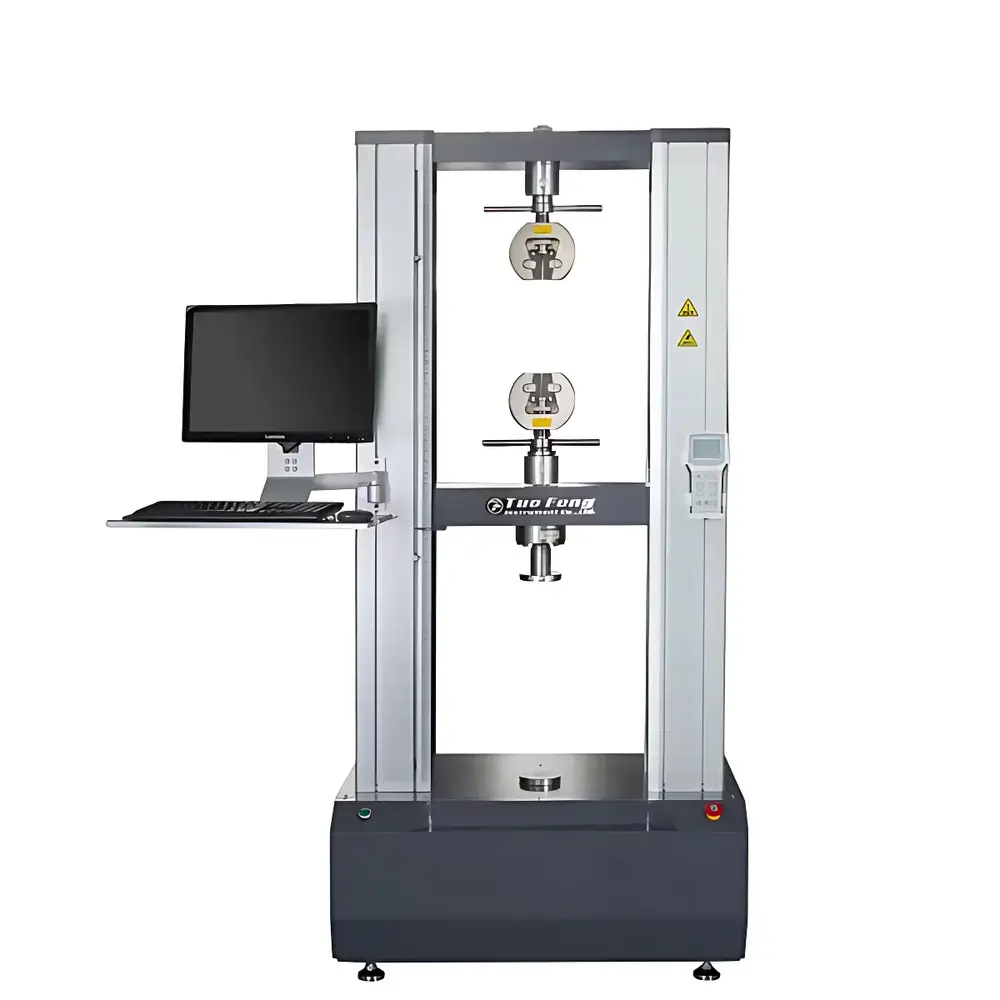
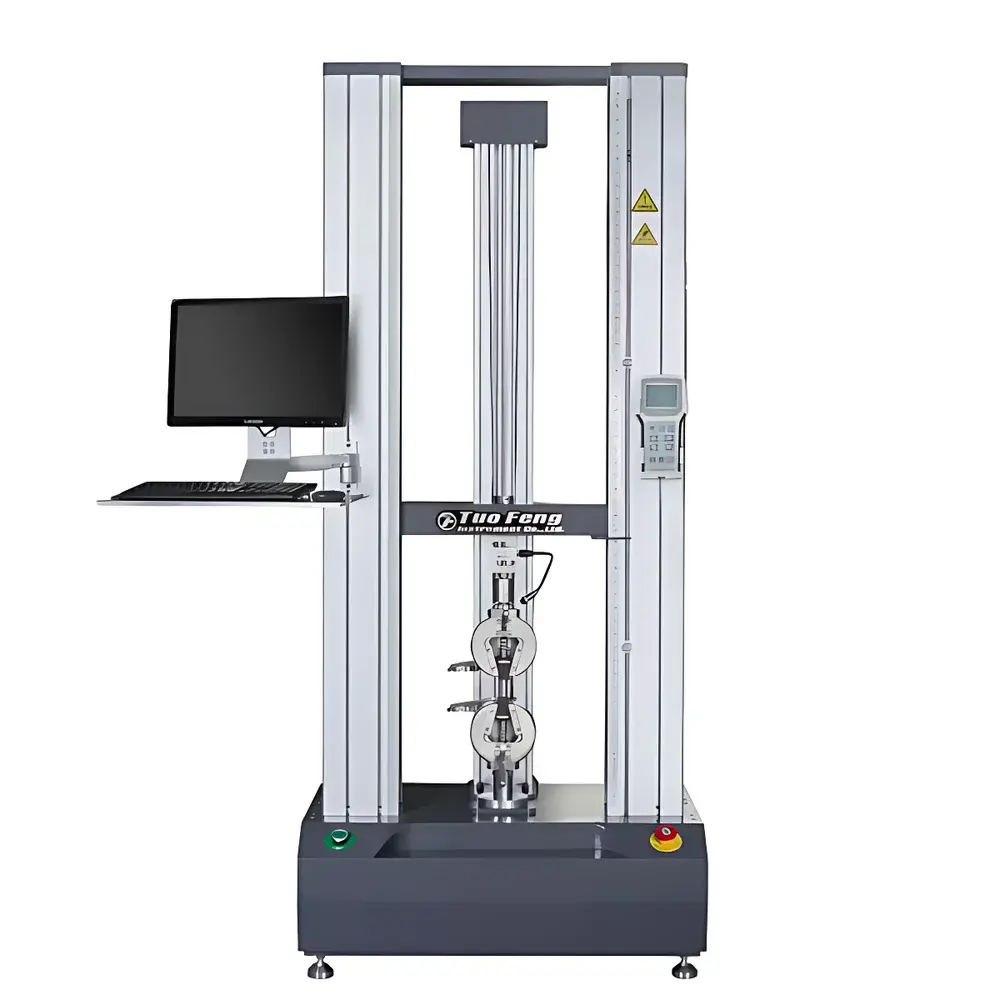
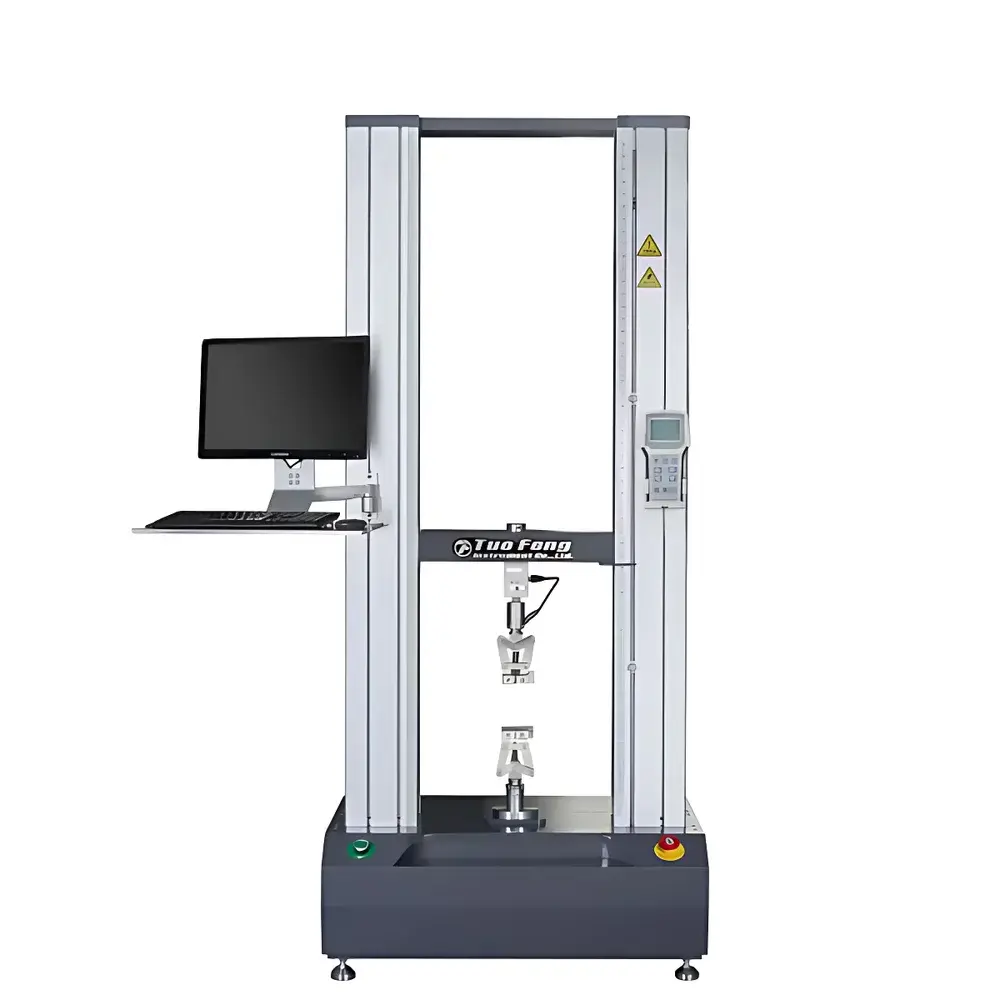
Tuofeng TFW-154 Advanced Microcomputer-Controlled Universal Testing Machine
| Brand | Tuofeng |
|---|---|
| Model | TFW-154 |
| Maximum Test Load | 150 kN (customizable from 5–200 kN) |
| Accuracy Class | 0.5 |
| Effective Force Range | 0.2%–100% of full scale |
| Force Measurement Accuracy | ±0.005% of reading |
| Load Resolution | 1/500,000 full-scale code (single-range, no auto-ranging) |
| Drive System | Imported servo motor with precision worm-gear reducer |
| Lead Screw | High-accuracy preloaded ball screw |
| Effective Test Width | 600 mm (expandable) |
| Stroke | 800 mm (height-adjustable) |
| Speed Range | 0.001–500 mm/min (infinitely variable) |
| Displacement Measurement | Optical encoder, accuracy ±0.005% of reading |
| Strain Measurement | Optional extensometer or large-deformation sensor, accuracy ±0.005% of reading |
| Safety Protection | Electronic limit switches, emergency stop button, overload protection (>110% FS), dual-speed motorized crosshead return |
| Software | Windows-based, multi-language (English/Chinese), compliant with ASTM E4, ISO 7500-1, GB/T 16491–2008, JJG 475–2008, supports GLP audit trails and 21 CFR Part 11 optional modules |
Overview
The Tuofeng TFW-154 Advanced Microcomputer-Controlled Universal Testing Machine is a high-precision electromechanical system engineered for static mechanical characterization of metallic, polymeric, ceramic, composite, and elastomeric materials. Based on the fundamental principles of uniaxial force–displacement transduction, it employs a closed-loop servo-controlled actuation architecture to deliver traceable, repeatable, and standards-compliant mechanical testing across tension, compression, bending, shear, peel, tear, and puncture configurations. Its modular load frame design—featuring a rigid dual-column structure, preloaded ball-screw transmission, and high-resolution optical displacement feedback—ensures minimal deflection, low hysteresis, and long-term dimensional stability under cyclic and sustained loading conditions. The system meets the metrological requirements defined in ISO 7500-1:2018 (Class 0.5), ASTM E4-23 (Standard Practices for Force Verification), and GB/T 16491–2008 (Chinese national standard for electronic universal testing machines), making it suitable for accredited laboratories operating under ISO/IEC 17025, GMP, or GLP frameworks.
Key Features
- High-fidelity force measurement system with ±0.005% reading accuracy and 1/500,000 internal resolution—no range switching required across the full 0.2–100% test capacity.
- Dual-mode motion control: precise low-speed creep testing down to 0.001 mm/min and rapid return at up to 500 mm/min, enabled by an imported industrial servo motor and optimized worm-gear reduction.
- Integrated safety architecture including hardware-based emergency stop, programmable electronic limit switches, real-time overload cutoff (>110% of rated load), and automatic crosshead return upon test completion.
- Modular extensometry support: compatibility with clip-on axial extensometers (for modulus and yield determination) and non-contact video extensometers or large-deformation sensors for highly ductile or fragile specimens.
- Thermally stable load frame construction using high-rigidity cast iron and precision-machined guide columns, minimizing thermal drift and mechanical compliance during extended-duration tests.
Sample Compatibility & Compliance
The TFW-154 accommodates standardized and custom geometries—from ASTM E8/E21 tensile bars and ISO 6892-1 flat coupons to ASTM D638 dogbones, ISO 178 flexural beams, ASTM D1876 T-peel fixtures, and ASTM D624 tear specimens. Its 600 mm effective test width and 800 mm vertical stroke allow evaluation of structural composites, laminates, and large-section polymers. All test protocols are fully compatible with international material standards, including ASTM D3039 (composite tensile), ASTM D695 (compressive strength), ISO 527-2 (plastics tensile), ISO 14129 (interlaminar shear), and GB/T 228.1–2021 (metallic materials tensile testing). Calibration and verification procedures adhere to JJG 475–2008 (Chinese verification regulation for electronic UTM) and support third-party certification per ISO/IEC 17025 requirements.
Software & Data Management
The embedded Windows-based testing software provides full configurability for force-controlled, displacement-controlled, and time-controlled test modes—including hold steps, ramp-hold sequences, and multi-step cyclic protocols. Real-time visualization includes synchronized plots of load vs. time, stress vs. strain, displacement vs. time, and user-defined derived curves. Data acquisition operates at ≥1 kHz sampling rate, with automatic calculation of tensile strength, yield point (0.2% offset), Young’s modulus, elongation at break, compressive yield, flexural modulus, peel adhesion energy, and tear propagation resistance. All raw data files are stored in open ASCII format with embedded metadata (operator ID, timestamp, calibration ID, environmental notes). Audit trail functionality—optionally enabled per FDA 21 CFR Part 11—logs all user actions, parameter changes, and report generations. Software updates are delivered remotely with version-controlled release notes and backward-compatible data migration.
Applications
This system serves as a core mechanical characterization platform in R&D labs and QC departments across aerospace (e.g., titanium alloy fasteners, carbon-fiber prepreg validation), automotive (polymer gaskets, battery cell housing compression, brake pad shear), medical device manufacturing (suture tensile strength, catheter kink resistance, orthopedic implant fatigue pre-screening), construction materials (rebar bond strength, geotextile tensile performance), and advanced packaging (peel strength of laminated films, seal integrity of pouches). It also supports academic research in polymer viscoelasticity (via creep/recovery protocols), additive manufacturing (mechanical anisotropy mapping), and biomaterials (hydrogel compression modulus, tendon graft fixation strength).
FAQ
What standards does the TFW-154 comply with for calibration and verification?
It conforms to ISO 7500-1:2018 (Class 0.5), ASTM E4-23, GB/T 16491–2008, and JJG 475–2008. Certificate of conformity and as-found/as-left calibration reports are provided with each shipment.
Can the system be integrated into an existing LIMS or MES environment?
Yes—via TCP/IP API and configurable CSV/XML export templates, supporting automated data ingestion into laboratory information management systems and enterprise quality databases.
Is strain measurement included as standard equipment?
No—axial extensometers and large-deformation sensors are optional accessories selected based on application requirements (e.g., ASTM E83 Class B-1 for metals, ISO 9513 Class 1 for plastics).
Does the software support multi-user role-based access control?
Yes—administrator, operator, and reviewer profiles can be configured with differential permissions for method editing, test execution, and report approval, aligned with GLP/GMP operational workflows.
What maintenance intervals are recommended for long-term accuracy retention?
Biannual verification of force and displacement channels is advised; annual mechanical inspection of lead screws, bearings, and drive belts is included in the preventive maintenance service plan.



