
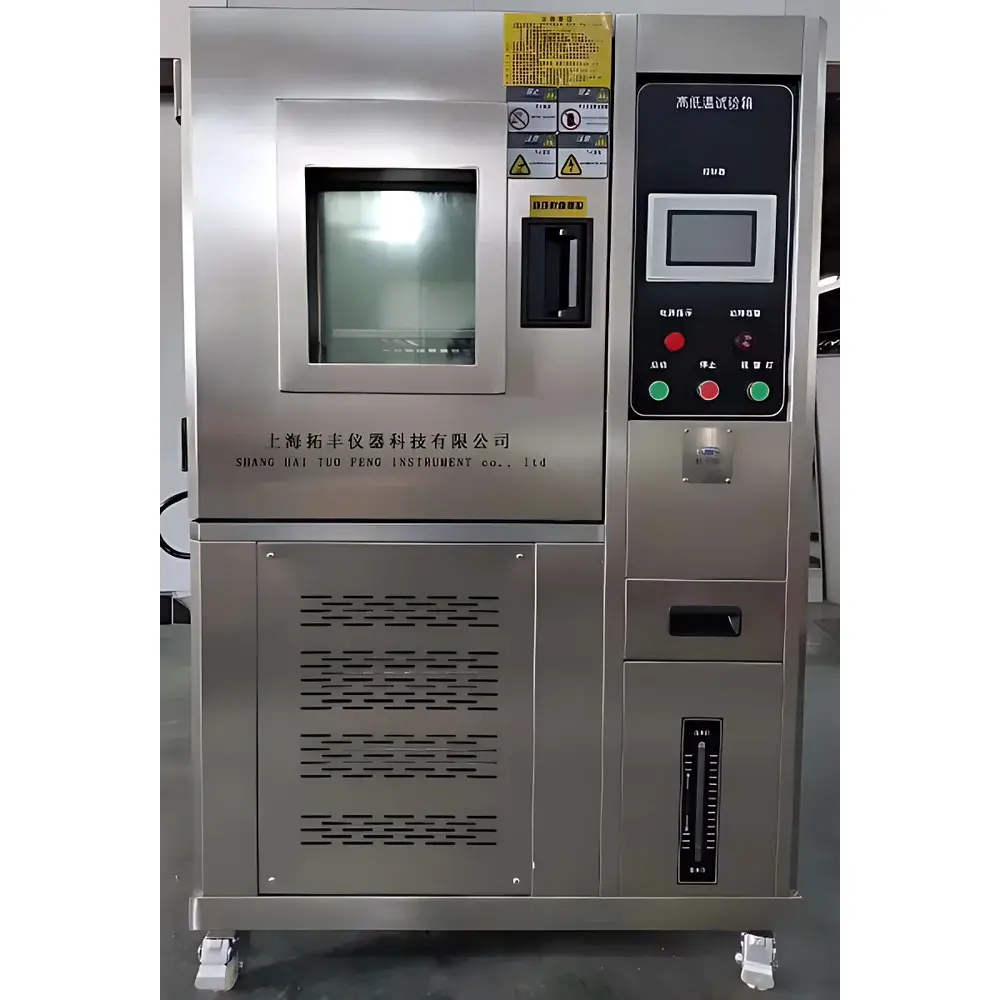
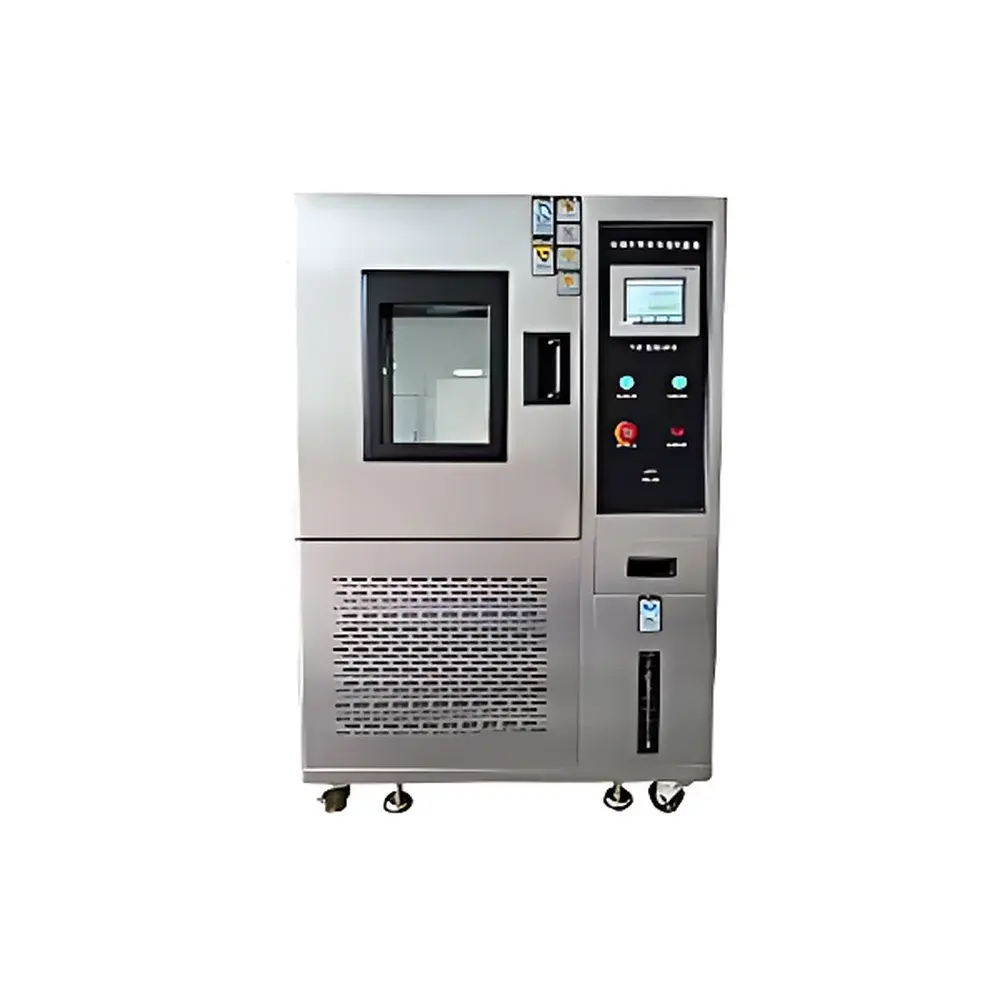
Tuofeng TF-320A-225L Environmental Test Chamber for Temperature and Humidity Cycling
| Brand | Tuofeng |
|---|---|
| Origin | Shanghai, China |
| Manufacturer Type | Direct Manufacturer |
| Country of Origin | China |
| Model | TF-320A-225L |
| Temperature Range | −70 °C to +150 °C |
| Temperature Fluctuation | ±0.5 °C |
| Temperature Uniformity | ±0.1 °C |
| Temperature Deviation | ±0.1 °C |
| Heating Rate | ≤60 min (−70 °C to +150 °C) |
| Cooling Rate | ≤45–80 min (depending on setpoint transition) |
| Internal Chamber Dimensions (W×H×D) | 500 mm × 750 mm × 600 mm |
| Chamber Volume | 225 L |
| Humidity Range | 20–98 % RH |
| Humidity Uniformity | ±3.0 % RH |
| Humidity Control Accuracy | ±2.0 % RH |
| Controller | TEMI (South Korea) |
| Compressor | Tecumseh (France) |
| Construction Material | SUS304 Stainless Steel |
| Insulation | High-density polyurethane foam with chlorinated ethyl ester formulation |
| Cooling System | Air- or water-cooled dual-stage refrigeration |
| Safety Protections | Fuseless circuit breaker, compressor overload protection, high/low refrigerant pressure switch, over-temperature/over-humidity cutoff, fault alarm system |
| Power Supply | 1φ 220 VAC ±10 %, 50/60 Hz or 3φ 380 VAC ±10 %, 50/60 Hz (configurable) |
Overview
The Tuofeng TF-320A-225L Environmental Test Chamber is a precision-engineered climatic simulation system designed for rigorous temperature and humidity cycling in accordance with international reliability testing standards. It operates on a dual-stage refrigeration principle coupled with PID-controlled steam humidification and electric heating, enabling stable, repeatable conditioning across a wide operational envelope (−70 °C to +150 °C; 20–98 % RH). Its chamber architecture integrates high-efficiency thermal insulation, uniform airflow distribution via tangential fan arrays, and real-time feedback from multiple platinum resistance thermometers (PT100) and capacitive hygrometers — all calibrated traceably to NIST-equivalent references. This configuration ensures compliance with the fundamental physical requirements for accelerated aging, environmental stress screening (ESS), and qualification testing in regulated R&D and production environments.
Key Features
- Stainless steel SUS304 interior and exterior construction for corrosion resistance and long-term dimensional stability under cyclic thermal loads
- Dual-stage compression refrigeration system with French Tecumseh compressors, supporting rapid cooling transitions while maintaining low refrigerant charge and energy efficiency
- Korean TEMI programmable controller with 100-segment ramp-soak profiles, real-time data logging, USB export, and password-protected parameter locking
- High-density polyurethane insulation with chlorinated ethyl ester formulation, minimizing thermal bridging and ensuring <±0.1 °C spatial uniformity at steady state
- Redundant safety architecture: independent over-temperature and over-humidity cutouts, refrigerant pressure monitoring, compressor thermal overload detection, and audible/visual fault alerts
- Configurable power input (single-phase 220 V or three-phase 380 V) with voltage tolerance ±10 % and frequency compatibility across 50/60 Hz grids
Sample Compatibility & Compliance
The TF-320A-225L accommodates samples up to 225 L volume with unrestricted mounting flexibility — including shelf-supported, rack-mounted, or freely suspended configurations. Its chamber geometry and airflow design support uniform exposure of heterogeneous assemblies (e.g., PCBs with mixed component heights, automotive ECUs with integrated heat sinks, or polymer film rolls). The system meets the mechanical, thermal, and metrological requirements of multiple international test standards, including ISO 16750-4 (road vehicles), IEC 60068-2-1/-2/-3/-14 (environmental testing), GB/T 2423.1–2423.4 (Chinese national equivalents), GJB 150.3/150.4/150.9 (military environmental testing), and ASTM D4332 (conditioning of plastics). All control algorithms and sensor calibrations are documented per GLP-compliant procedures, and optional audit trail functionality supports FDA 21 CFR Part 11 readiness when paired with validated software extensions.
Software & Data Management
The TEMI controller provides native CSV data export via USB flash drive, with timestamped records of chamber setpoints, actual temperatures/humidity, compressor status, and alarm events. Optional Ethernet or RS485 interfaces enable integration into centralized lab management systems (LIMS) or SCADA platforms using Modbus RTU or TCP protocols. Firmware updates are performed via secure firmware signing to prevent unauthorized modification. For regulatory environments, optional validation packages include IQ/OQ documentation templates, sensor calibration certificates (traceable to national metrology institutes), and electronic signature-capable reporting modules compliant with ALCOA+ data integrity principles.
Applications
This chamber serves critical roles in product development and quality assurance workflows across industries requiring environmental robustness verification. In electronics manufacturing, it supports JEDEC JESD22-A104 (temperature cycling) and A110 (highly accelerated stress testing). Automotive suppliers use it for ISO 16750-4 thermal shock validation and climate endurance of infotainment modules. Aerospace component vendors apply it to MIL-STD-810G Method 502.6 (low temperature) and Method 507.5 (humidity). Pharmaceutical packaging labs employ it for ICH Q1A(R2) stability protocol conditioning (25 °C/60 % RH, 30 °C/65 % RH), while materials science labs utilize its precise gradients for polymer crystallinity studies and adhesive bond aging kinetics.
FAQ
What is the maximum allowable sample mass inside the 225 L chamber without compromising thermal uniformity?
For optimal performance, total sample mass should not exceed 35 kg. Higher masses may require extended stabilization time and affect recovery after rapid transitions.
Can the chamber operate continuously at −70 °C and 98 % RH simultaneously?
No — extreme low-temperature operation limits achievable humidity due to dew point constraints. At −40 °C, maximum relative humidity is ~10 % RH; full 98 % RH is only sustainable above +10 °C.
Is third-party calibration certification available upon delivery?
Yes — optional factory calibration with NIST-traceable PT100 and humidity sensors, including as-found/as-left reports and uncertainty budgets, is provided upon request.
Does the system support remote monitoring via cloud-based platforms?
With the optional IoT gateway module, real-time chamber status, historical trends, and alarm notifications can be accessed via secure HTTPS dashboard or integrated into enterprise MES systems.
What maintenance intervals are recommended for the refrigeration system?
Compressor oil and refrigerant filter driers require replacement every 24 months under continuous operation; condenser coils must be cleaned quarterly in non-climate-controlled rooms.



