
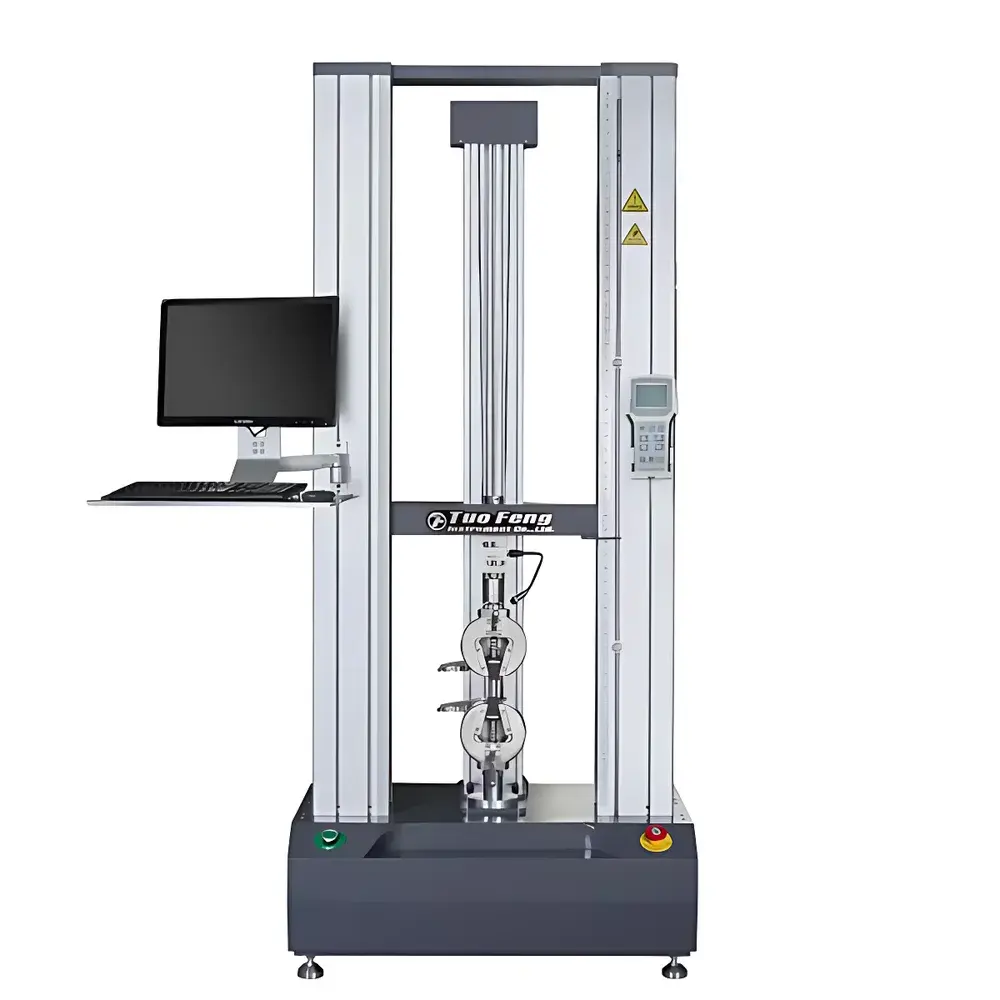
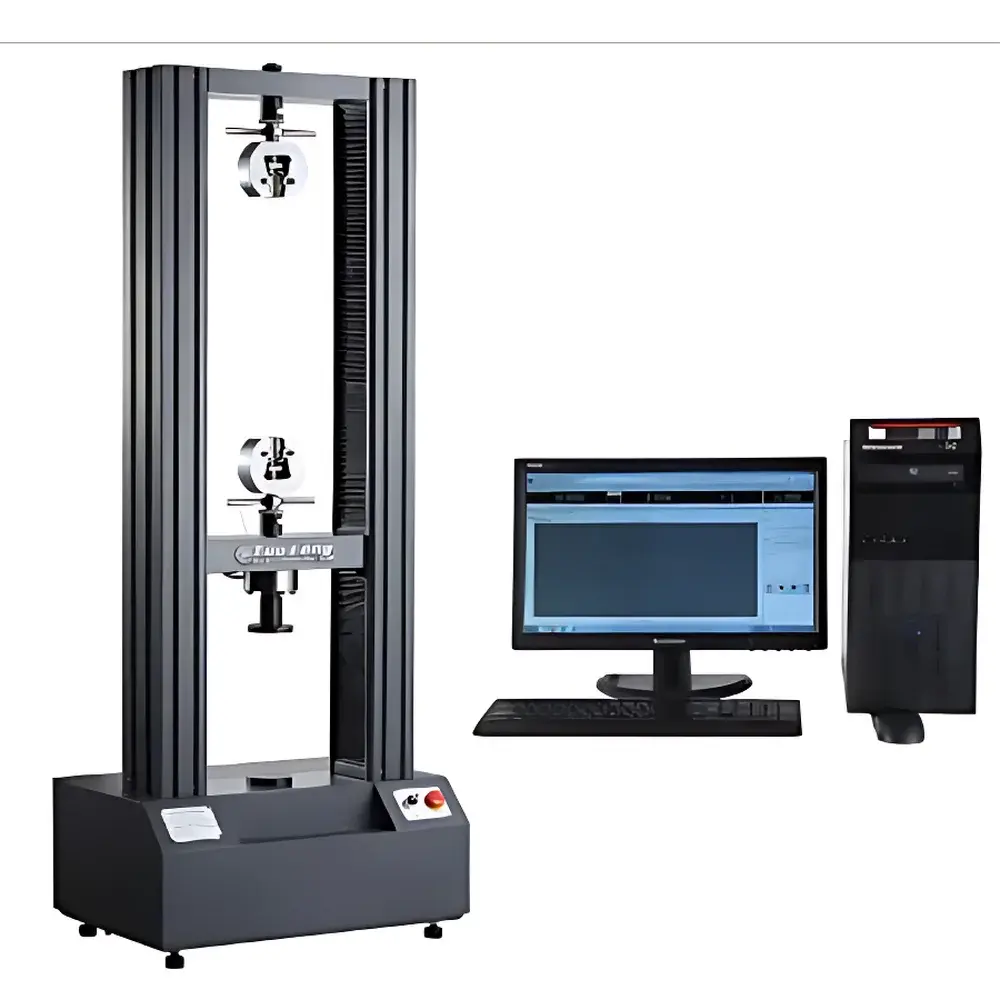
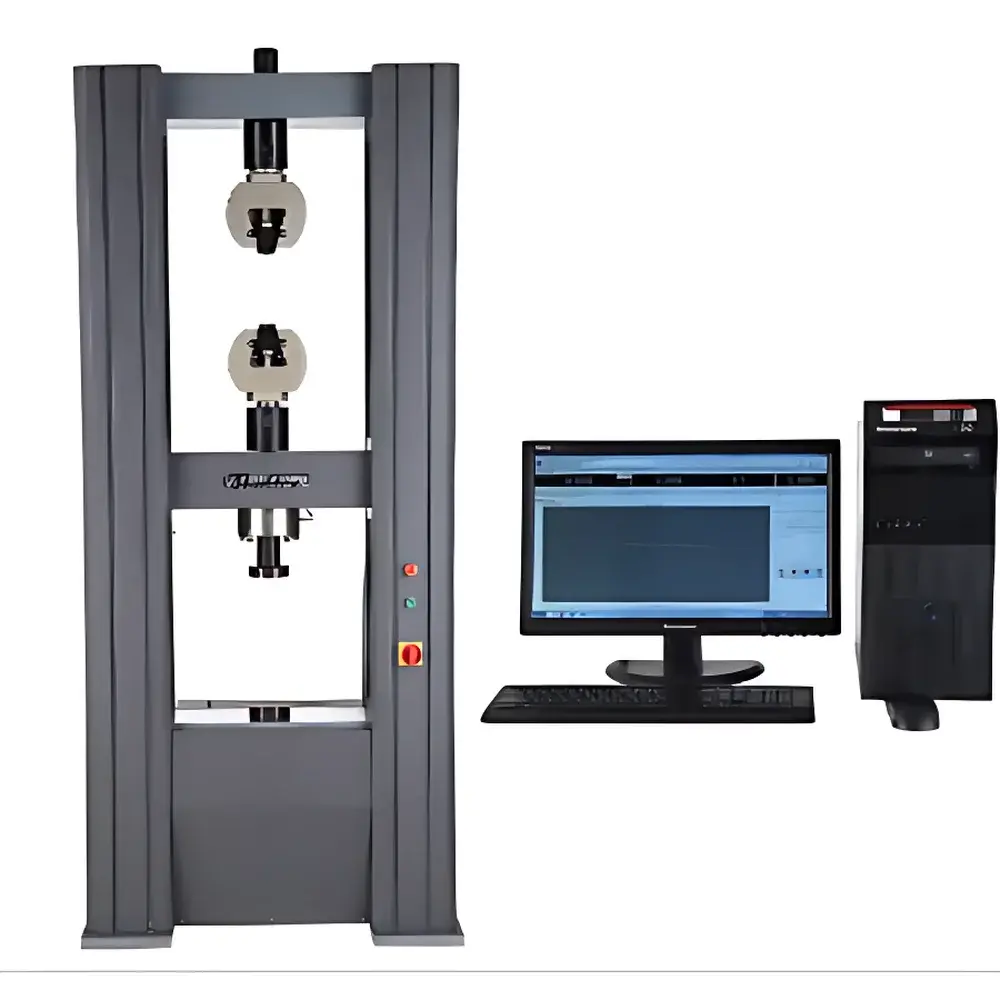
Tuofeng TFW-189 Microcomputer-Controlled Electronic Universal Testing Machine
| Brand | Tuofeng |
|---|---|
| Origin | Shanghai, China |
| Manufacturer Type | Direct Manufacturer |
| Instrument Type | Electronic Universal Testing Machine |
| Model | TFW-189 |
| Compliance | GB/T 16491–2008, JJG 475–2008 |
| Accuracy Class | 0.5 |
| Effective Force Range | 0.2%–100% of Full Scale |
| Load Measurement Accuracy | ±0.005% of Reading |
| Force Resolution | 1 part in ±500,000 full-scale counts (no range switching, constant resolution) |
| Drive System | Imported Servo Motor with Worm Gear Reducer |
| Lead Screw | High-Precision Ball Screw |
| Effective Test Width | 400 mm (customizable up to 600 mm) |
| Stroke | 800 mm (extendable) |
| Speed Range | 0.001–500 mm/min (infinitely variable) |
| Displacement Measurement | Optical Encoder |
| Displacement Accuracy | ±0.005% of Reading |
| Strain Measurement | Optional Extensometer or Large-Deformation Gauge |
| Strain Accuracy | ±0.005% of Reading |
| Safety Protection | Electronic Limit Switches, Emergency Stop Button, Overload Protection (10% above rated capacity) |
| Crosshead Control | Dual-Speed (Fast/Slow) Motorized Adjustment with Position Memory |
| Return Function | Automatic or Manual High-Speed Return to Initial Position |
| Fixture Customization | Application-Specific Grips Available |
| Power Supply | 220 V AC, 750 W |
| Dimensions (W×D×H) | 780 × 560 × 1700 mm |
| Approx. Weight | 280 kg |
Overview
The Tuofeng TFW-189 Microcomputer-Controlled Electronic Universal Testing Machine is a high-precision, servo-driven mechanical testing system engineered for static tensile, compressive, flexural, shear, tear, peel, and burst testing of metallic, polymeric, composite, and ceramic materials. It operates on the fundamental principle of controlled displacement actuation via a high-rigidity load frame, precision ball screw transmission, and closed-loop feedback control of force, displacement, and strain—enabling traceable, repeatable, and standards-compliant mechanical property characterization. Designed for laboratory and industrial quality control environments, the TFW-189 meets the metrological and structural requirements of GB/T 16491–2008 (Chinese national standard for electronic UTM) and JJG 475–2008 (verification regulation for electronic universal testing machines), and supports method execution per ASTM E8/E9/E21, ISO 6892-1, ISO 178, ISO 527, DIN 53455, JIS Z2241, and BS EN 10002-1.
Key Features
- 0.5-class accuracy certified force measurement system with ±0.005% reading accuracy and 1:500,000 internal resolution—ensuring high reproducibility across the full 0.2–100% force range without range switching.
- Imported servo motor coupled with a self-locking worm gear reducer delivers smooth, low-noise motion control and precise speed regulation from 0.001 to 500 mm/min.
- High-stiffness cast-iron frame with preloaded ball screws minimizes elastic deformation and ensures axial alignment stability during high-load testing.
- Dual-speed crosshead drive enables rapid positioning and fine-step adjustment; programmable return-to-start function improves throughput in batch testing workflows.
- Comprehensive safety architecture includes hardware-based emergency stop, electronic travel limits, and automatic overload cutoff at 110% of rated capacity.
- Modular fixture interface supports standardized wedge-action, pneumatic, hydraulic, and custom-designed grips for flat, round, threaded, or irregular specimens.
Sample Compatibility & Compliance
The TFW-189 accommodates specimens ranging from thin films (≥0.05 mm thick) to structural metal bars (up to Ø25 mm diameter), including ASTM-standard tensile coupons (Type I–V), ISO dog-bone specimens, compression cylinders (Ø10–50 mm), three- and four-point bending beams, peel strips (90°/180°), and puncture discs. All test configurations comply with GLP-aligned data integrity practices: audit-trail-enabled software logs user actions, parameter changes, and calibration events. The system satisfies functional requirements for ISO/IEC 17025-accredited laboratories and supports documentation for FDA 21 CFR Part 11 compliance when deployed with validated software configuration and electronic signature modules.
Software & Data Management
The Windows-based TFW-TestSuite v4.x provides multi-mode control (constant rate of extension, constant load, constant strain, hold, cyclic ramp-hold), real-time plotting of up to six synchronized curves (e.g., stress–strain, load–displacement, strain–time), and automated calculation of mechanical parameters—including tensile strength, yield strength (0.2% offset), Young’s modulus, elongation at break, compressive yield stress, flexural modulus, tear strength, and peel adhesion energy. Units are freely convertible between SI, imperial, and legacy systems (N/kN, lbf, MPa/psi, mm/in, %). Test reports are exportable as PDF, CSV, or XML; raw data files retain timestamped, uneditable acquisition metadata. The software architecture allows third-party API integration and supports future expansion via licensed plug-in modules for fatigue, creep, or DMA-correlated analysis.
Applications
This system serves as a primary mechanical characterization platform across R&D, production QA/QC, and regulatory submission support. In aerospace, it validates tensile properties of aluminum alloys (e.g., 2024-T3, 7075-T6) and carbon-fiber prepregs per ASTM D3039. In medical device manufacturing, it verifies tensile strength and elongation of silicone tubing (ISO 10993-12) and suture materials (USP ). Automotive suppliers use it for rubber compound hardness–tensile correlation studies (ASTM D412), while construction labs apply it to rebar yield testing (GB/T 1499.2) and concrete compression (GB/T 50081). Universities employ the system for teaching materials science fundamentals and validating constitutive models in finite element simulation.
FAQ
What international standards does the TFW-189 support out-of-the-box?
It natively implements test sequences and reporting templates aligned with ASTM E8, ISO 6892-1, ISO 178, GB/T 228.1, and JIS Z2241. Custom method scripting is available for non-standard protocols.
Can the system be integrated into an existing LIMS or MES environment?
Yes—via OPC UA or TCP/IP socket interface; detailed communication protocol documentation and driver libraries are provided upon request.
Is strain measurement included by default?
No—extensometer or large-deformation gauge is optional hardware. However, the controller features dedicated analog input channels and firmware support for ASTM E83-compliant devices.
What calibration documentation is supplied?
Each unit ships with a factory calibration certificate traceable to NIM (National Institute of Metrology, China), covering force, displacement, and speed axes. Optional UKAS or DAkkS-accredited calibration services are available.
Does the software meet FDA 21 CFR Part 11 requirements?
The base software supports audit trails, electronic signatures, and role-based access control. Full Part 11 compliance requires installation validation, change control procedures, and documented configuration management—services offered under Tuofeng’s GxP Support Program.



