
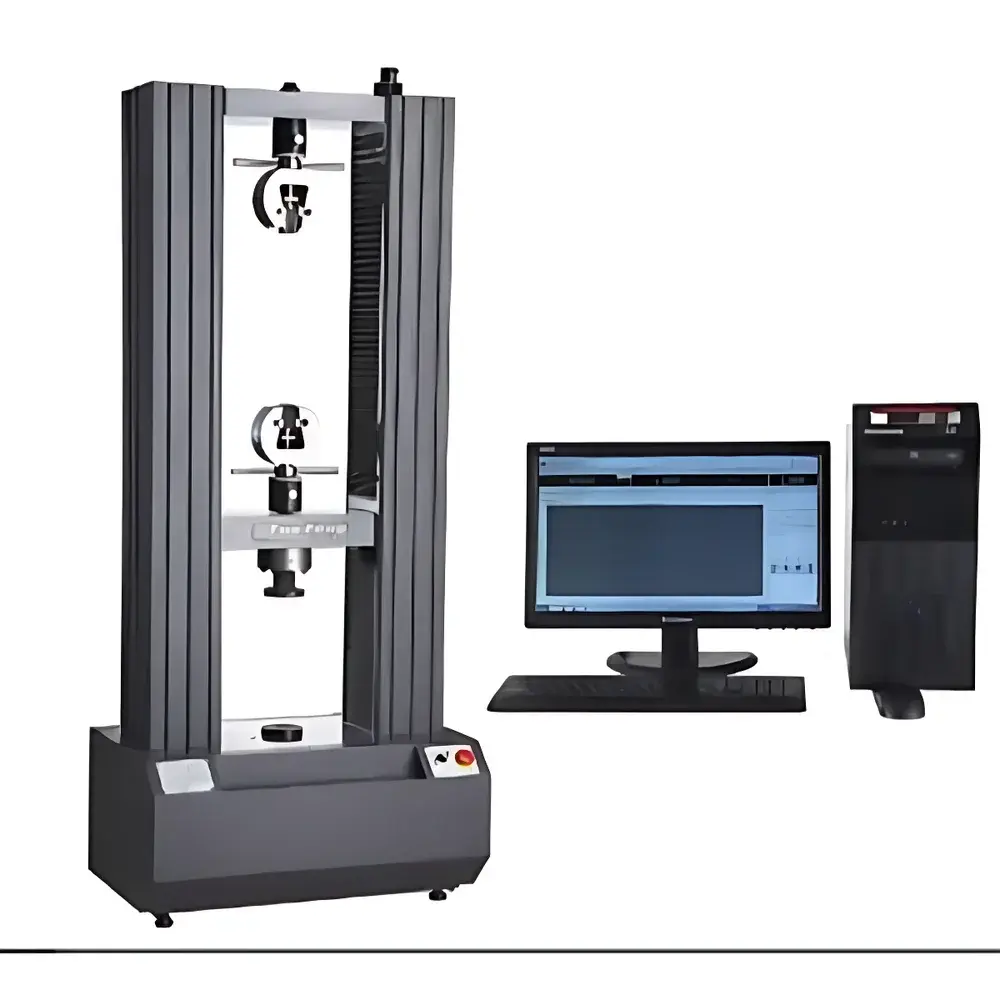
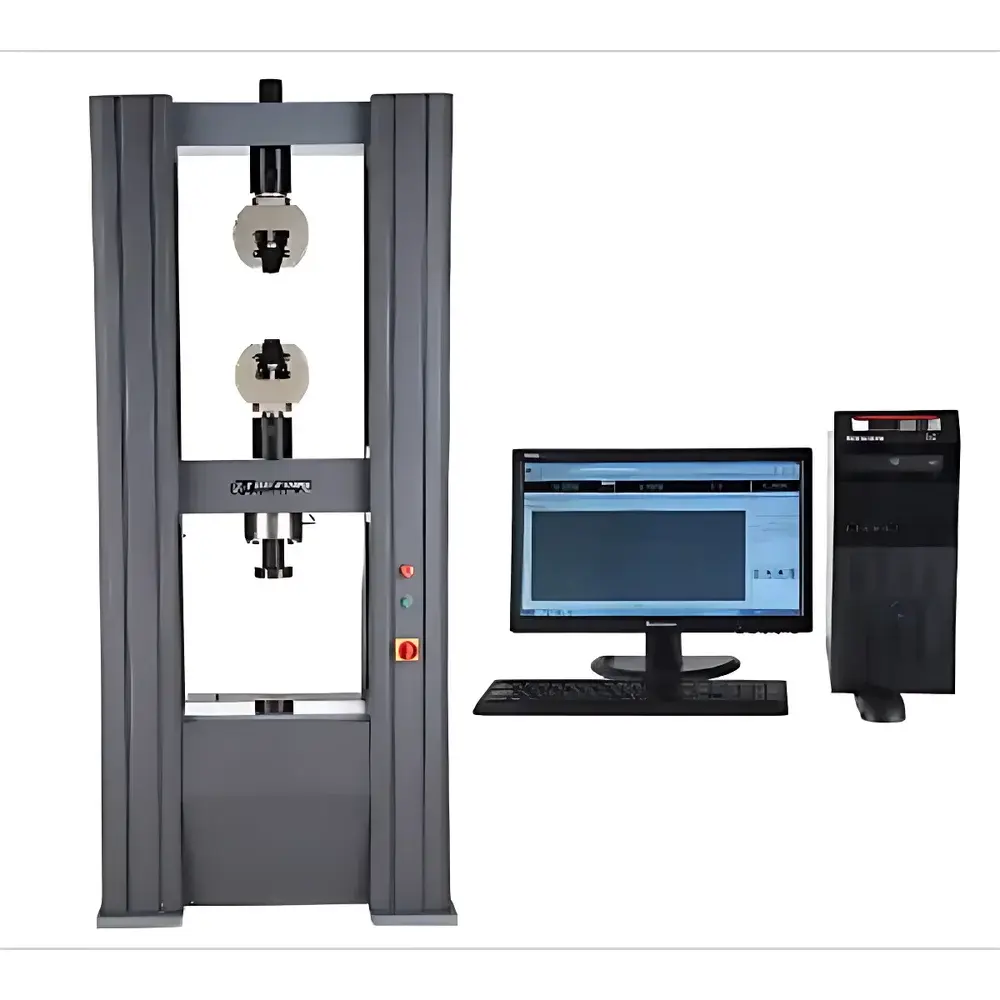
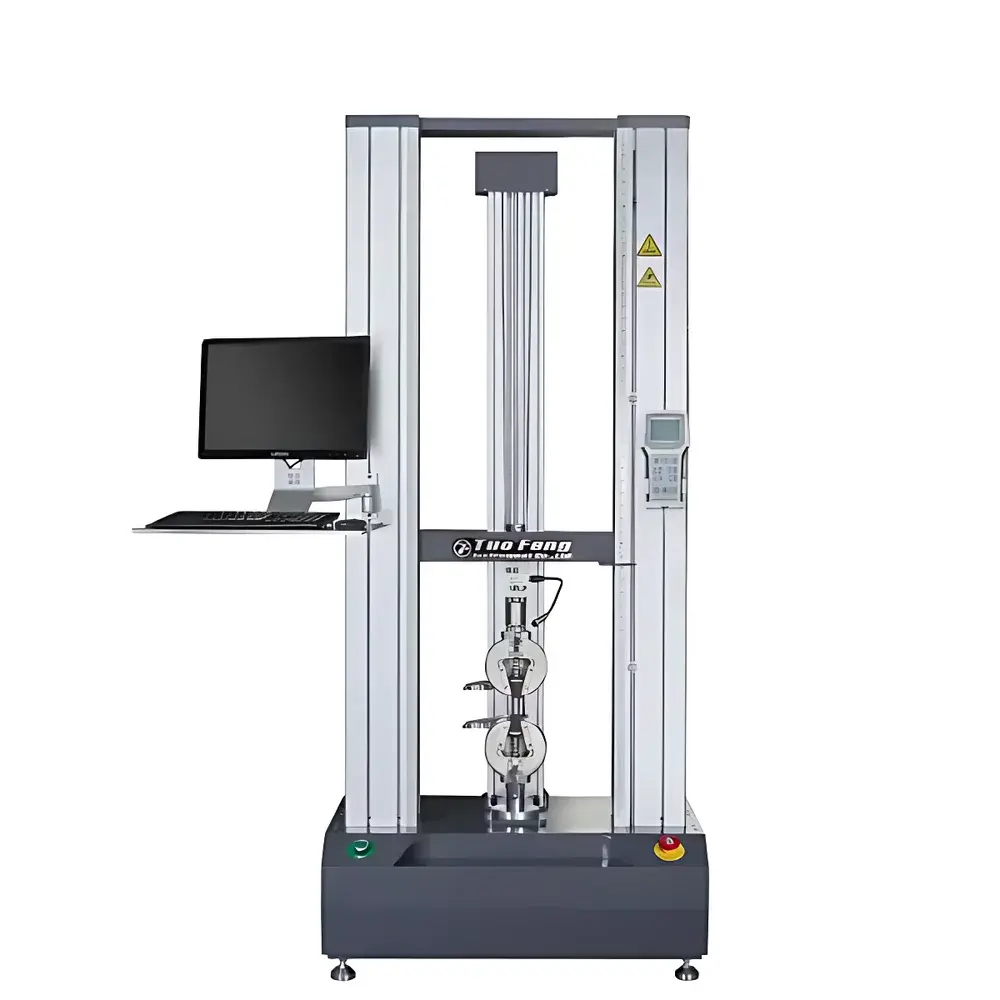
Tuofeng TFW-268 Microcomputer-Controlled Electronic Universal Testing Machine
| Brand | Tuofeng |
|---|---|
| Origin | Shanghai, China |
| Manufacturer Type | Direct Manufacturer |
| Equipment Type | Electromechanical Universal Testing Machine |
| Model | TFW-268 |
| Force Capacity | 20 kN |
| Accuracy Class | 0.5 |
| Effective Force Range | 0.2–100% of full scale |
| Force Measurement Accuracy | ±0.005% of reading |
| Load Cell Resolution | 1 part in 500,000 (full-scale, single-range, no auto-ranging) |
| Drive System | Imported servo motor with precision worm-gear reducer |
| Lead Screw | High-accuracy preloaded ball screw |
| Effective Test Width | 600 mm (customizable) |
| Maximum Stroke | 800 mm (extendable) |
| Speed Range | 0.001–500 mm/min (infinitely variable, programmable) |
| Displacement Measurement | Optical encoder, accuracy ±0.005% of reading |
| Strain Measurement | Optional extensometer or large-deformation sensor, accuracy ±0.005% of reading |
| Safety Protection | Electronic limit switches, emergency stop button, overload protection (10% above rated capacity) |
| Software | Windows-based, multi-language (English/Chinese), compliant with ASTM E4, ISO 7500-1, GB/T 16491-2008, and JJG 475-2008 |
Overview
The Tuofeng TFW-268 is a microcomputer-controlled electromechanical universal testing machine engineered for high-precision mechanical property evaluation of metallic, polymeric, composite, and elastomeric materials. It operates on the principle of controlled axial force application via a servo-driven ball-screw actuation system, enabling accurate displacement and load control across static and quasi-static loading regimes. Designed to meet international metrological and regulatory requirements—including ISO 7500-1 (Class 0.5), ASTM E4 (Standard Practices for Force Verification), and GB/T 16491-2008—the TFW-268 delivers traceable, repeatable, and auditable test results suitable for quality assurance, R&D validation, and regulatory submissions. Its modular architecture supports standardized test configurations per ASTM D638 (tensile), ASTM D790 (flexural), ASTM D695 (compressive), ASTM D1876 (peel), and ISO 179 (impact-modified bending), making it a foundational instrument in accredited laboratories and production QA environments.
Key Features
- High-resolution force measurement system with 1:500,000 internal resolution and ±0.005% reading accuracy—no range switching required across the full 0.2–100% load span
- Precision preloaded ball screw transmission paired with an imported servo motor and low-backlash worm-gear reducer ensures smooth motion control and minimal hysteresis
- Dual-speed automatic crosshead positioning (fast/slow modes) with jog functionality and programmable return-to-start behavior after test completion
- Integrated safety architecture: electronic travel limits, hardware-based emergency stop circuitry, and real-time overload cutoff at 110% of rated capacity (22 kN)
- Modular fixture interface supporting custom-designed grips, bend fixtures, peel jigs, and compression platens—compatible with standard ISO/ASTM mounting patterns
- Real-time dual-channel data acquisition (load + displacement) at ≥1 kHz sampling rate, synchronized with optional strain measurement inputs
Sample Compatibility & Compliance
The TFW-268 accommodates specimens ranging from thin polymer films (≥0.05 mm thickness) to structural metal coupons (up to 200 mm wide × 25 mm thick), including wire, rod, sheet, tube, and molded components. Its 600 mm effective test width and 800 mm vertical stroke support standard and extended geometry testing per ISO 527-2, ASTM D3039, and EN 10002-1. The system complies with national and international calibration and verification standards: JJG 475-2008 (China’s verification regulation for electronic UTM), GB/T 16491-2008 (design and performance criteria), and ISO/IEC 17025:2017 requirements for test equipment traceability. All force transducers are factory-calibrated against NIST-traceable deadweight standards, with certificates provided upon delivery.
Software & Data Management
The embedded Windows-based testing software provides full compliance-ready operation. It supports GLP/GMP-aligned workflows through audit-trail-enabled user authentication, electronic signatures, and immutable test record generation (per FDA 21 CFR Part 11 when configured with optional security modules). Users may select from multiple control modes—including constant rate of extension (CRE), constant rate of loading (CRL), load-hold, displacement-hold, and closed-loop strain control. Real-time plotting includes load-time, load-displacement, stress-strain, and extension-time curves, with overlay capability for comparative analysis across up to 16 datasets. Results export seamlessly to CSV, PDF, and XML formats; raw data files include metadata (operator ID, timestamp, environmental conditions, calibration status). Software updates are provided free-of-charge for the lifetime of the instrument, with version history and change logs maintained for audit purposes.
Applications
The TFW-268 serves as a core platform in diverse industrial and academic settings: tensile strength and elongation-at-break characterization of copper wire and insulated cable jackets in electrical manufacturing; compressive yield and modulus determination of aerospace-grade aluminum alloys; flexural stiffness assessment of automotive thermoplastic composites; peel adhesion quantification of medical device laminates per ISO 8510-2; and shear strength validation of powder metallurgy sintered parts. It is routinely deployed in third-party certification labs for CE marking, UL listing, and IEC 60695 fire-test material qualification—particularly where mechanical integrity under thermal aging or humidity exposure must be documented.
FAQ
What standards does the TFW-268 comply with for force calibration and verification?
It conforms to ISO 7500-1 (Class 0.5), ASTM E4, GB/T 16491-2008, and JJG 475-2008, with factory calibration traceable to national metrology institutes.
Can the system perform closed-loop strain-controlled tests?
Yes—when equipped with an ASTM E83-compliant extensometer or video-based digital image correlation (DIC) module, the software enables true strain-controlled ramping and hold protocols.
Is the test software validated for regulated environments?
The base software meets ALCOA+ principles; optional 21 CFR Part 11 compliance packages include role-based access control, electronic signatures, and full audit trail logging.
What is the maximum specimen height accommodated without modification?
The standard vertical clearance is 800 mm between platens; custom-height columns (up to 1,500 mm) are available for tall or layered assemblies.
Does the machine support automated batch testing with pass/fail logic?
Yes—test sequences can embed conditional logic (e.g., “abort if yield strength < X MPa”) and auto-generate summary reports with statistical process control (SPC) metrics.



