
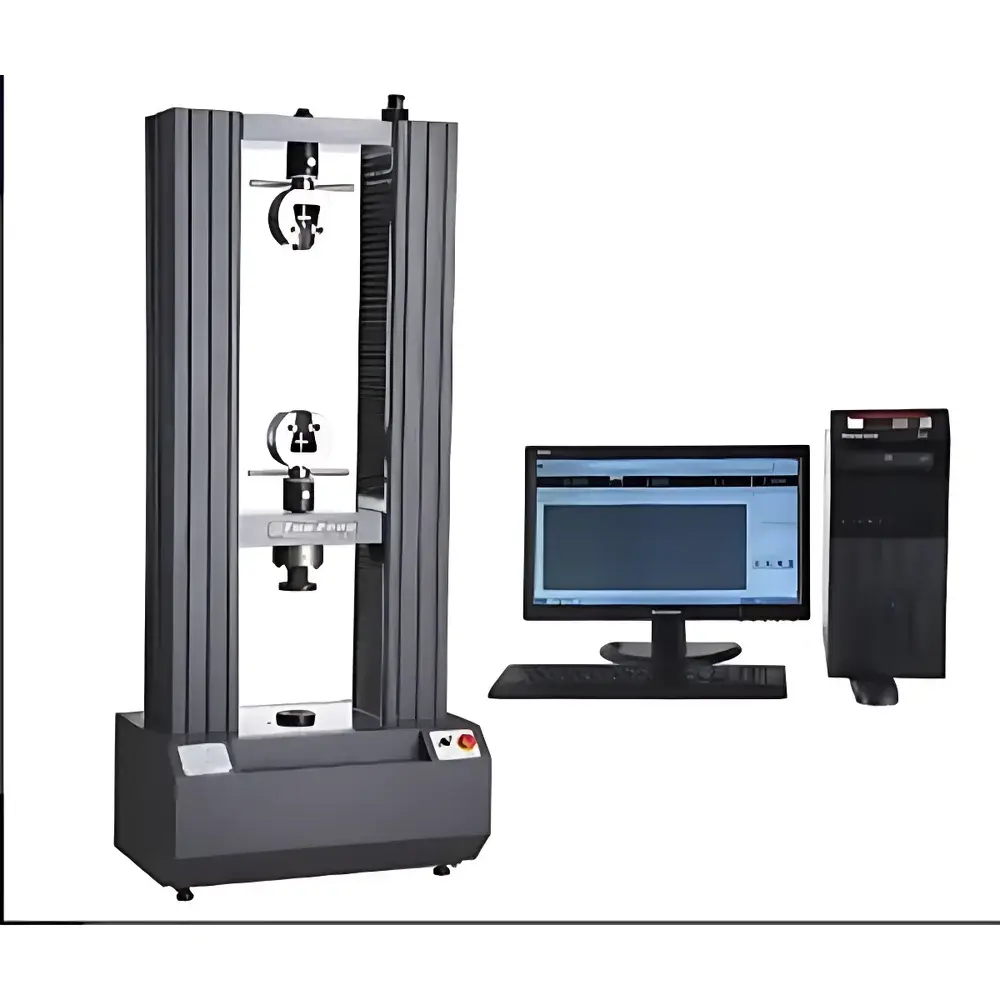
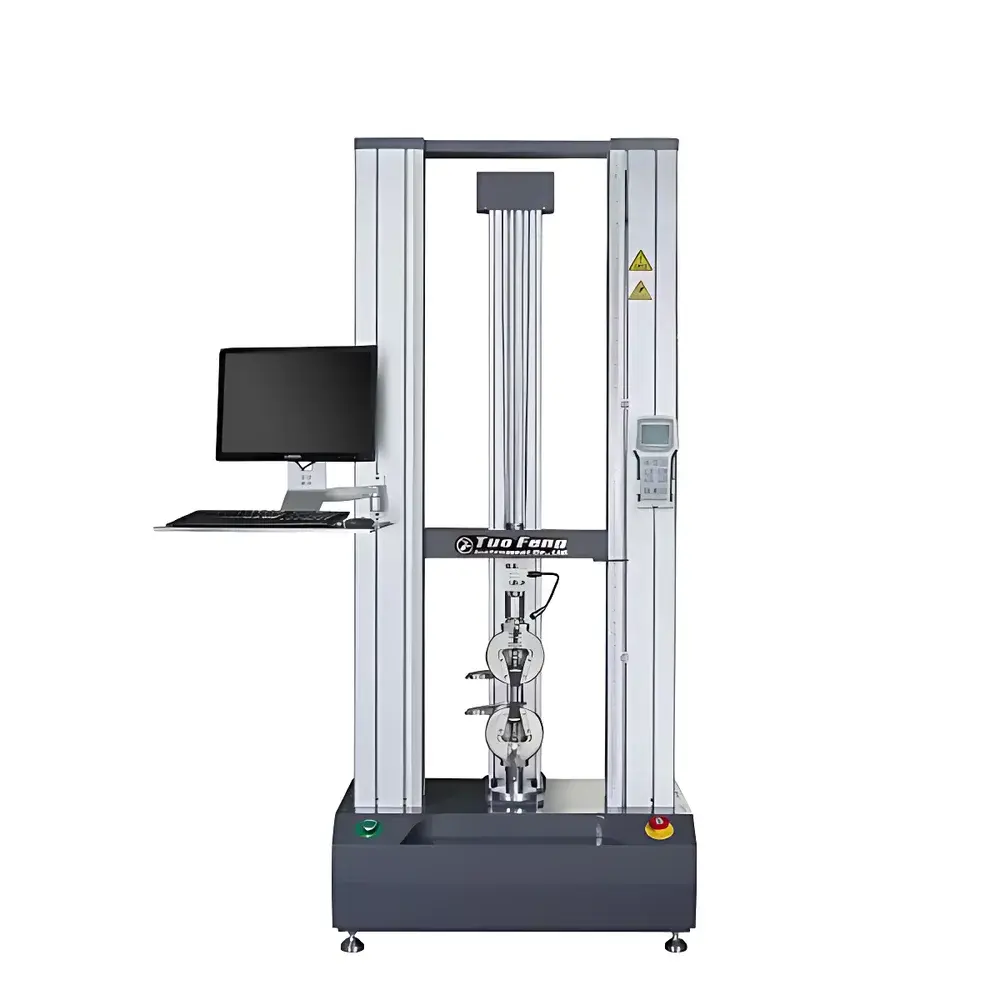
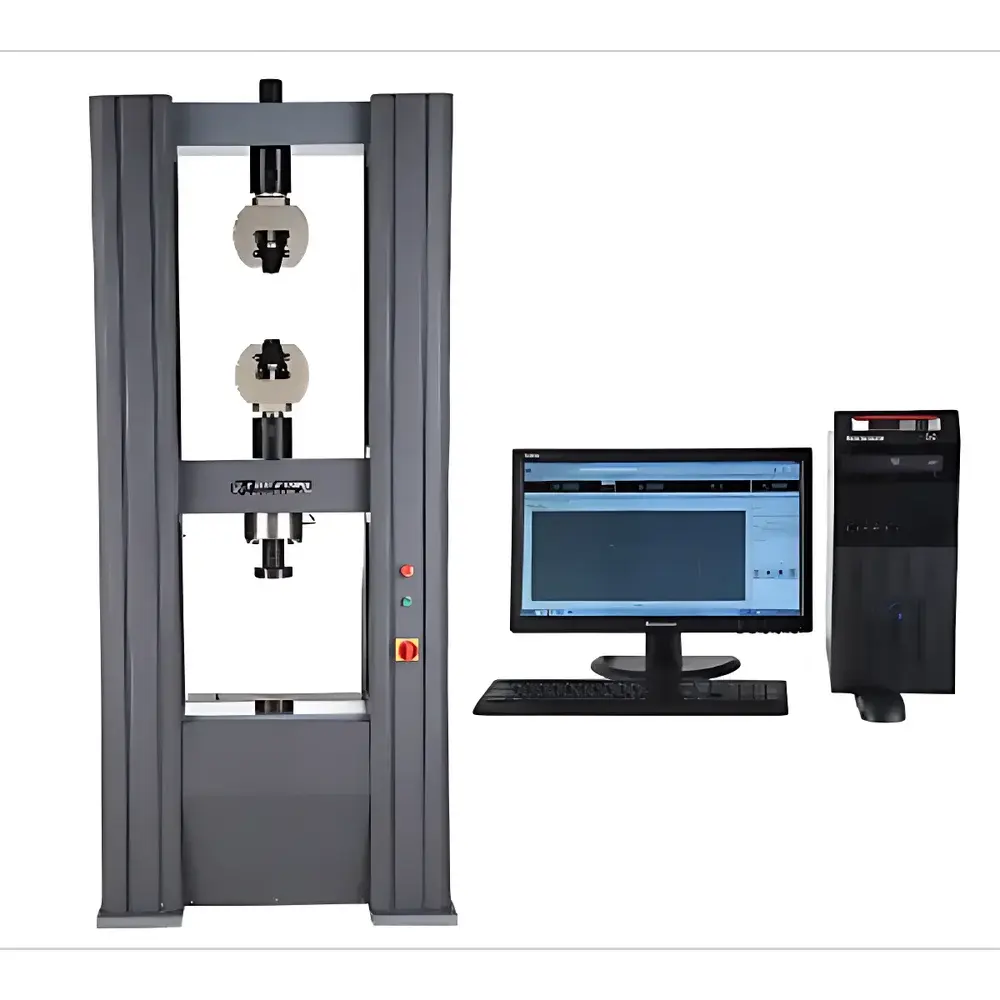
Tuofeng TFW-262 Microcomputer-Controlled Electronic Universal Testing Machine
| Brand | Tuofeng |
|---|---|
| Origin | Shanghai, China |
| Manufacturer Type | Direct Manufacturer |
| Instrument Type | Electronic Universal Testing Machine |
| Model | TFW-262 |
| Force Capacity | 20 kN |
| Accuracy Class | 0.5 |
| Effective Force Range | 0.2–100% of Full Scale |
| Force Measurement Accuracy | ±0.005% of Reading |
| Resolution | 1 part in ±500,000 full-scale codes (single-range, no switching) |
| Drive System | Imported Servo Motor with Worm Gear Reducer |
| Lead Screw | High-Precision Ball Screw |
| Effective Test Width | 600 mm (customizable) |
| Max Travel | 800 mm (extendable) |
| Speed Range | 0.001–500 mm/min (infinitely variable) |
| Displacement Measurement | Optical Encoder |
| Displacement Accuracy | ±0.005% of Reading |
| Strain Measurement | Optional Extensometer or Large-Deformation Sensor |
| Safety Protection | Electronic Limit Switches, Emergency Stop, Overload Protection (10% above rated load) |
| Crosshead Control | Dual-Speed Motorized升降 (Fast/Slow), Manual/Automatic Return |
| Power Supply | 220 V, 1.0 kW |
| Approx. Weight | 450 kg |
| Compliance | GB/T 16491–2008, JJG 475–2008, ASTM E4, ISO 7500-1, DIN 51221, JIS B 7721 |
Overview
The Tuofeng TFW-262 is a microprocessor-controlled electronic universal testing machine engineered for high-fidelity mechanical property characterization of metallic, polymeric, composite, and elastomeric materials. It operates on the fundamental principle of axial force application via a precision servo-driven ball screw actuation system, enabling controlled uniaxial loading under displacement- or load-controlled conditions. Designed to meet international metrological standards for static mechanical testing, the TFW-262 delivers traceable force measurement with 0.5-class accuracy per GB/T 16491–2008 and ISO 7500-1, making it suitable for accredited laboratories requiring compliance with GLP, GMP, and ISO/IEC 17025 frameworks. Its modular architecture supports standardized test configurations—including tension, compression, bending, shear, tear, peel, and puncture—through interchangeable fixtures and extensometry options.
Key Features
- High-resolution force sensing system with ±0.005% reading accuracy and 1:500,000 internal resolution, ensuring repeatability across low-load (e.g., textile cord, safety webbing) and high-load (e.g., structural steel cable) regimes.
- Imported servo motor coupled with worm-gear reduction and preloaded ball screw transmission for smooth, backlash-free motion control and exceptional positional stability during hold tests.
- Dual-speed crosshead drive (fast approach / slow test) with programmable return logic—enabling rapid specimen setup and precise strain-rate control down to 0.001 mm/min.
- Integrated multi-level safety architecture: hardware-based emergency stop, electronic travel limits, real-time overload detection (>110% F.S.), and automatic shutdown with event logging.
- Modular extensometry support—compatible with clip-on axial extensometers (for modulus and yield determination) and non-contact video extensometers (for large-strain or brittle material applications).
- Rigid, reinforced frame design (450 kg mass) minimizes deflection under load, maintaining alignment integrity per ASTM E4 requirements for force verification.
Sample Compatibility & Compliance
The TFW-262 accommodates specimens ranging from fine-diameter safety ropes (Ø3–16 mm), synthetic webbing, wire rope terminations, and fall arrest anchorage components to bulk metallic coupons and polymer extrusions. Standardized grips include pneumatic wedge-action clamps (for ropes and fibers), vise-type flat grips (for sheet metal and plastic strips), and custom-designed anchor-point fixtures compliant with EN 354, EN 361, ANSI Z359.1, and ISO 10333-1 test protocols. The system is validated against national and international calibration standards including JJG 475–2008 (China), ASTM E4–22 (force verification), and ISO 7500-1:2018 (static calibration). All test reports include metadata required for regulatory submissions—time-stamped audit trails, operator ID, environmental conditions, and instrument calibration status.
Software & Data Management
The Windows-based TFW-TestSuite software provides full configurability for method-driven testing workflows. It supports ASTM- and ISO-compliant test templates (e.g., tensile strength per ISO 6892-1, breaking load per EN 1263-2), with built-in calculation modules for ultimate tensile strength, yield point (0.2% offset), elongation at break, modulus of elasticity, and energy absorption. Real-time plotting includes synchronized force–displacement, stress–strain, and load–time curves; up to eight datasets can be overlaid for comparative analysis. Data export conforms to ASTM E1434 and ISO 10360-5 formats—CSV, XML, and PDF report generation includes digital signatures, revision history, and embedded calibration certificates. Software architecture complies with FDA 21 CFR Part 11 requirements for electronic records and signatures when configured with user authentication and audit trail activation.
Applications
The TFW-262 serves as a primary verification tool for personal protective equipment (PPE) manufacturers validating EN 361-certified harnesses and lanyards, as well as for third-party testing labs performing rope certification per UIAA 101 or NFPA 1983. In industrial R&D, it characterizes adhesion strength of coated safety slings, creep behavior of aramid fiber composites under sustained load, and cyclic fatigue performance of carabiner gate mechanisms. Additional use cases include quality assurance of aerospace fasteners (ASTM F606), tensile validation of geotextile reinforcement layers (ISO 10319), and mechanical screening of biodegradable suture materials (ISO 10993-12). Its versatility extends to academic research in polymer viscoelasticity, fracture mechanics, and constitutive modeling.
FAQ
What safety standards does the TFW-262 support for fall protection equipment testing?
It enables full compliance with EN 354 (lanyards), EN 361 (full-body harnesses), EN 364 (test methods), and ANSI Z359.1–2021 through configurable test sequences, fixture kits, and certified force calibration.
Can the system perform constant-load hold tests for creep evaluation?
Yes—via closed-loop load control mode with programmable dwell duration, ramp rate, and tolerance bands; data logging interval is adjustable from 10 ms to 10 s.
Is third-party calibration documentation included with delivery?
Each unit ships with a NIST-traceable factory calibration certificate covering force, displacement, and speed axes, valid for 12 months under normal operating conditions.
Does the software support automated reporting for ISO/IEC 17025-accredited labs?
Yes—report templates embed uncertainty budgets per GUM (JCGM 100), instrument identification, environmental monitoring logs, and electronic signature fields compliant with ILAC P14.
What is the maximum rope diameter the standard wedge grips accommodate?
Standard pneumatic rope grips handle diameters from 4 mm to 16 mm; optional heavy-duty hydraulic clamps extend capacity to 28 mm with surface-pressure optimization.



