
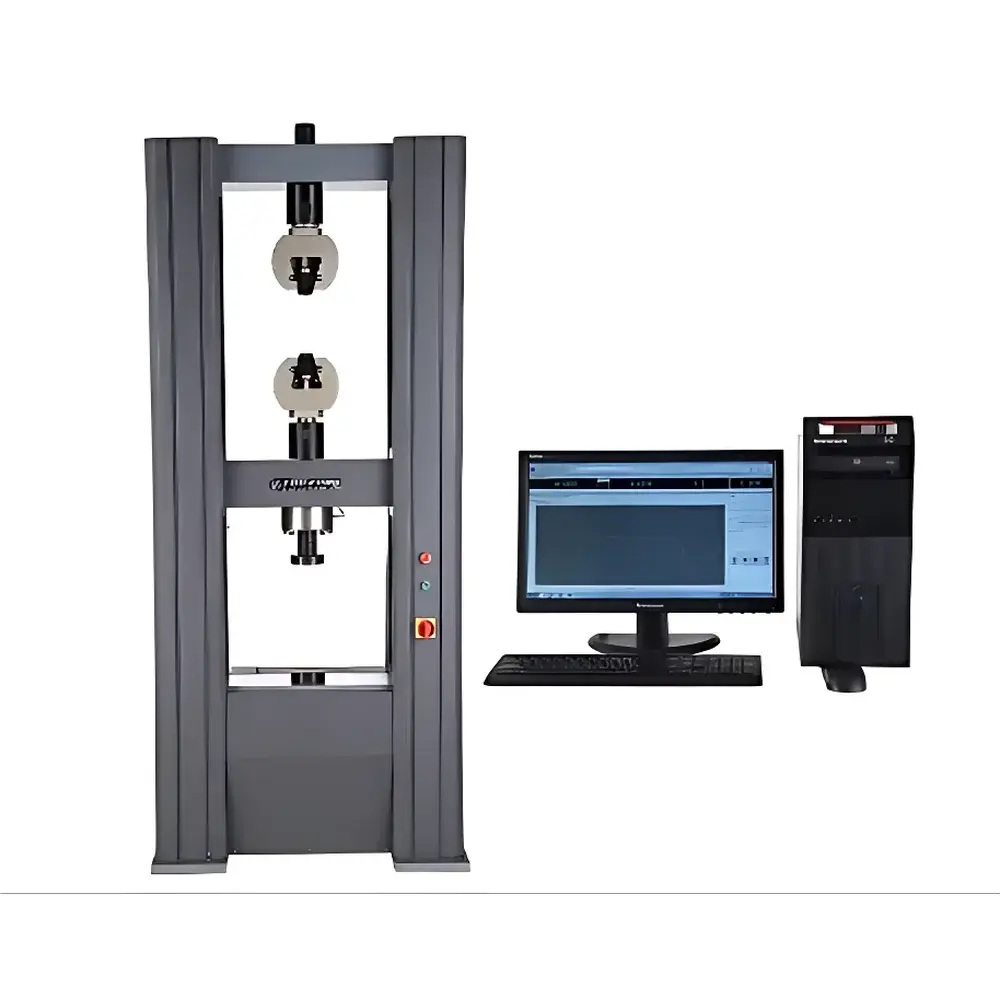
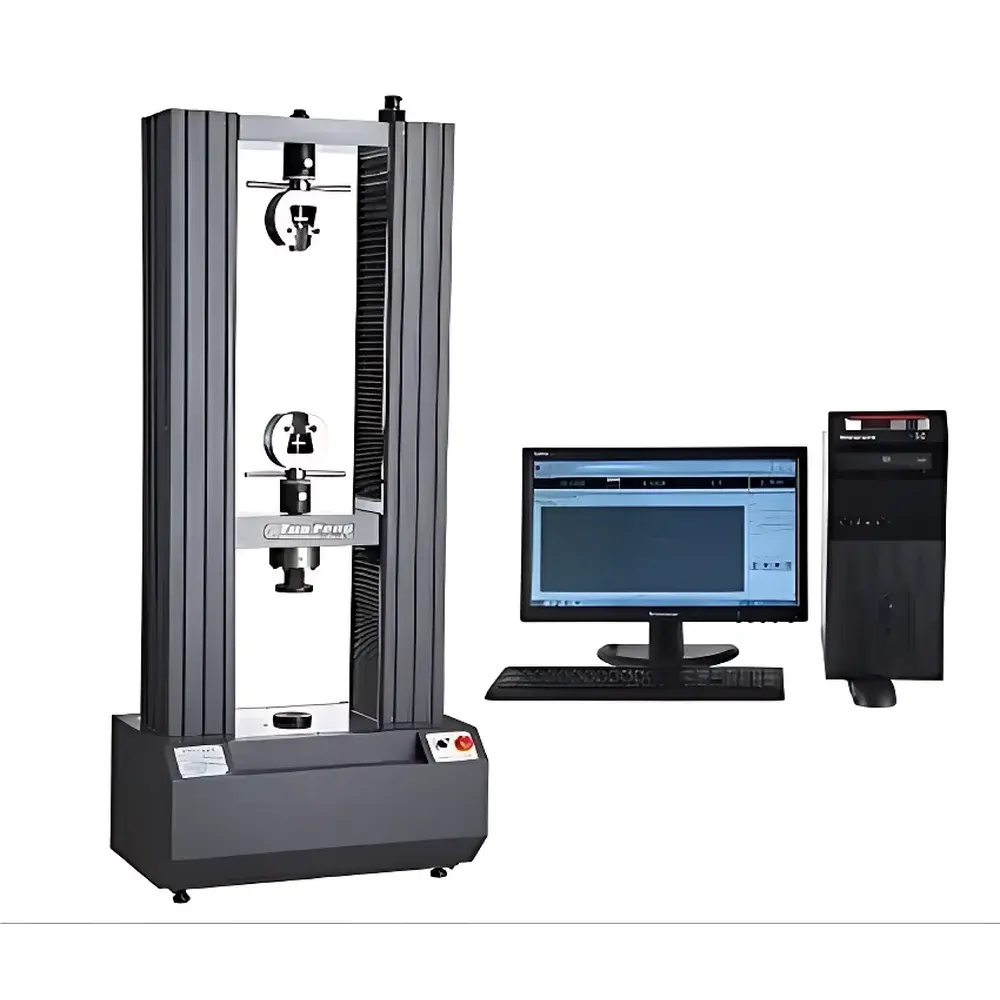
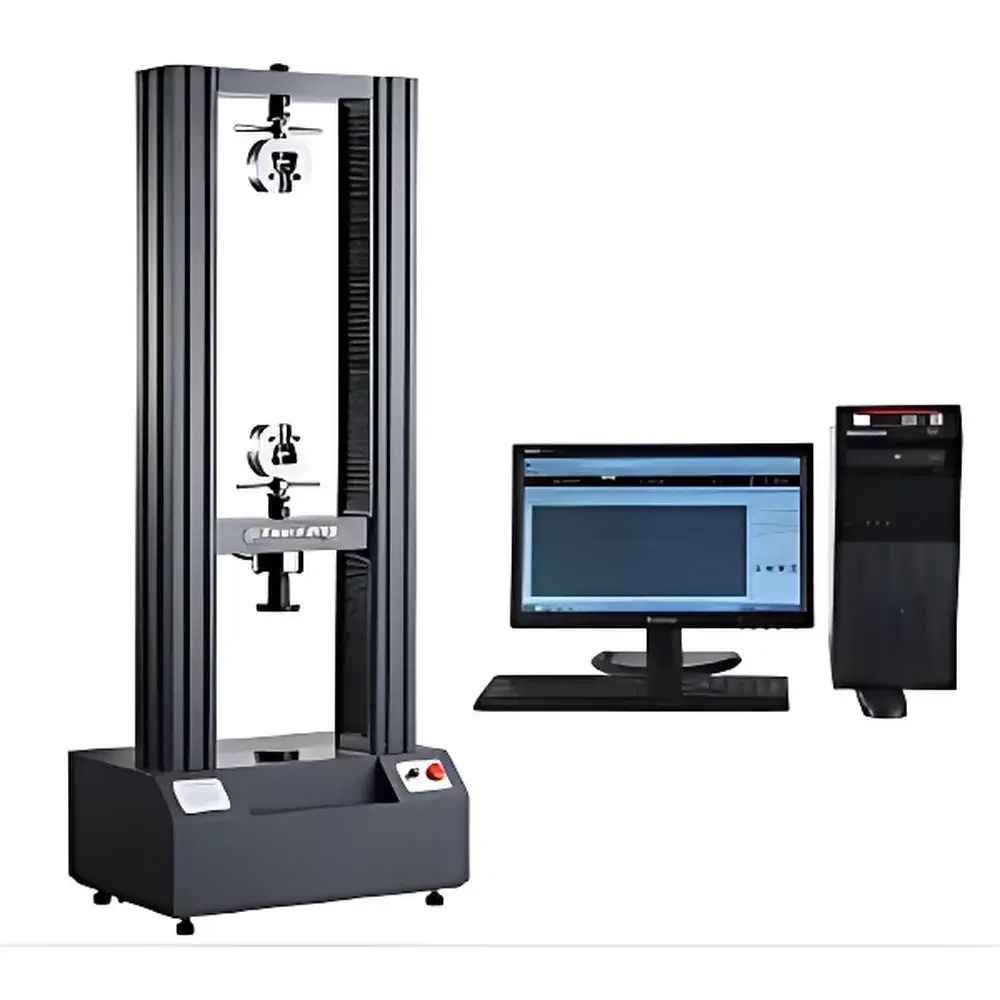
Tuofeng TFW Series Microcomputer-Controlled Electronic Universal Testing Machine
| Brand | Tuofeng |
|---|---|
| Origin | Shanghai, China |
| Manufacturer Type | Direct Manufacturer |
| Product Category | Domestic |
| Model | TFW-05S / TFW-10S / TFW-20S / TFW-50S / TFW-100S / TFW-200S |
| Instrument Type | Electromechanical Universal Testing Machine |
| Force Capacity Range | 5 kN to 200 kN |
| Accuracy Class | 0.5 |
| Effective Force Measurement Range | 0.2%–100% of Full Scale |
| Load Cell Accuracy | ±0.005% of reading |
| Resolution | 1 part in ±500,000 full-scale codes (single-range, no auto-ranging) |
| Drive System | Imported servo motor with precision worm-gear reducer |
| Lead Screw | High-precision preloaded ball screw |
| Effective Test Width | 400 mm / 500 mm / 600 mm (customizable) |
| Maximum Travel | 800 mm (extendable) |
| Speed Range | 0.001–500 mm/min (infinitely variable, programmable) |
| Displacement Measurement | Optical encoder |
| Displacement Accuracy | ±0.005% of reading |
| Strain Measurement | Optional extensometer (clip-on or video-based) or large-deformation transducer |
| Strain Accuracy | ±0.005% of reading |
| Safety Protection | Dual electronic limit switches, emergency stop button, overload cutoff (110% FS), mechanical hard stops |
| Crosshead Control | Dual-speed (fast/slow) motorized up/down with jog function |
| Return Function | Automatic high-speed return to initial position post-test |
| Overload Protection | Automatic shutdown at >110% of maximum rated load |
| Fixture Customization | Application-specific grips and fixtures available per ASTM/ISO/GB standards |
| Frame Dimensions (L×W×H) | 780×560×1700 mm to 1100×900×2600 mm (model-dependent) |
| Power Supply | 220 V AC, 0.75 kW to 3.0 kW (model-dependent) |
| Net Weight | 280 kg to 1500 kg (model-dependent) |
| Compliance | GB/T 16491–2008, JJG 475–2008, ASTM E4, ASTM E8, ASTM D638, ASTM D790, ISO 6892-1, ISO 178, ISO 527, DIN 53455, JIS Z2241, BS EN 10002-1 |
Overview
The Tuofeng TFW Series Microcomputer-Controlled Electronic Universal Testing Machine is a dual-column electromechanical system engineered for high-precision static mechanical property evaluation of metallic, polymeric, ceramic, composite, and elastomeric materials. Based on closed-loop servo-controlled force and displacement actuation, the system employs a high-rigidity frame, preloaded ball screws, and a calibrated load cell to deliver traceable, repeatable measurements under tensile, compressive, flexural, shear, tear, peel, and puncture loading conditions. Its architecture conforms to international metrological requirements for materials testing instrumentation—including ISO/IEC 17025 traceability frameworks—and supports fully automated test sequences compliant with standardized protocols across R&D, QA/QC, and regulatory submission environments.
Key Features
- Class 0.5 accuracy per GB/T 16491–2008 and JJG 475–2008, validated against national metrology institute reference standards.
- Single-range, high-resolution load measurement system (1:500,000 internal resolution) with no range switching—ensuring consistent sensitivity across the entire force span (0.2%–100% FS).
- Infinitely variable crosshead speed control (0.001–500 mm/min), programmable via software-defined ramp-hold-step profiles for creep, stress relaxation, and cyclic testing.
- Dual-mode displacement sensing: optical encoder for gross motion tracking and optional high-accuracy extensometers (contact or non-contact) for localized strain measurement per ASTM E83 or ISO 9513.
- Integrated safety architecture: hardware-based emergency stop, dual electronic travel limits, real-time overload detection (>110% FS), and mechanical end-stop redundancy.
- Motorized crosshead with independent fast/slow control and programmable return-to-start functionality—reducing operator intervention and cycle time variability.
- Modular fixture interface supporting standardized wedge, pneumatic, hydraulic, and custom-designed grips aligned with ASTM E4, ISO 6892-1, and GB/T 228.1 geometries.
Sample Compatibility & Compliance
The TFW series accommodates specimens ranging from miniature metallic coupons (e.g., ASTM E8 sub-size) to structural composites (e.g., ASTM D3039 laminates) and soft biomaterials (e.g., ISO 527-3 films). Standard configurations support widths up to 600 mm and stroke lengths up to 800 mm—with extended options available for large-format or high-elongation applications. All models comply with GB/T 16491–2008 (Chinese national standard for UTM design and verification), JJG 475–2008 (verification regulation), and are operationally compatible with ASTM, ISO, DIN, JIS, and BS test methods. Calibration certificates include uncertainty budgets traceable to NIM (National Institute of Metrology, China) and may be supplemented with third-party ISO/IEC 17025 accreditation upon request.
Software & Data Management
The Windows-based TFW TestSuite software provides ISO 17025-aligned data integrity controls, including user-level access permissions, electronic signatures, audit trails, and 21 CFR Part 11–compliant optional modules (available as add-ons). It supports multi-language UI (English, Simplified/Traditional Chinese), customizable unit systems (N/kN/lbf, mm/in, MPa/psi), and real-time plotting of up to four synchronized axes (e.g., stress–strain, load–time, displacement–time). Raw data export is supported in CSV, Excel, and XML formats; graphical reports include automatic annotation of yield point, ultimate strength, modulus, elongation at break, and secant modulus. Batch analysis tools enable statistical comparison across specimen sets—including max/min/mean calculation, curve superposition, and tolerance band overlay. All test definitions, results, and metadata are stored in an encrypted local database with manual and scheduled auto-backup capability.
Applications
This system serves as a primary mechanical characterization platform in accredited laboratories and industrial QA departments. Typical use cases include: tensile property validation of aerospace aluminum alloys (per AMS 4027); compression testing of structural foams (ASTM D1621); flexural modulus determination in thermoplastic composites (ISO 178); peel strength assessment of pressure-sensitive adhesives (ASTM D903); tear resistance of elastomeric seals (ISO 34-1); and mechanical screening of additive-manufactured metal parts (ASTM F3049). It is routinely deployed in building material certification (GB/T 5224 prestressing steel), automotive component validation (SAE J211), medical device polymer qualification (ISO 5832-1), and powder metallurgy sintered part verification (MPIF Standard 42).
FAQ
What standards does the TFW series support out-of-the-box?
The system is pre-configured with method templates for ASTM E8/E9/E21, ISO 6892-1/178/527, GB/T 228.1/1040.1/1449.1, and DIN 53455—covering basic tensile, compression, and flexure testing.
Can the system be integrated into a GLP/GMP-compliant environment?
Yes—when equipped with the optional 21 CFR Part 11 module, it supports role-based authentication, electronic signatures, immutable audit trails, and data archiving protocols required for regulated submissions.
Is strain measurement included by default?
Displacement-based strain is calculated from crosshead motion; however, true engineering strain requires an external extensometer—available as a calibrated, plug-and-play option meeting ISO 9513 Class 1 specifications.
What is the warranty and service coverage?
Tuofeng provides a 24-month comprehensive hardware warranty, lifetime technical support, and free software updates—including future compliance patches for evolving ASTM/ISO revisions.
Are calibration certificates provided with shipment?
Each unit ships with a factory calibration report referencing national standards; NIST-traceable calibration certificates with uncertainty statements are available upon request prior to delivery.



