
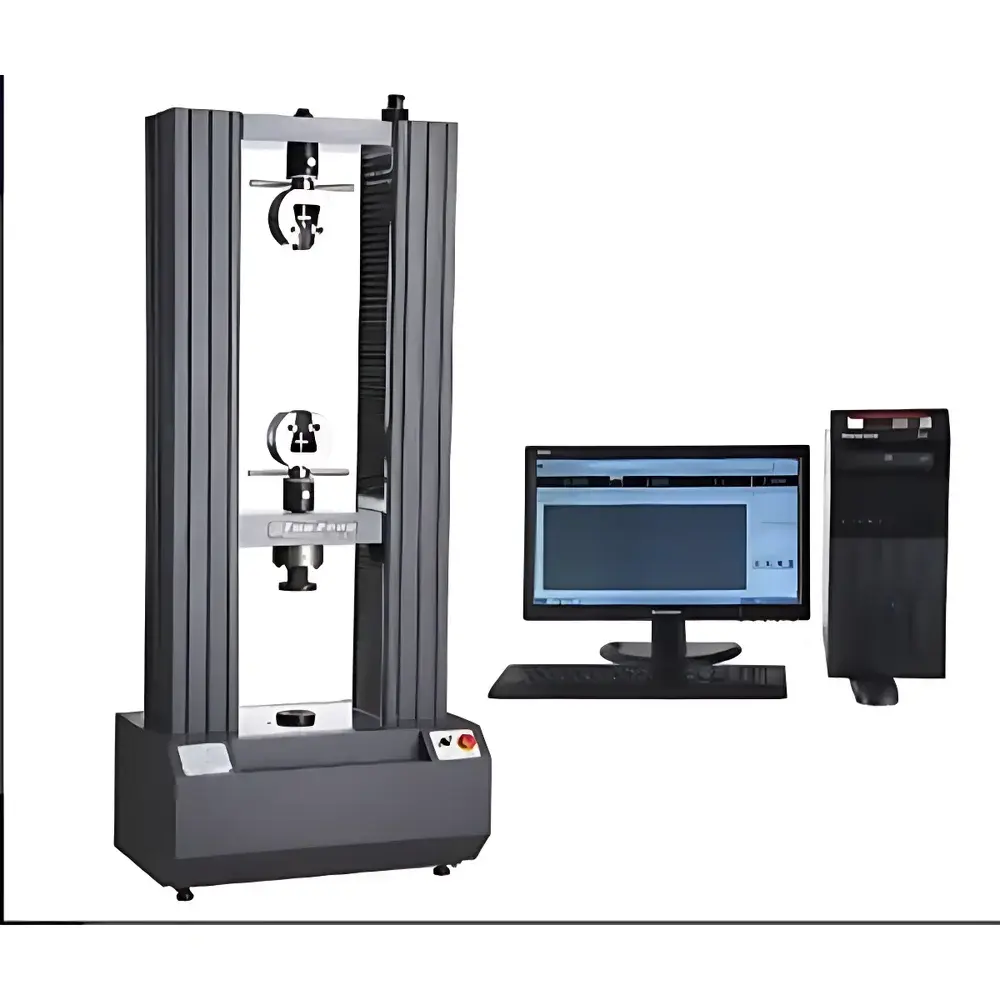
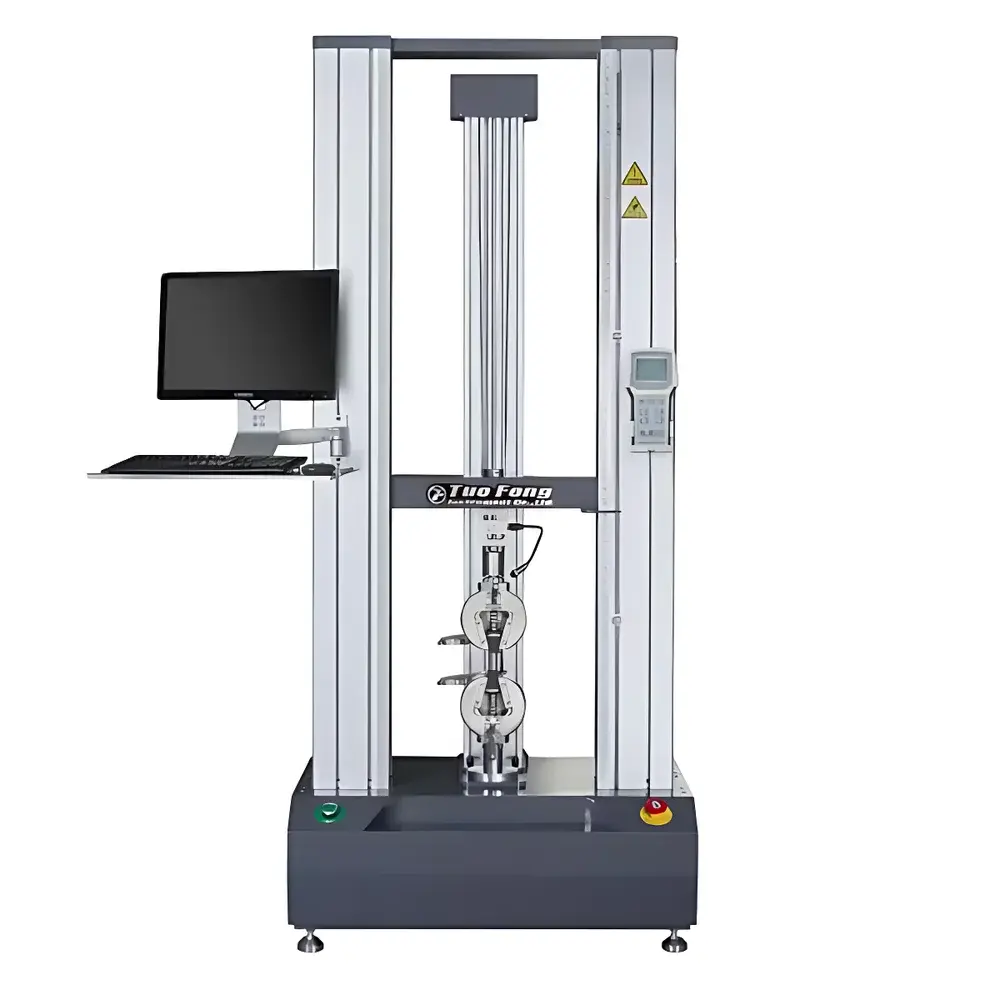
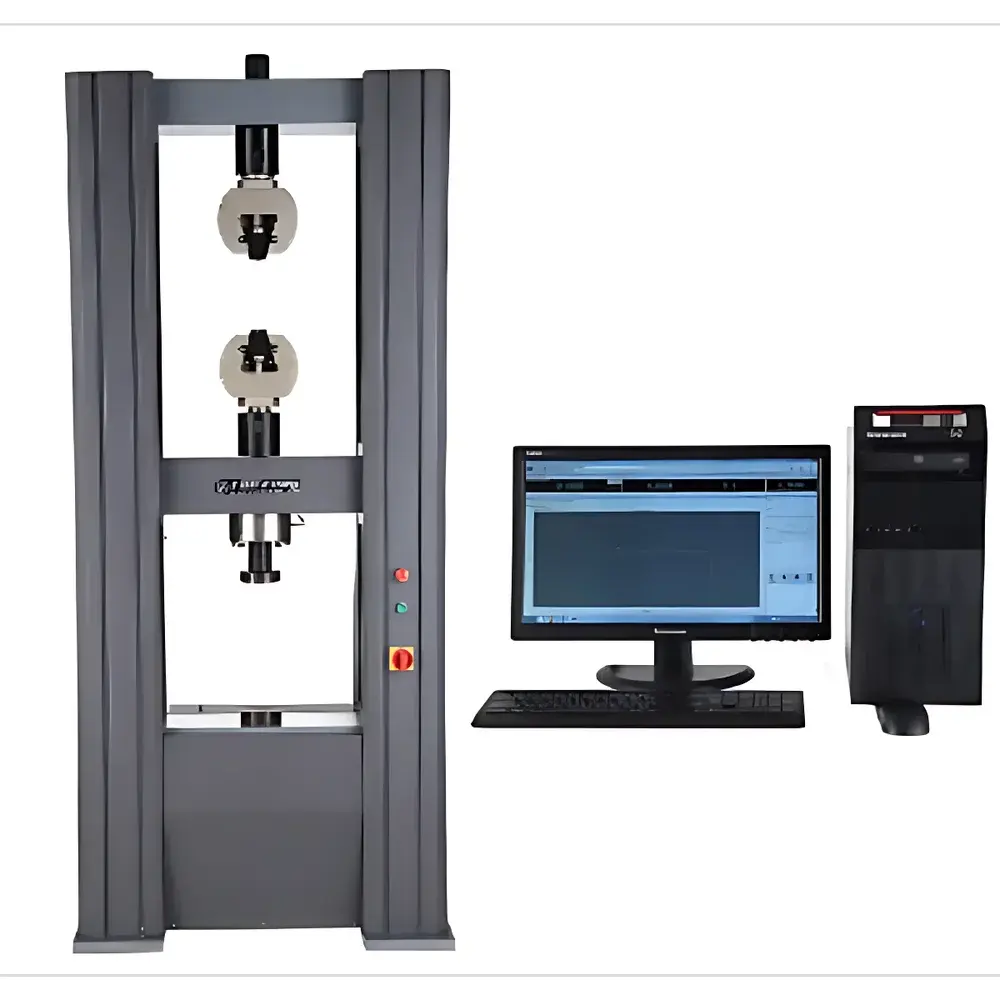
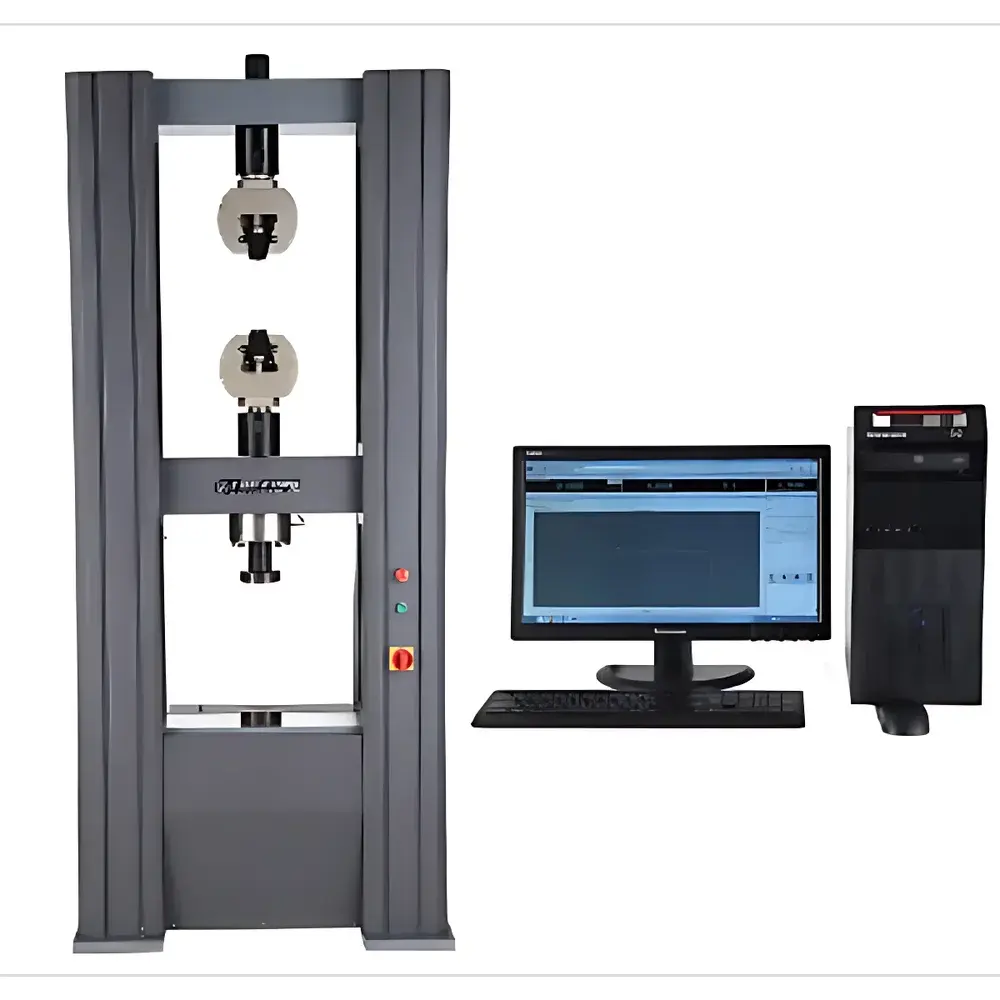
Tuofeng TFW-269 Microcomputer-Controlled Electronic Universal Testing Machine
| Brand | Tuofeng |
|---|---|
| Origin | Shanghai, China |
| Manufacturer Type | Direct Manufacturer |
| Model | TFW-269 |
| Instrument Type | Electromechanical Universal Testing Machine |
| Accuracy Class | 0.5 |
| Effective Force Range | 0.2%–100% of Full Scale |
| Load Measurement Accuracy | ±0.005% of Reading |
| Force Resolution | 1 part in ±500,000 full-scale counts (no range switching, constant resolution) |
| Drive System | Imported Servo Motor with Worm Gear Reducer |
| Lead Screw | High-Precision Ball Screw |
| Effective Test Width | 400 mm (customizable up to 600 mm) |
| Max Travel | 800 mm (extendable) |
| Speed Range | 0.001–500 mm/min (infinitely variable) |
| Displacement Measurement | Optical Encoder |
| Displacement Accuracy | ±0.005% of Reading |
| Strain Measurement | Optional Extensometer or Large-Deformation Sensor |
| Safety Protection | Electronic Limit Switches, Emergency Stop, Overload Cutoff (10% above capacity) |
| Crosshead Control | Dual-Speed Motorized (Fast/Slow), Manual Jog, Auto-Return Function |
| Power Supply | 220 V, 750 W |
| Approx. Weight | 280 kg |
| Compliance | GB/T 16491–2008, JJG 475–2008, ASTM E4, ASTM E8, ISO 6892-1, ISO 7500-1, DIN 51221, JIS Z2241 |
Overview
The Tuofeng TFW-269 Microcomputer-Controlled Electronic Universal Testing Machine is an electromechanical force-testing platform engineered for high-fidelity mechanical property characterization of metallic, polymeric, composite, and elastomeric materials. Based on closed-loop servo-controlled load application and precision displacement feedback, the system operates under the principles of uniaxial quasi-static loading—enabling rigorous evaluation of tensile, compressive, flexural, shear, tear, peel, and puncture behavior per internationally recognized test standards. Its modular architecture supports interchangeable fixtures and transducers, allowing seamless adaptation across diverse specimen geometries and industry-specific protocols—including those governing wire-and-cable insulation integrity, conductor tensile strength, jacket adhesion, and sheath elongation performance.
Key Features
- 0.5-class accuracy certified per GB/T 16491–2008 and JJG 475–2008, validated against ISO 7500-1 and ASTM E4 reference methodologies
- High-resolution force measurement with ±0.005% reading accuracy and true 500,000-count internal resolution—maintained uniformly across the entire 0.2–100% load range without auto-ranging artifacts
- Imported servo motor coupled with a backlash-free worm gear reducer and preloaded ball screw assembly ensures smooth, repeatable crosshead motion and minimal axial play
- Dual-speed motorized crosshead control (fast positioning + fine adjustment), integrated emergency stop, electronic overtravel limits, and hardware-based overload cutoff (10% above rated capacity)
- Optical encoder-based displacement sensing with ±0.005% reading accuracy; optional clip-on extensometers or large-deformation sensors available for strain-critical applications (e.g., rubber elongation, polymer necking)
- Modular fixture interface compatible with standardized grips (pneumatic, wedge, vise), bending jigs, peel fixtures, and custom cable-clamping assemblies per IEC 60811, UL 1581, and EN 50363 requirements
Sample Compatibility & Compliance
The TFW-269 accommodates a broad spectrum of specimen types—from solid metal wires (AWG 40–0000), stranded conductors, thermoplastic and thermoset cable jackets, cross-linked polyethylene (XLPE) insulation layers, to braided shielding tapes and composite armor systems. Its configurable test width (up to 600 mm), extended travel (800 mm standard), and programmable speed range (0.001–500 mm/min) support both low-strain stiffness measurements and high-elongation failure analysis. The system fully complies with mechanical testing clauses in GB/T 2951, IEC 60227, IEC 60245, ASTM D4565, UL 1581 Section 1000, and EN 60811 series standards. Calibration traceability aligns with national metrological institutes and satisfies GLP audit requirements for accredited laboratories.
Software & Data Management
The Windows-based TFW-TestSuite software provides ISO/IEC 17025-aligned data acquisition and reporting functionality. It supports multiple control modes—including load-controlled, displacement-controlled, strain-controlled, hold, and ramp-hold sequences—essential for evaluating creep, stress relaxation, and modulus transitions. Real-time plotting includes force-time, force-displacement, stress-strain, and extension-time curves, with overlay capability for comparative analysis of batch or material variants. Units are freely convertible (N/kN/lbf, mm/in, MPa/psi), and language switching (English, Simplified Chinese, Traditional Chinese) is supported without reinstallation. All raw data—including timestamps, operator ID, environmental metadata, and calibration logs—are stored in encrypted binary format with optional SQL database export. Audit trail features comply with FDA 21 CFR Part 11 requirements when configured with user authentication and electronic signature modules.
Applications
- Tensile strength and elongation-at-break testing of copper/aluminum conductors and alloy wires per ASTM B3, ASTM B8, and GB/T 3953
- Insulation and jacket tensile properties (modulus, yield point, ultimate stress) in accordance with IEC 60811-1-1 and UL 1581 Table 10.1
- Peel strength assessment of laminated cable shields and foil-bonded barriers using 90° or 180° peel fixtures
- Compression testing of cable fillers, bedding compounds, and fire-retardant wraps under controlled strain rates
- Bending fatigue simulation via cyclic flexure fixtures for flexible cord evaluation (IEC 60227-2, EN 50525-2-21)
- Quality assurance and incoming inspection in wire-and-cable manufacturing, aerospace harness production, and automotive wiring harness validation labs
FAQ
Does the TFW-269 support ASTM D3032 for wire and cable bend testing?
Yes—the system accepts standardized bending mandrels and custom fixtures compliant with ASTM D3032, enabling evaluation of flexibility, kink resistance, and jacket cracking under repeated flexing.
Can the software generate reports compliant with ISO/IEC 17025 accreditation requirements?
Yes—TFW-TestSuite supports customizable report templates, digital signatures, revision-controlled calibration records, and full audit trails meeting ILAC P10 and CNAS-CL01 requirements.
Is it possible to integrate third-party extensometers from MTS or Instron?
Yes—the system features analog voltage input channels (±10 V) and TTL-compatible trigger interfaces compatible with industry-standard extensometers requiring LVDT, strain-gauge, or video-based signal conditioning.
What maintenance intervals are recommended for long-term accuracy retention?
Annual verification against certified reference load cells and displacement standards is advised; quarterly functional checks of limit switches, emergency circuits, and grip alignment are included in the preventive maintenance protocol.
Does the machine meet CE marking requirements for export to the EU?
Yes—the TFW-269 conforms to Machinery Directive 2006/42/EC, Low Voltage Directive 2014/35/EU, and EMC Directive 2014/30/EU, with full technical documentation and Declaration of Conformity provided upon shipment.



