
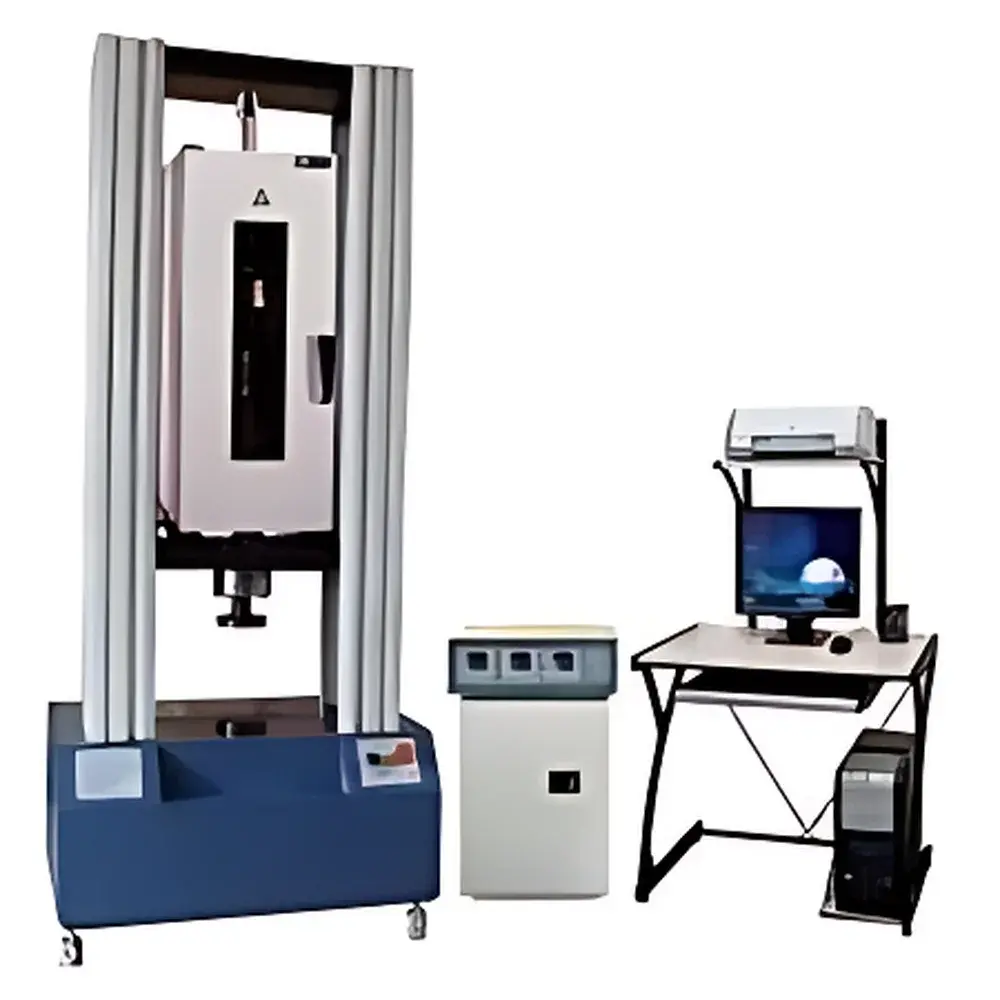
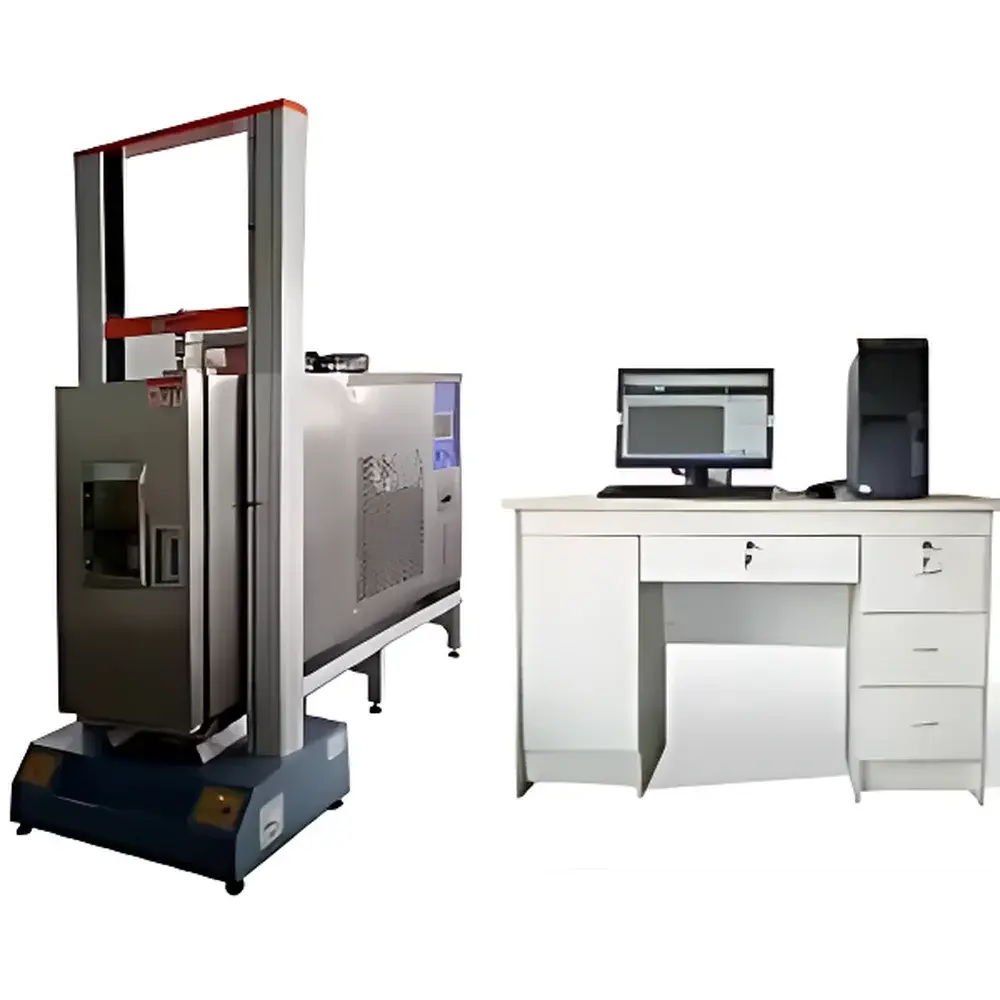
TOFENG TFW-50G High-Temperature Tensile Testing Machine
| [Brand | TOFENG |
|---|---|
| Model | TFW-50G |
| Max Test Load | 200 kN |
| Load Accuracy | ±0.5% of reading |
| Test Stroke | 1000 mm |
| Displacement Resolution | 0.0001 mm |
| Temperature Range | Ambient to 300 °C |
| Temp. Uniformity | ±1 °C |
| Temp. Resolution | 0.1 °C |
| Compliance | GB/T 228.1–2021, GB/T 7314–2017, ISO 6892-1:2019, ASTM E8/E8M] |
Overview
The TOFENG TFW-50G High-Temperature Tensile Testing Machine is a fully integrated electromechanical testing system engineered for precise mechanical property evaluation of metallic, polymeric, ceramic, and composite materials under controlled elevated-temperature conditions. It combines a precision servo-driven universal testing frame with a high-stability convection-type high-temperature chamber—designed to maintain thermal uniformity across the gauge length during dynamic loading. The system operates on the principle of force-controlled or displacement-controlled uniaxial tensile deformation, where load is applied via a ball-screw-driven crosshead actuated by a brushless AC servo motor, while real-time force, displacement, and strain data are acquired through calibrated load cells, optical encoders, and optional extensometers. This architecture ensures traceable, repeatable, and thermally stable mechanical characterization in accordance with international standards for high-temperature tensile testing.
Key Features
- Integrated high-temperature chamber with 304 stainless steel interior, insulated double-wall construction, and PID-controlled forced-air convection—achieving ±1 °C temperature uniformity within the 300 × 250 × 600 mm working volume.
- Robust dual-column frame with 400 mm column spacing and 1000 mm effective stroke—optimized for specimen alignment and thermal expansion compensation during high-temperature tests.
- Servo-motor-driven motion control system delivering closed-loop speed regulation from 0.01 to 500 mm/min, supporting quasi-static and creep-compatible loading profiles.
- High-fidelity signal acquisition: load cell accuracy ±0.5% of full scale; displacement resolution 0.0001 mm; strain measurement compatible with clip-on or non-contact extensometry (optional).
- Thermally isolated load train design minimizing heat transfer from chamber to load cell and ensuring long-term calibration stability at temperatures up to 300 °C.
- Comprehensive hardware safety interlocks—including over-travel limit switches, overload cutoff, emergency stop circuitry, and automatic shutdown upon specimen rupture or thermal excursion beyond setpoint.
Sample Compatibility & Compliance
The TFW-50G accommodates standard tensile specimens per ISO 6892-1, ASTM E8/E8M, and GB/T 228.1—supporting flat, round, and notched geometries up to 200 kN ultimate load capacity. Its modular chamber interface allows direct mounting of custom grips, furnace adapters, and environmental accessories (e.g., inert gas purge ports). The system complies with national and international regulatory frameworks including GB/T 228.1–2021 (Metallic Materials — Tensile Testing), GB/T 7314–2017 (Compression Testing of Metallic Materials), ISO 6892-1:2019, and ASTM E21 (Tensile Tests of Metallic Materials at Elevated Temperatures). All measurement subsystems are designed to meet Class 0.5 accuracy requirements per ISO 7500-1 and ASTM E4, with documented traceability to national metrological standards.
Software & Data Management
Control and analysis are executed via a Windows-based proprietary software suite compliant with GLP and GMP data integrity principles. The application supports multi-channel synchronized acquisition (load, displacement, temperature, time), real-time curve plotting (force–displacement, stress–strain, time–strain), and automated parameter extraction—including yield strength (Rp0.2), ultimate tensile strength (Rm), elongation at break (A%), reduction of area (Z%), Young’s modulus (E), and creep compliance coefficients. All raw data files are saved in encrypted binary format with embedded metadata (operator ID, test date/time, environmental conditions, calibration stamps). Audit trails record user actions, method changes, and report exports—fully aligned with FDA 21 CFR Part 11 requirements for electronic records and signatures when configured with user authentication and digital signing modules.
Applications
The TFW-50G serves R&D laboratories, quality control departments, and certification bodies requiring reliable high-temperature mechanical data for material qualification, process validation, and failure analysis. Typical use cases include: thermal-mechanical property mapping of aerospace alloys (e.g., Inconel 718, Ti-6Al-4V) at service temperatures; creep resistance assessment of high-performance polymers (PEEK, polyimides); interfacial strength evaluation of metal-ceramic composites under thermal cycling; validation of weld joint integrity in pressure vessel steels; and accelerated aging studies of elastomeric seals and gasket materials. Its flexibility extends to compression, bending, and shear testing configurations when paired with appropriate fixtures—enabling full mechanical property datasets under identical thermal boundary conditions.
FAQ
What is the maximum operating temperature of the integrated high-temperature chamber?
The standard configuration supports continuous operation from ambient to 300 °C, with optional upgrades available for extended ranges up to 600 °C.
Can the system perform tests under inert or reducing atmospheres?
Yes—custom chamber variants include gas inlet/outlet ports for nitrogen, argon, or forming gas purging, enabling oxidation-sensitive testing protocols.
Is the software validated for regulated environments (e.g., ISO 17025 or FDA-regulated labs)?
The software platform supports IQ/OQ documentation packages and can be configured with 21 CFR Part 11-compliant access controls, electronic signatures, and audit trail generation.
What types of extensometers are compatible with high-temperature testing?
Contact-type high-temperature extensometers (up to 1000 °C) and non-contact video extensometry systems are supported via standardized analog/digital I/O interfaces.
Does the system support automated test sequences with temperature ramping and dwell cycles?
Yes—the software includes programmable thermal-mechanical profiles, allowing synchronized temperature ramps, isothermal holds, and load application sequences within a single test method.



