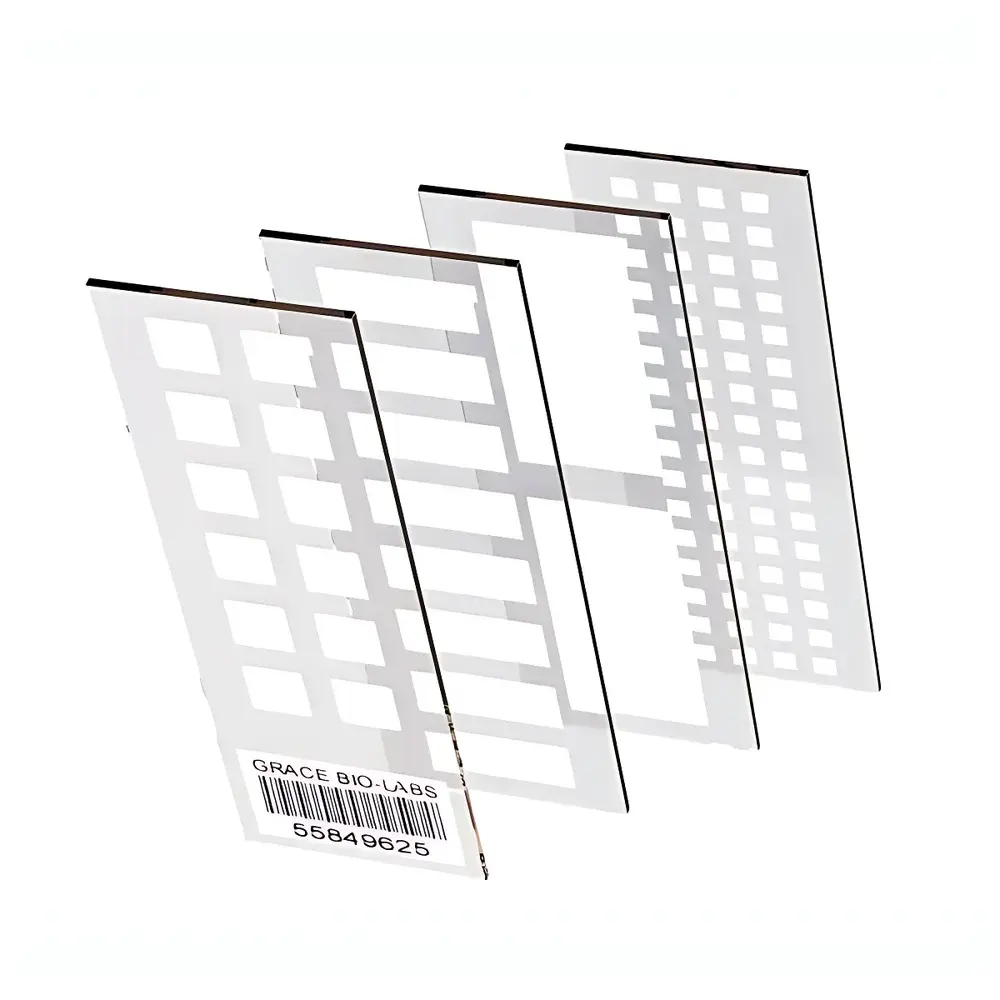
Grace Bio-Labs ONCYTE® Porous Nitrocellulose-Coated Microarray Slides
| Brand | Grace Bio-Labs |
|---|---|
| Model | ONCYTE® |
| Substrate Type | Glass Microscope Slide with Porous Nitrocellulose Membrane Coating |
| Origin | USA |
| Intended Sample Type | Proteins |
| Compatible Assay Formats | Fluorescence-based (e.g., Cy3/Cy5, Alexa Fluor), Chemiluminescence, Colorimetric |
| Surface Chemistry | Hydrophilic, High-Binding Nitrocellulose |
| Pore Size | ~0.45 µm (typical for protein retention) |
| Binding Capacity | ≥100 ng/cm² for IgG (standardized per ISO 15197:2015 Annex B methodology) |
| Sterility | Non-sterile, for research use only |
| Packaging | Individually barcoded, vacuum-sealed in nitrogen-flushed aluminum pouches |
| Shelf Life | 24 months at 4–25°C |
| Compliance | Manufactured under ISO 13485-certified quality system |
| Regulatory Status | RUO (Research Use Only), not for diagnostic use |
Overview
The Grace Bio-Labs ONCYTE® Porous Nitrocellulose-Coated Microarray Slides are precision-engineered solid-phase substrates designed for high-sensitivity, quantitative protein immobilization and detection in microarray-based assays. Unlike conventional flat-surface slides, the ONCYTE® platform features a uniform, microporous nitrocellulose membrane covalently bonded to optically clear, low-autofluorescence microscope-grade glass. This architecture enables three-dimensional protein capture within the membrane matrix—significantly increasing effective binding surface area while minimizing steric hindrance and non-specific background. The porous structure supports rapid capillary-driven sample loading and efficient reagent penetration, making it particularly suitable for low-volume, high-concentration protein applications such as antibody profiling, autoantibody screening, and post-translational modification analysis. The coating is chemically stable across pH 4–10 and resistant to common organic solvents (e.g., methanol, ethanol, DMSO) and denaturants (e.g., urea, guanidine HCl), ensuring assay robustness during stringent washing and blocking steps.
Key Features
- High-capacity, isotropic nitrocellulose membrane with controlled pore size (~0.45 µm) optimized for retention of proteins >5 kDa without aggregation or leaching
- Consistent thickness (±5% tolerance) and surface homogeneity verified by interferometric profilometry and contact angle mapping
- Low intrinsic fluorescence (<0.5% relative fluorescence units at 532/635 nm excitation/emission) validated per ASTM E275-22 standard test methods
- Compatible with automated spotter platforms (e.g., ArrayJet, Piezorray) and manual arraying; surface wettability supports uniform 100–500 pL droplet deposition
- Thermally stable up to 65°C for extended incubation protocols; compatible with steam autoclaving (121°C, 15 min) for reusable chamber configurations
- Batch-certified binding performance: each lot includes QC data for IgG adsorption capacity, coefficient of variation (CV) <8% across 96-slide validation set
Sample Compatibility & Compliance
ONCYTE® slides are validated for direct immobilization of purified antibodies, recombinant antigens, peptide libraries, and native serum/plasma proteins without pre-activation. They support multiplexed detection via fluorescent secondary antibodies (Cy3, Cy5, Alexa Fluor 488/647), enzyme-conjugated probes (HRP, AP), and gold nanoparticle labels. The substrate meets critical regulatory benchmarks for life science research infrastructure: manufacturing adheres to ISO 13485:2016 quality management systems; lot traceability includes full material history, environmental control logs, and particulate testing per ISO 14644-1 Class 7 cleanroom standards. While designated RUO, documentation packages include ISO/IEC 17025-aligned calibration records for surface characterization instruments used in release testing—facilitating GLP-compliant study design and audit readiness.
Software & Data Management
ONCYTE® slides integrate seamlessly with industry-standard microarray image acquisition and analysis platforms including GenePix Pro (Molecular Devices), ImaGene (BioDiscovery), and open-source tools such as MeV and R/Bioconductor limma. Each slide’s unique barcode links to a digital certificate of analysis (CoA) accessible via Grace Bio-Labs’ secure portal, containing batch-specific binding efficiency curves, autofluorescence baselines, and edge-effect maps. Raw TIFF images generated from scanners (e.g., Axon GenePix 4400A, InnoScan 710) retain EXIF metadata compliant with MIAME 2.0 guidelines. For GxP environments, optional 21 CFR Part 11-compliant electronic lab notebook (ELN) integration is available through validated API connectors supporting audit trail generation and user-level permission controls.
Applications
- Quantitative serological profiling for autoimmune disease biomarker discovery (e.g., anti-CCP, anti-dsDNA arrays)
- High-throughput epitope mapping using overlapping peptide libraries
- Host-cell protein (HCP) residual monitoring in biopharmaceutical process development
- FRET-based conformational studies with site-specifically labeled proteins
- SPR-compatible surface functionalization when coupled with dextran or carboxymethylated chip priming
- IHC validation workflows using tissue lysate-derived antigen arrays
- Single-cell secretome analysis via reverse-phase protein microarrays (RPPA)
FAQ
What is the recommended blocking agent for ONCYTE® slides?
BSA (1–3% in PBS-T) or casein-based blockers (e.g., Roche Blocking Reagent) are optimal; avoid non-fat dry milk due to endogenous biotin interference.
Can ONCYTE® slides be reused after stripping?
Yes—stripping with 6 M guanidine HCl + 1% SDS at 55°C for 30 min restores >92% baseline binding capacity; verify via IgG spike-in control before reuse.
Is there lot-to-lot variability in binding performance?
No—each production lot undergoes mandatory QC per ISO 15197 Annex B; CV for IgG binding across 96 slides is consistently ≤7.3% (n=12 lots).
Do these slides require special storage conditions?
Store unopened at 4–25°C in original nitrogen-flushed packaging; avoid freeze-thaw cycles and ambient humidity >60% RH.
Are ONCYTE® slides compatible with MALDI-TOF mass spectrometry post-detection?
Yes—membrane composition permits on-slide trypsin digestion and matrix application; validated with α-cyano-4-hydroxycinnamic acid (CHCA) and sinapinic acid (SA) matrices.