
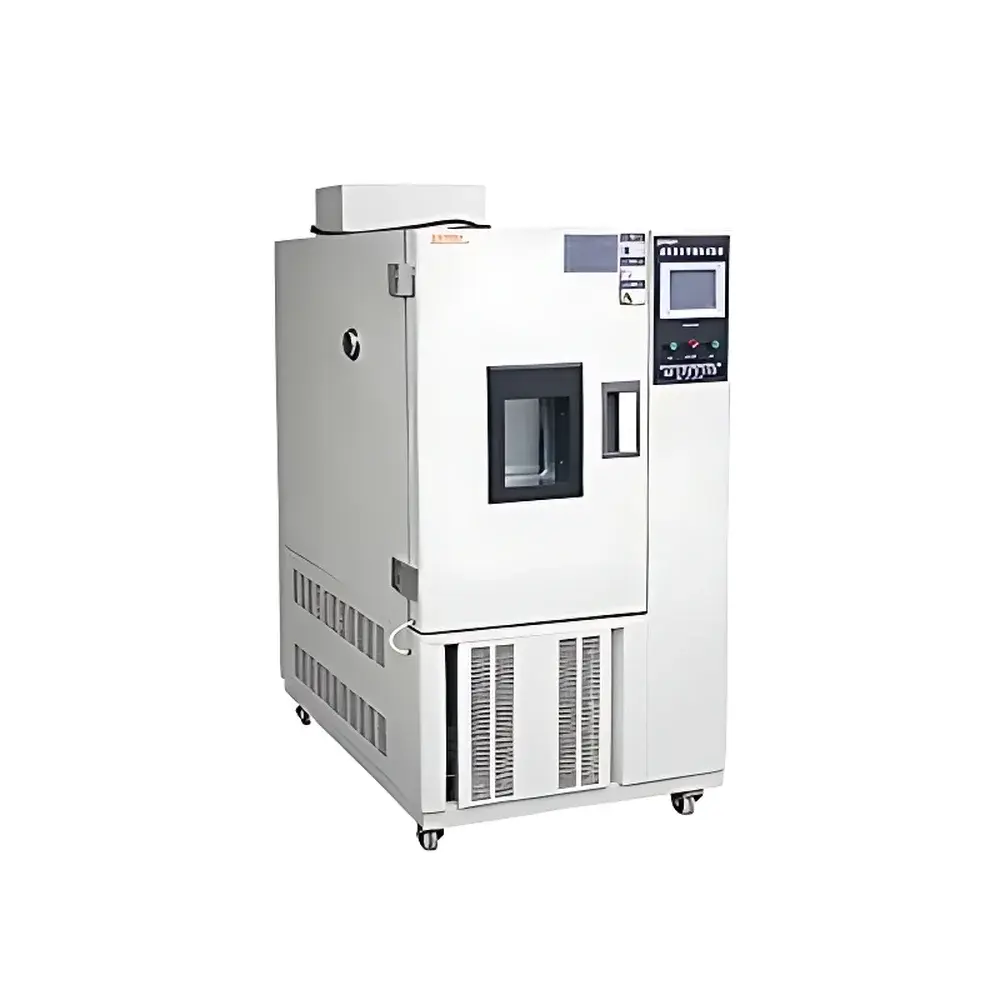
TF-312C Ozone Aging Test Chamber
| Brand | Tuofeng |
|---|---|
| Origin | Shanghai, China |
| Manufacturer Type | OEM Manufacturer |
| Region of Origin | Domestic (China) |
| Model | TF-312C |
| Price Range | USD 7,000 – 14,000 |
| Internal Dimensions (W×D×H, mm) | 450×450×500 / 500×600×750 / 700×800×900 / 800×1000×1000 |
| External Dimensions (W×D×H, mm) | 1200×1000×1800 / 1300×1150×2050 / 1450×1400×2250 / 1520×1540×2300 |
| Power Consumption | 4.0 kW / 4.5 kW / 7.0 kW / 11.5 kW |
| Temperature Range | 0°C to 70°C |
| Humidity Range | 30–65% RH |
| Ozone Concentration Range | 50–500 pphm (parts per hundred million) |
| Temperature Uniformity | ±0.5°C |
| Sample Rack | 360° continuous rotation at 1 rpm (static mode optional) |
| Gas Flow Velocity | 12–16 mm/s |
| Temperature Controller | Imported LED digital P.I.D. + S.S.R. microcomputer-integrated controller |
| Timer | High-precision programmable timer (hour/minute/second) |
| Ozone Monitoring | Imported ozone concentration analyzer with 4–20 mA analog output and RS232 communication interface |
| Ozone Generator Type | Silent corona discharge tube or UV absorption type (optional) |
| Safety Protections | Leakage current protection, short-circuit protection, overtemperature cutoff, motor overheat protection, overcurrent protection |
Overview
The TF-312C Ozone Aging Test Chamber is an engineered environmental test system designed for accelerated evaluation of ozone-induced degradation in elastomeric and polymeric materials. It operates on the principle of controlled exposure to elevated ozone concentrations under regulated temperature and humidity conditions—mimicking long-term atmospheric aging in a compressed timeframe. This chamber complies with internationally referenced standards including GB/T 7762–2003 (equivalent to ISO 1431–1) for rubber resistance to ozone cracking and GB/T 2951.21–2008 (aligned with IEC 60811-502) for electrical insulating materials. The system supports both static and dynamic testing configurations, enabling assessment of material behavior under mechanical strain—critical for validating seals, gaskets, cable jackets, and automotive rubber components subjected to cyclic deformation in service.
Key Features
- Configurable internal volume options (450×450×500 mm to 800×1000×1000 mm) accommodate diverse sample geometries—from small tensile strips to assembled subassemblies.
- High-stability ozone generation via silent corona discharge tubes ensures consistent output across the 50–500 pphm range; UV absorption-type generators are available as an alternative for applications requiring ultra-low background interference.
- Precision microcomputer-based P.I.D. temperature control maintains setpoint accuracy within ±0.5°C, supported by forced-air circulation and insulated double-wall construction.
- Rotating sample rack rotates continuously at 1 rpm (360° per minute), ensuring uniform ozone exposure across all specimen surfaces—essential for eliminating positional bias in crack initiation studies.
- Dual-mode operation: Static mode for baseline oxidation analysis; dynamic mode (with optional motorized extension) for simultaneous mechanical flexing during exposure—simulating real-world stress states.
- Integrated ozone concentration analyzer provides real-time feedback with 4–20 mA analog output and RS232 serial interface, facilitating integration into centralized lab data acquisition networks.
- Comprehensive safety architecture includes independent thermal cutouts, ground-fault circuit interruption, motor overheat monitoring, and overcurrent relays—designed to meet IEC 61000-6-2 EMC immunity requirements and UL 61010-1 safety compliance benchmarks.
Sample Compatibility & Compliance
The TF-312C accommodates flat, tubular, and molded specimens—including vulcanized rubber compounds (NR, SBR, EPDM, CR), thermoplastic elastomers (TPE), silicone rubbers, and halogen-free flame-retardant cable insulation. Specimen mounting fixtures conform to ISO 1431–1 Annex A dimensions and clamping force specifications. All operational parameters—including ozone concentration, temperature ramp rates, dwell times, and rotational synchronization—are traceable and auditable, supporting GLP-compliant documentation workflows. The chamber’s control firmware and data logging architecture are structured to align with FDA 21 CFR Part 11 requirements when paired with validated third-party LIMS or ELN systems.
Software & Data Management
While the TF-312C operates via embedded microcontroller with LED interface, its RS232 port enables bidirectional communication with external PC-based supervision software (provided separately). Users can schedule multi-step test profiles—including ramp-hold cycles, ozone concentration gradients, and conditional triggers based on elapsed time or sensor thresholds. Logged data (ozone ppm, chamber temperature, humidity, runtime) is timestamped and exportable in CSV format. Audit trails record operator ID, parameter changes, alarm events, and calibration timestamps—supporting ISO/IEC 17025 laboratory accreditation evidence packages.
Applications
- Evaluation of ozone resistance in automotive weatherstrips, engine mounts, and brake hoses per SAE J224.
- Qualification of elastomeric seals used in HVAC systems, medical devices, and aerospace enclosures.
- Comparative aging studies for R&D of new polymer formulations targeting extended service life in high-ozone urban environments.
- QC release testing of rubber goods in accordance with ASTM D1149 and ISO 1431–1 protocols.
- Failure analysis of field-returned components exhibiting surface cracking attributable to oxidative embrittlement.
FAQ
What ozone concentration ranges are achievable, and how is stability maintained?
The chamber delivers stable ozone concentrations from 50 to 500 pphm using closed-loop feedback control. The imported ozone analyzer continuously monitors output, and the controller dynamically adjusts generator power to compensate for ambient temperature drift or airflow variations.
Is calibration of the ozone sensor traceable to NIST or equivalent standards?
Yes—the ozone analyzer is factory-calibrated against certified ozone reference gas standards (NIST-traceable), with recalibration intervals recommended every 12 months or after 2,000 operating hours.
Can the chamber operate unattended for extended durations (e.g., 72+ hours)?
Yes. The system includes redundant overtemperature protection, automatic shutdown on ozone sensor fault, and non-volatile memory that preserves test parameters during brief power interruptions.
Does the TF-312C support humidity control beyond 65% RH?
No. The standard configuration maintains 30–65% RH. For higher humidity requirements (e.g., 85% RH), a custom humidification module must be specified at order stage.
Are spare parts and technical support available outside China?
Tuofeng maintains authorized service partners in Germany, USA, and Singapore; critical spares—including ozone generators, PID controllers, and sample racks—are stocked regionally with typical lead time under 10 business days.



