
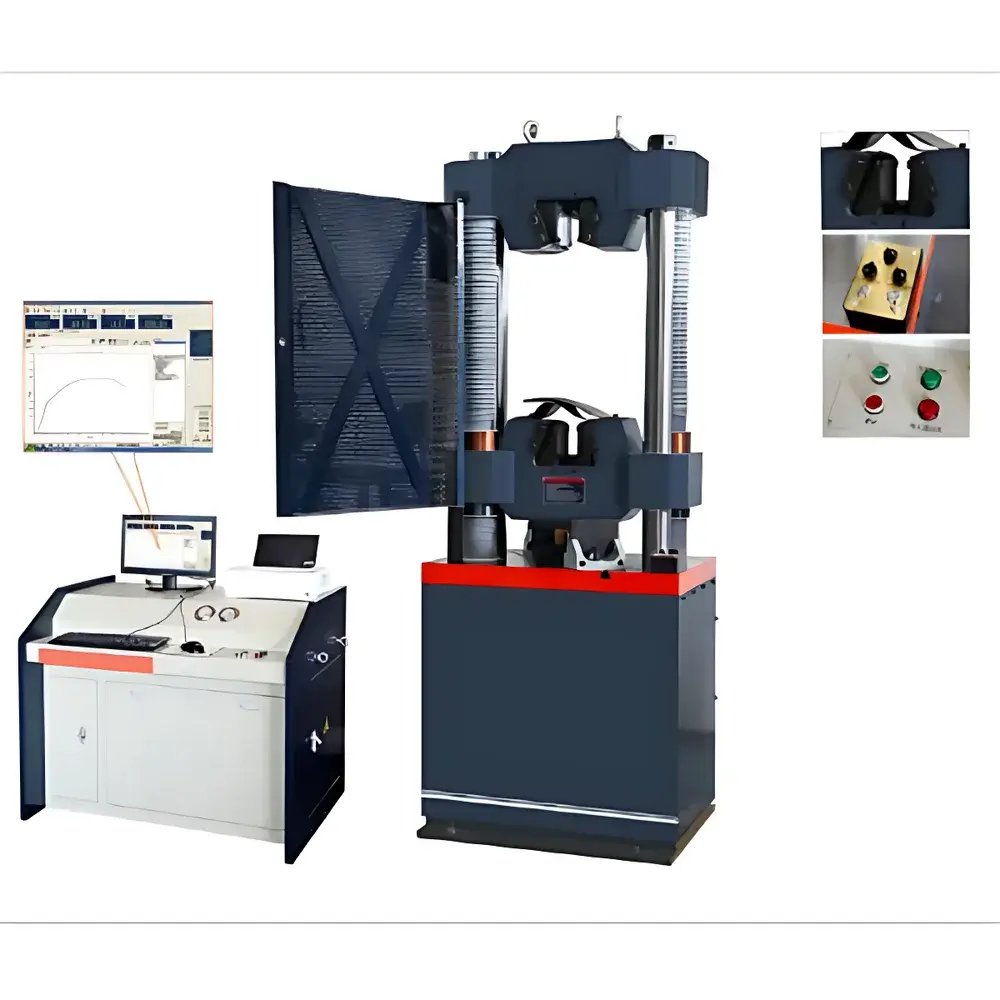
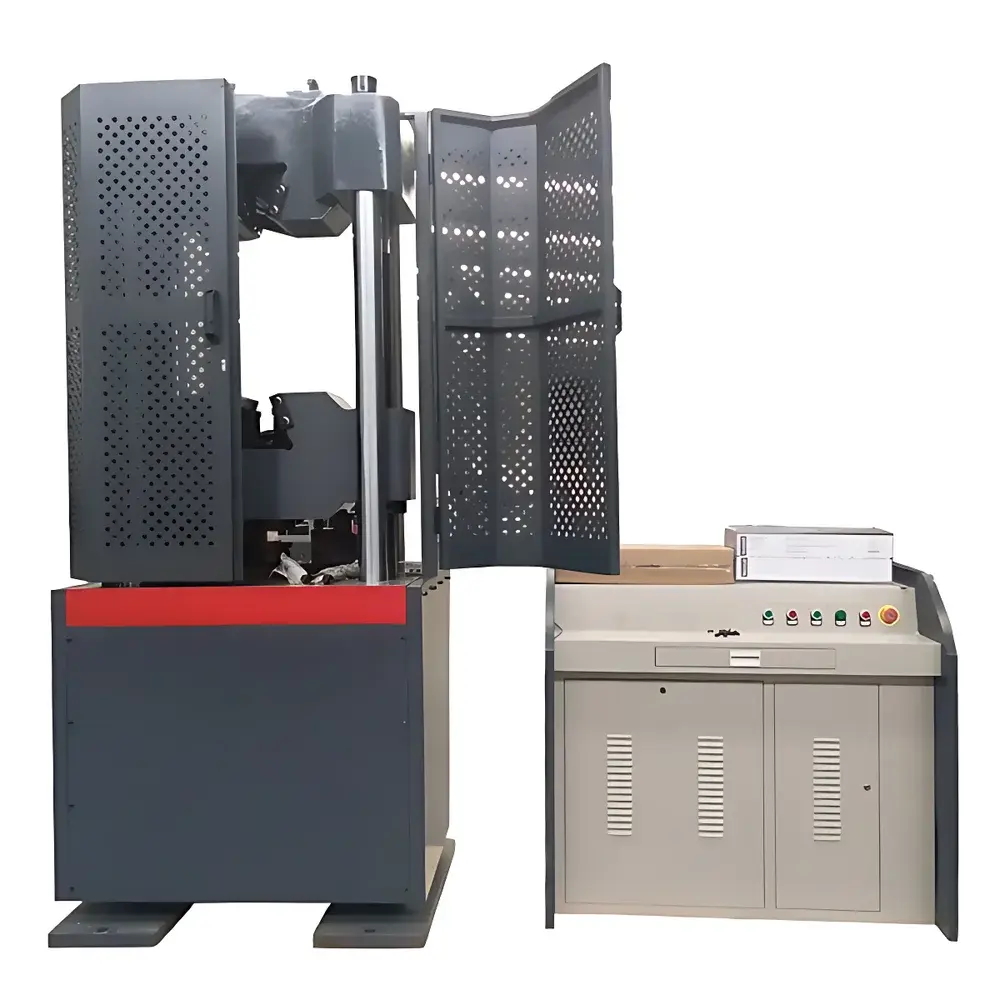
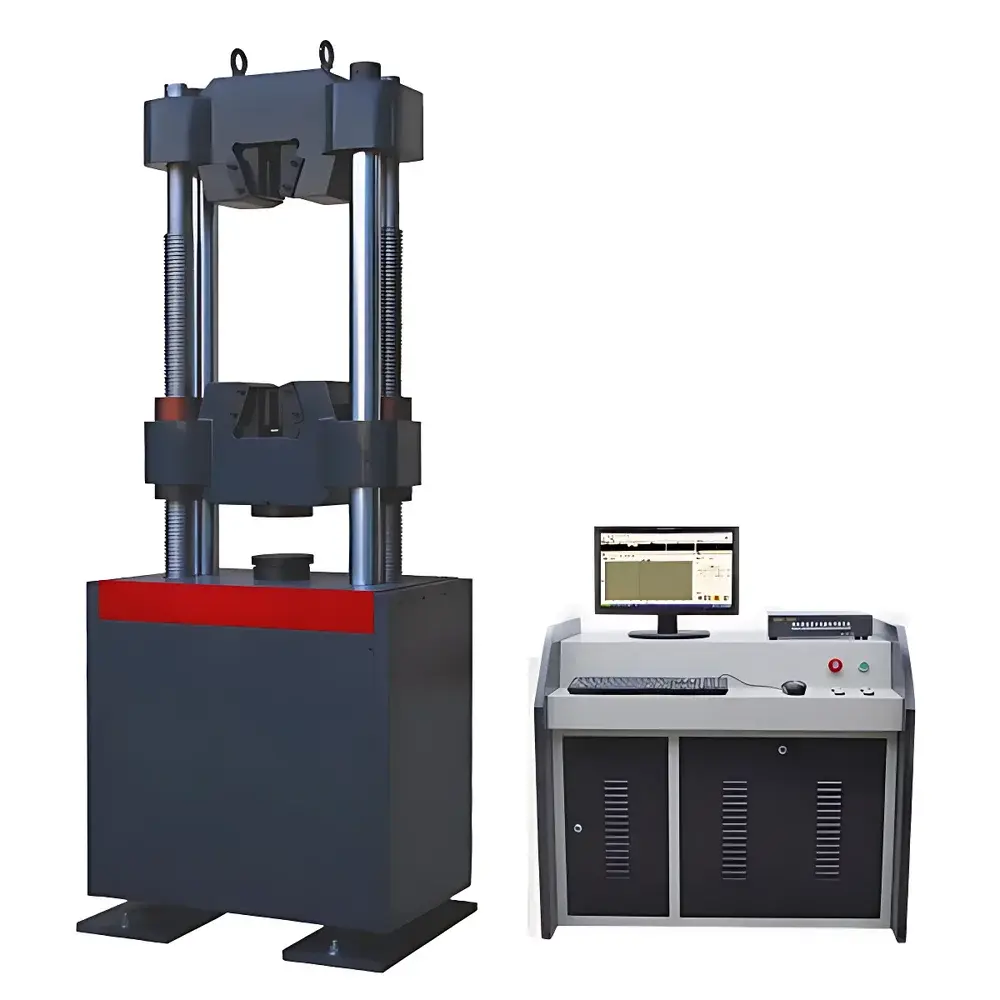
TuoFeng TFW-226 Electro-Hydraulic Servo Steel Strand Tensile Testing Machine
| Brand | TuoFeng |
|---|---|
| Origin | Shanghai, China |
| Manufacturer Type | Direct Manufacturer |
| Equipment Type | Electro-Hydraulic Servo Universal Testing Machine |
| Model | TFW-226 |
| Max Load Capacity | 1000 kN |
| Force Measurement Range | 1–100% of Full Scale |
| Force Resolution | 0.01 kN |
| Force Accuracy | ±1% of indicated value |
| Displacement Resolution | 0.01 mm |
| Displacement Accuracy | ±1% of indicated value |
| Tensile Test Space | 650 mm |
| Compression Test Space | 650 mm |
| Round Specimen Clamping Diameter | Φ13–40 mm |
| Flat Specimen Clamping Thickness | 0–15 mm |
| Clamping Method | Automatic Hydraulic Clamping |
| Piston Stroke | 250 mm |
| Maximum Piston Speed | 70 mm/min |
| Bend Support Roller Spacing | 40–600 mm |
| Bend Support Roller Width | 140 mm |
| Maximum Allowable Deflection | 100 mm |
| Shear Specimen Diameter | Φ10 mm |
| Compression Platen Dimensions | 204 × 204 mm |
| Host Dimensions (L×W×H) | 890 × 660 × 2200 mm |
| Control Cabinet Dimensions | 500 × 400 × 1200 mm |
| Power Supply | 2.2 kW, 3-phase |
| Weight | 3400 kg |
Overview
The TuoFeng TFW-226 Electro-Hydraulic Servo Steel Strand Tensile Testing Machine is a high-capacity, precision-engineered universal testing system designed for static mechanical property evaluation of prestressed steel strands, high-strength wires, anchorages, and structural metal components. Built on a robust four-column, two-screw, oil-below frame architecture, the machine features an upper tensile zone and a lower compression/bending zone—enabling full compliance with ISO 6892-1, ASTM E8/E21, GB/T 228.1–2021, and EN 10002-1 test standards. Its electro-hydraulic servo actuation delivers stable force control across wide dynamic ranges, while the dual-cylinder loading system ensures uniform load distribution and minimal eccentricity during high-force tensile tests on multi-strand assemblies (e.g., 7-wire 15.2 mm strands up to 1860 MPa ultimate tensile strength). The system’s closed-loop hydraulic circuit—comprising high-pressure piston pump, differential pressure valve group, and proportional servo valve—enables precise regulation of oil flow into the main cylinder, supporting constant-rate force, displacement, or strain control modes with seamless transition between them.
Key Features
- Four-column, oil-below frame with rigid cast-iron base and reinforced crosshead structure for minimal deflection under 1000 kN load
- Automatic hydraulic clamping system with synchronized pressure control for consistent gripping force across Φ13–40 mm round specimens and 0–15 mm flat coupons
- Multi-channel digital closed-loop controller supporting stress, strain, and displacement control—fully compliant with GB/T 228.1–2021 ramping profiles (e.g., Stage I: ≤10 MPa/s; Stage II: ≤0.0025/s strain rate)
- High-resolution optical encoder-based displacement measurement (0.01 mm resolution, ±1% accuracy) and load cell signal conditioning with 24-bit ADC
- Modular software architecture enabling user-defined test sequences, multi-step ramp/hold protocols, and real-time parameter override without interrupting active tests
- Dual-zone workspace: 650 mm vertical clearance for tensile elongation measurement; adjustable lower zone accommodating compression (204 × 204 mm platens), three-point bending (40–600 mm support spacing), and shear (Φ10 mm punch/die setup)
Sample Compatibility & Compliance
The TFW-226 accommodates standardized steel strand specimens per GB/T 5224, ASTM A416, and EN 10138, including 1×7, 1×19, and 1×37 configurations with nominal diameters from 9.3 mm to 18.0 mm. It supports direct testing of bonded anchor systems, wedge assemblies, and grouted duct segments under controlled displacement rates. All force and displacement data acquisition meets GLP audit requirements, with timestamped raw channel logging, electronic signature support, and 21 CFR Part 11–compliant user access control (administrator/test operator roles). Calibration certificates traceable to CNAS-accredited national metrology institutes are provided with each unit, and verification procedures align with JJG 139–2014 (verification regulation for universal testing machines).
Software & Data Management
Built-in Windows-based control software offers fully customizable Excel-formatted reporting templates—users define column order, units, statistical functions (mean, CoV, max/min), and pass/fail thresholds per test step. Raw data export includes .csv and .txt formats with millisecond-level time stamps for post-test analysis in MATLAB or Python. Audit trails record all parameter changes, user logins, calibration events, and test interruptions. Data integrity safeguards include automatic backup to external USB storage, write-protected historical archives, and encrypted database storage. Software supports batch processing of identical specimen sets with auto-numbering and barcode-assisted sample ID linking.
Applications
- Tensile strength, yield strength, elongation at break, and modulus of elasticity measurement for prestressing steel strands used in bridge cables, precast concrete, and post-tensioned structures
- Proof load and ultimate failure testing of anchorage systems per ISO 15630-2 and GB/T 14370
- Compression testing of concrete-filled steel tubes (CFST) and high-strength grouts
- Three-point bending evaluation of reinforcing bar couplers and splice sleeves
- Shear resistance assessment of strand-to-anchorage interfaces using standardized Φ10 mm shear fixtures
- Creep and relaxation characterization under sustained load (when integrated with optional long-term hold modules)
FAQ
What standards does the TFW-226 comply with for steel strand tensile testing?
It fully supports GB/T 228.1–2021, ASTM E8/E21, ISO 6892-1, and EN 10002-1 for metallic materials, with additional configuration options for GB/T 5224 and ASTM A416 strand-specific protocols.
Can the system perform simultaneous force and displacement control during a single test?
Yes—the multi-loop controller enables concurrent inner-loop strain control with outer-loop force ramping, critical for evaluating yield plateau behavior in high-strength steels.
Is the software compatible with LIMS integration?
The system provides OPC UA and TCP/IP API interfaces for bidirectional communication with laboratory information management systems, supporting automated test initiation and result ingestion.
What maintenance intervals are recommended for the hydraulic system?
Hydraulic oil and high-pressure filter replacement every 2,000 operating hours; servo valve recalibration annually or after 10,000 test cycles, as documented in the included maintenance logbook.
Does the machine support third-party extensometer integration?
Yes—standard analog voltage (±10 V) and digital TTL inputs accept clip-on, video, or laser extensometers meeting ASTM E83 Class B-2 specifications.



