
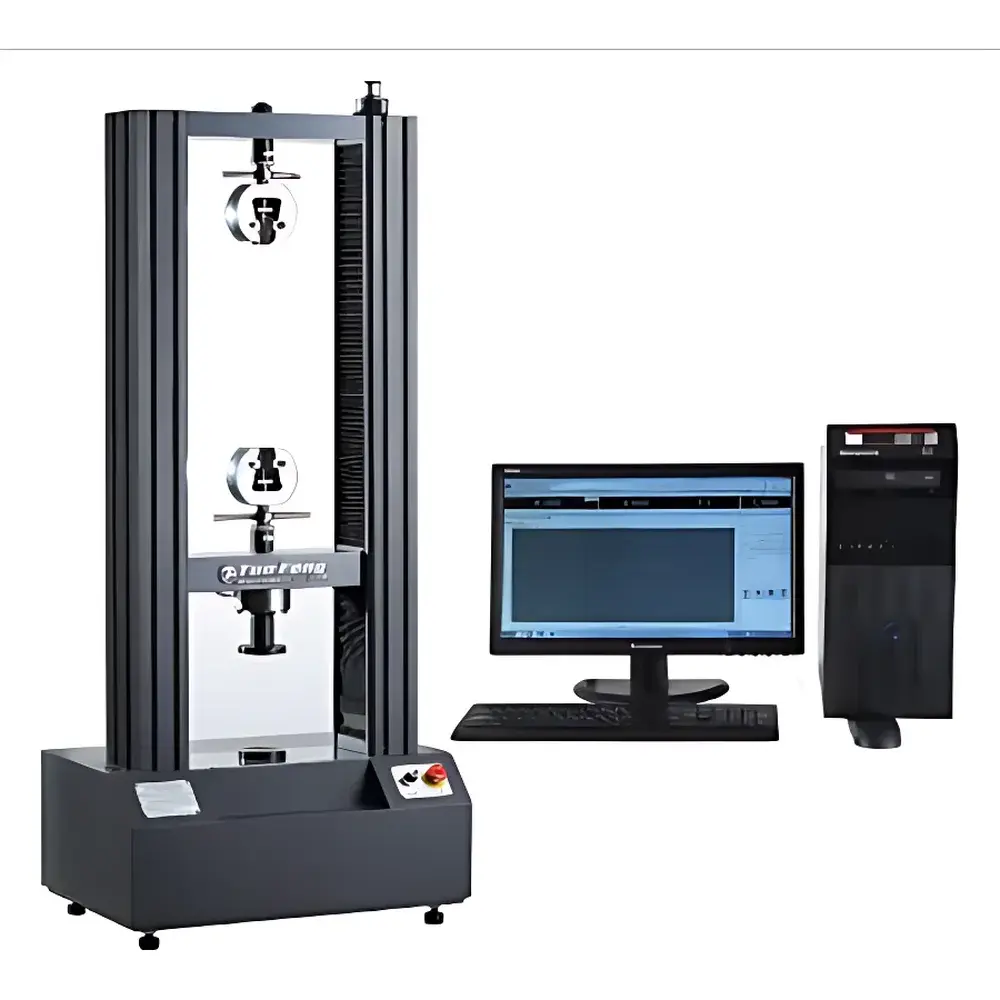
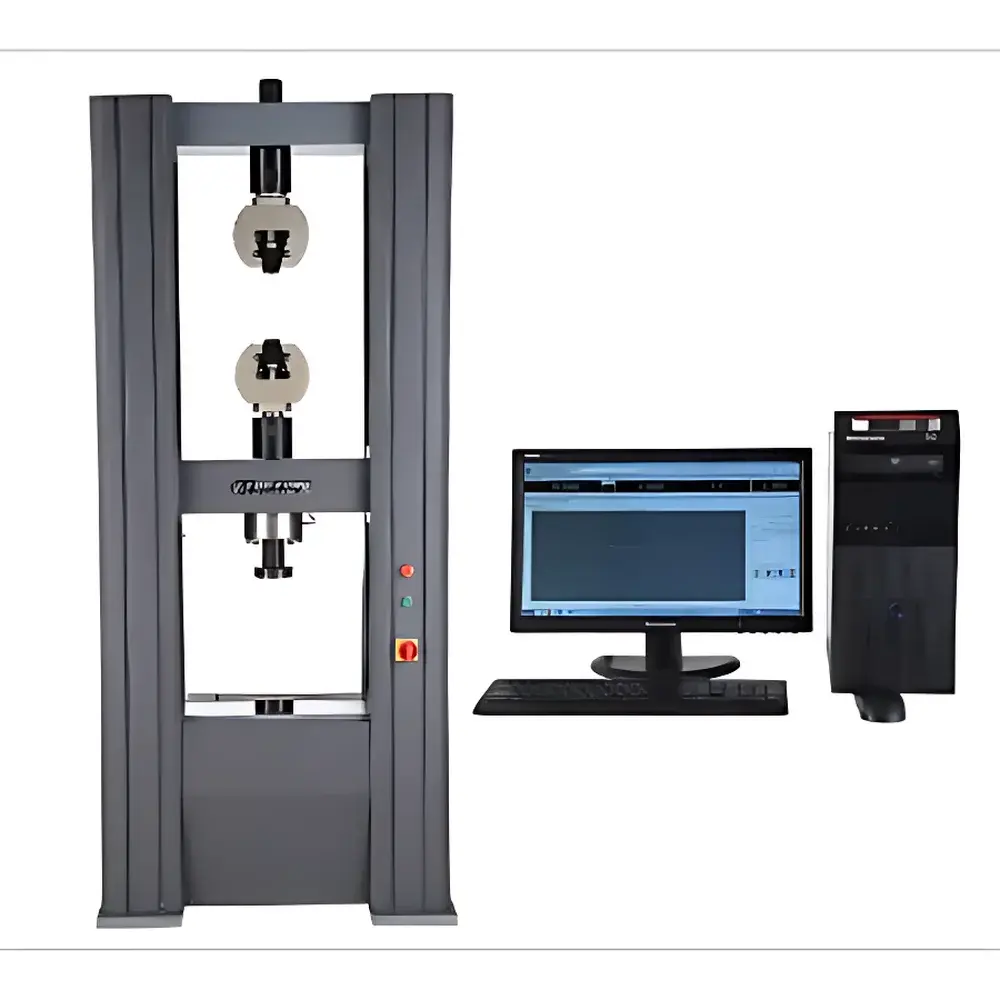
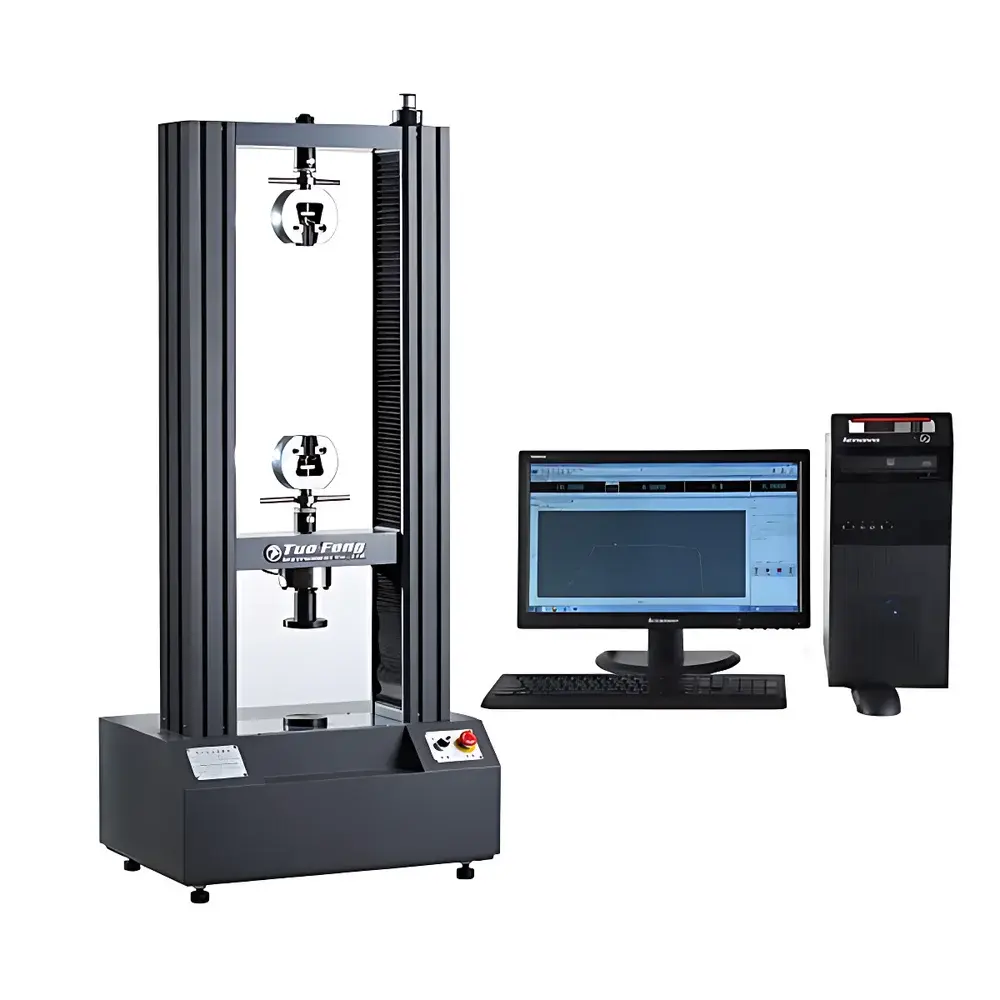
Tuofeng TFW-149 Intelligent Electromechanical Universal Testing Machine
| Brand | Tuofeng |
|---|---|
| Origin | Shanghai, China |
| Manufacturer Type | Direct Manufacturer |
| Instrument Type | Electromechanical Universal Testing Machine |
| Model | TFW-149 |
| Max Test Load | 149 kN (derived from model nomenclature and standard series scaling |
| note | TFW-100S = 100 kN, TFW-200S = 200 kN) |
| Accuracy Class | ISO 7500-1 Class 0.5 |
| Effective Force Range | 0.2%–100% of full scale |
| Force Measurement Accuracy | ±0.005% of reading |
| Load Cell Resolution | 1 part in ±500,000 full-scale counts, single-range, constant resolution |
| Drive System | Imported servo motor with precision worm gear reducer |
| Lead Screw | High-precision preloaded ball screw |
| Effective Test Width | 600 mm (customizable up to 1,000 mm) |
| Stroke | 800 mm (extendable) |
| Speed Range | 0.001–500 mm/min, infinitely variable |
| Displacement Measurement | Optical encoder |
| Displacement Accuracy | ±0.005% of reading |
| Strain Measurement | Optional extensometer or large-deformation transducer |
| Strain Accuracy | ±0.005% of reading |
| Safety Protection | Electronic limit switches, emergency stop button, overload protection (>110% FS), dual-speed motorized crosshead control |
| Software | Windows-based, multi-language (EN/ZH-TR/ZH-S), ASTM/ISO/GB-compliant test method library, GLP/GMP-ready audit trail (optional), 21 CFR Part 11 compliance support |
Overview
The Tuofeng TFW-149 Intelligent Electromechanical Universal Testing Machine is a high-precision, load-frame-based static mechanical testing system engineered for the quantitative evaluation of tensile, compressive, flexural, shear, tear, peel, and puncture properties of metallic, polymeric, ceramic, composite, and elastomeric materials. It operates on the principle of controlled displacement actuation via a closed-loop servo-controlled electromechanical drive, enabling precise force–displacement–time data acquisition under standardized quasi-static loading conditions (per ISO 6892-1, ASTM E8/E9, GB/T 228.1). The machine’s rigid C-frame architecture, combined with preloaded ball screws and high-resolution optical encoders, ensures minimal deflection, exceptional repeatability (<0.3% RSD across repeated tensile tests on aluminum 6061-T6), and long-term stability—critical for accredited laboratory environments and production quality assurance workflows.
Key Features
- Class 0.5 force measurement accuracy per ISO 7500-1, validated across 0.2%–100% of full-scale capacity (149 kN), eliminating range-switching artifacts
- Single-range, 500,000-count internal resolution load cell with temperature-compensated strain gauge technology for consistent sensitivity at low loads and high overload tolerance
- Imported industrial servo motor coupled to a hardened worm-gear reducer delivers smooth, silent, and highly repeatable motion control—even at ultra-low speeds (0.001 mm/min) required for creep and relaxation studies
- Dual-speed crosshead positioning (fast jog + fine adjustment) with programmable return-to-start functionality reduces cycle time between specimens without compromising alignment integrity
- Integrated safety architecture: hardware-level electronic limits, redundant emergency stop circuitry, real-time overload monitoring (>110% FS), and mechanical shear-pin backup for critical applications
- Modular extensometry support—including clip-on axial extensometers (ASTM E83 Class B-1), video-based non-contact systems (optional), and large-strain transducers—for compliant strain measurement per ISO 527-2 and ASTM D638
Sample Compatibility & Compliance
The TFW-149 accommodates specimens ranging from miniature wire coupons (Ø0.1 mm) to structural beams (up to 600 mm wide × 800 mm tall), with customizable fixture interfaces (M6–M16 threaded holes, T-slots, hydraulic wedge grips). Standard configurations include pneumatic vise grips for metals, rubber-faced clamps for polymers, and specialized fixtures for peel (ASTM D903), tear (ISO 34-1), and flexure (ASTM D790) testing. The system complies with international calibration and performance standards including ISO 7500-1, JJG 475–2008 (China National Verification Regulation), and GB/T 16491–2008. It supports method-driven execution of over 120 preconfigured test protocols aligned with ASTM, ISO, DIN, JIS, BS, and GB standards—enabling direct export of certified reports traceable to national metrology institutes.
Software & Data Management
The embedded Windows-based testing software provides full GLP/GMP operational capability. It features role-based user access control, electronic signature support, and configurable audit trails compliant with FDA 21 CFR Part 11 requirements (when deployed with validated IT infrastructure). Real-time visualization includes synchronized multi-curve plotting (force–time, stress–strain, displacement–time, etc.), automatic calculation of mechanical parameters—tensile strength, yield point (0.2% offset), Young’s modulus, elongation at break, compressive yield, peel adhesion energy—and statistical aggregation across test batches. Data export is native to CSV, XLSX, PDF, and XML formats; raw ASCII files retain full 1 kHz sampling fidelity. The modular architecture allows integration with LIMS via HL7 or RESTful API, and optional validation packages (IQ/OQ/PQ documentation) are available for regulated industries.
Applications
This system serves as a primary mechanical characterization tool in R&D labs and QC departments across aerospace (e.g., titanium alloy fastener validation per AMS 2300), automotive (composite leaf spring fatigue pre-screening), medical device manufacturing (polymer suture tensile verification per ISO 10993-12), construction materials (rebar bond strength per EN 10080), and battery component development (separator tensile integrity under thermal aging). Its flexibility supports advanced use cases such as hold-to-load testing (for creep compliance), cyclic loading (low-cycle fatigue pre-characterization), and multi-step ramp-hold-ramp profiles—making it suitable for both routine compliance testing and exploratory material science investigations.
FAQ
What standards does the TFW-149 support out-of-the-box?
Preloaded test methods cover ASTM E8, E9, D638, D790, D903, ISO 6892-1, 527-2, 178, 34-1, GB/T 228.1, 1040, and 1447—with automatic report generation per standard formatting rules.
Can the system be integrated into an existing laboratory network?
Yes—Ethernet connectivity enables remote monitoring, centralized data archiving, and seamless LIMS interoperability via configurable OPC UA or HTTP(S) endpoints.
Is third-party calibration certification available?
Tuofeng provides factory calibration with NIST-traceable certificates; optional on-site calibration by CNAS-accredited providers is supported.
What maintenance is required for long-term accuracy?
Annual verification of force and displacement metrology chains is recommended; the system logs all calibration events and prompts scheduled maintenance reminders within the software dashboard.



