
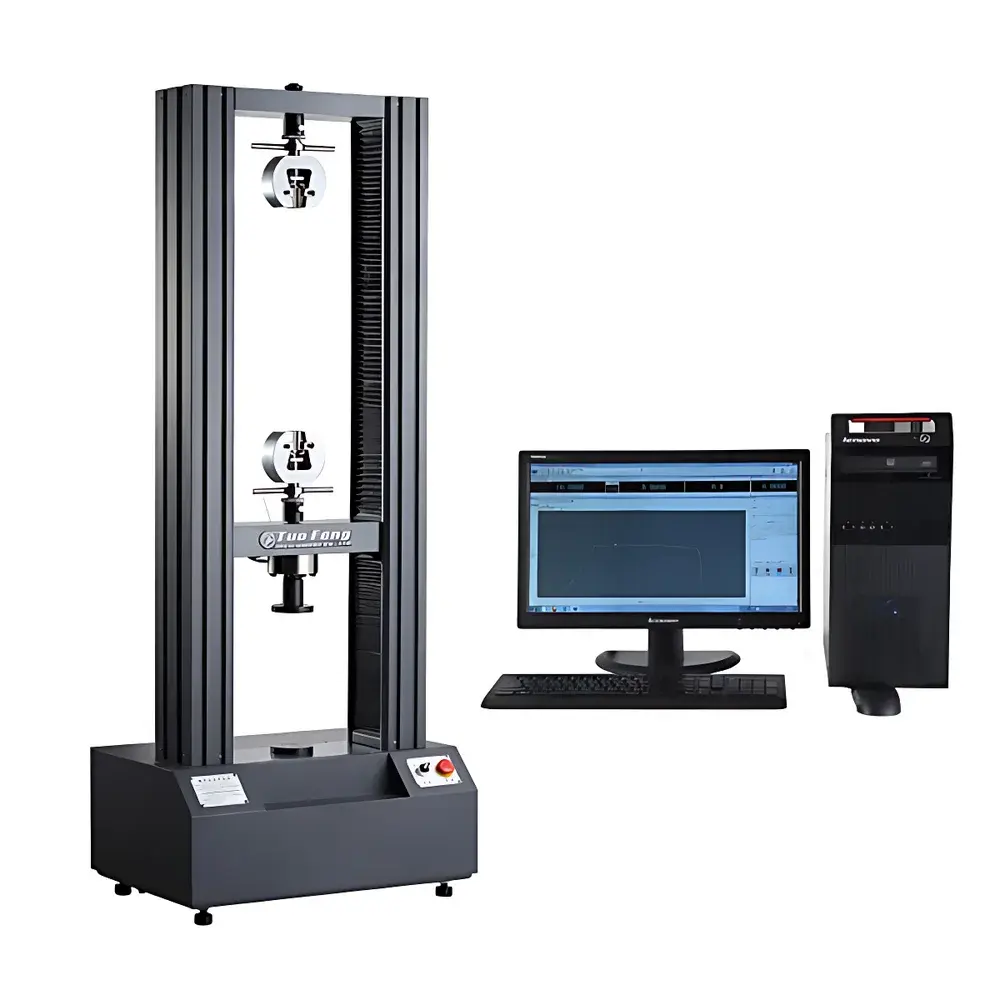
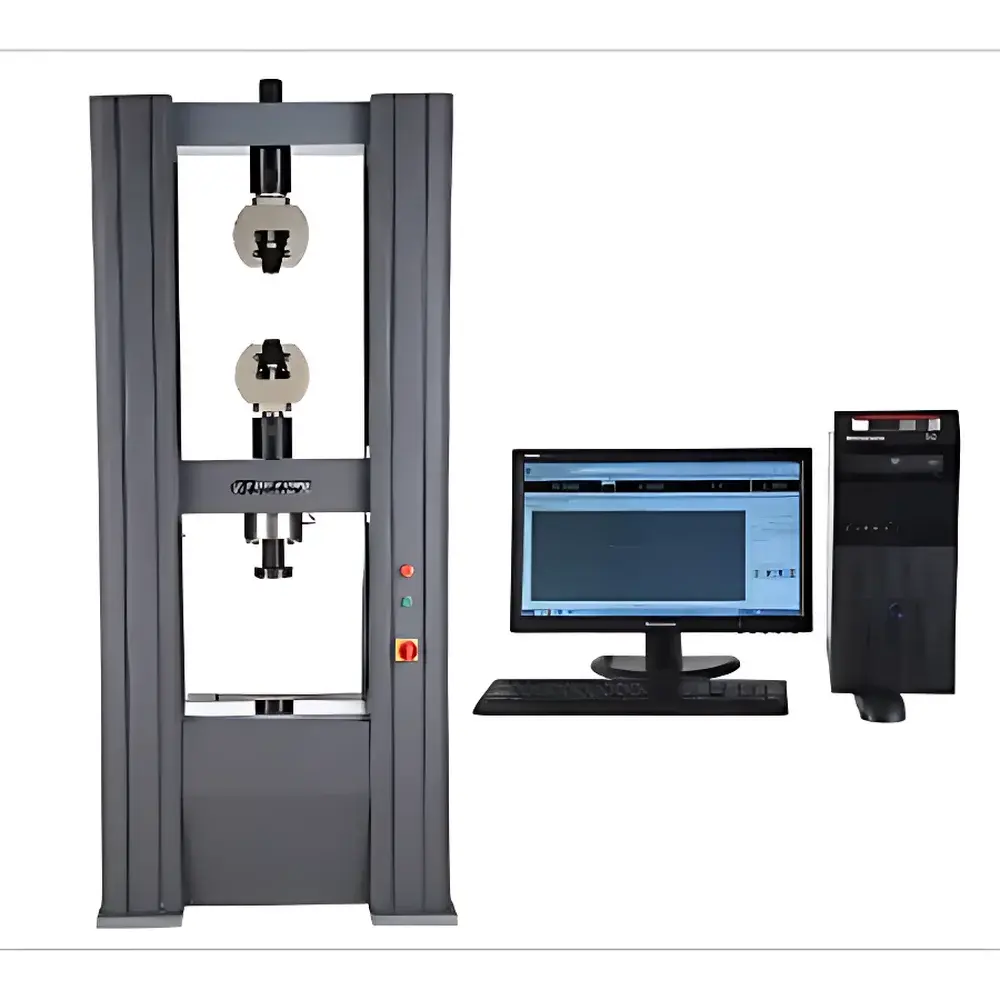
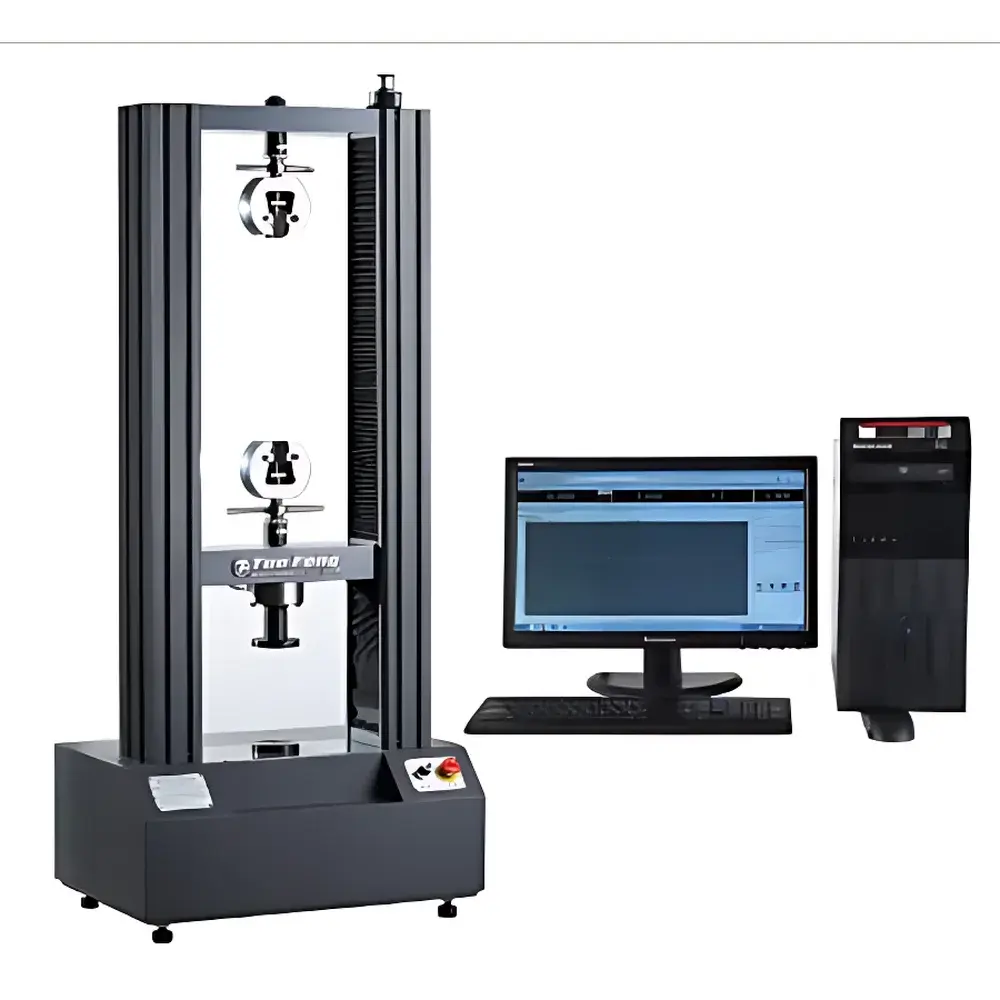
Tuofeng TFW-144 Microcomputer-Controlled Electronic Universal Testing Machine
| Brand | Tuofeng |
|---|---|
| Origin | Shanghai, China |
| Manufacturer Type | Direct Manufacturer |
| Instrument Type | Electromechanical Universal Testing Machine |
| Model | TFW-144 |
| Max Test Load | 144 kN (derived from series context: TFW-100S=100kN, TFW-200S=200kN |
| Accuracy Class | 0.5 |
| Effective Force Range | 0.2–100% of full scale |
| Force Measurement Accuracy | ±0.005% of reading |
| Load Cell Resolution | 1 part in ±500,000 full-scale codes, single-range, constant resolution |
| Drive System | Imported servo motor with precision worm gear reducer |
| Lead Screw | High-accuracy preloaded ball screw |
| Effective Test Width | 600 mm (customizable) |
| Stroke | 800 mm (extendable) |
| Speed Range | 0.001–500 mm/min, infinitely variable |
| Displacement Measurement | Optical encoder, accuracy ±0.005% of reading |
| Strain Measurement | Optional extensometer or large-deformation sensor, accuracy ±0.005% of reading |
| Safety Protection | Electronic limit switches, emergency stop, overload protection (10% over capacity), dual-speed motorized crosshead control |
| Software | Windows-based, multi-language (EN/ZH-T/ZH-S), compliant with ASTM E4, ISO 7500-1, GB/T 16491-2008, JJG 475-2008 |
Overview
The Tuofeng TFW-144 Microcomputer-Controlled Electronic Universal Testing Machine is a high-precision electromechanical system engineered for static mechanical property characterization of metallic, polymeric, composite, and fiber-optic cable materials under controlled uniaxial loading conditions. It operates on the principle of closed-loop servo-controlled force and displacement actuation, where load is applied via a high-rigidity frame, preloaded ball screw transmission, and imported servo drive—ensuring minimal backlash, thermal drift, and hysteresis. Designed to meet international metrological standards—including ISO 7500-1 (Class 0.5), ASTM E4 (verification of force-measuring instruments), and GB/T 16491-2008—the TFW-144 delivers traceable, repeatable, and auditable mechanical data essential for R&D validation, QC release, and regulatory submission. Its architecture supports both tensile and compressive testing protocols, with bidirectional force capability and programmable load/strain/displacement control modes required for advanced material qualification in optical fiber cable manufacturing, aerospace structural composites, and automotive polymer systems.
Key Features
- High-fidelity force measurement system with ±0.005% reading accuracy and 1:500,000 internal resolution—enabling detection of sub-millinewton load variations across full dynamic range
- Constant-resolution, single-range load cell design eliminates range-switching artifacts and ensures linearity from 0.2% to 100% of full scale (144 kN)
- Dual-speed motorized crosshead with jog functionality and automatic return-to-start—reducing operator intervention and cycle time variability
- Modular extensometry support: compatible with clip-on axial extensometers (for modulus and yield determination) and non-contact video extensometers (for brittle or high-elongation specimens)
- Integrated safety architecture: hardware-level emergency stop, electronic travel limits, and software-enforced overload cutoff at 110% of rated capacity
- Thermally stable frame with reinforced C-frame geometry and vibration-damped base—minimizing environmental influence on low-force measurements
Sample Compatibility & Compliance
The TFW-144 accommodates standardized and custom test specimens per ISO 527, ASTM D638, ASTM D3039, ISO 6892-1, and IEC 60794-1-2 (optical fiber cable mechanical testing). Its 600 mm effective test width and 800 mm stroke allow evaluation of full-length fiber optic cables (including armored, loose-tube, and ribbon configurations), polymer jacketing, strength members (aramid yarn, steel wire), and hybrid composite reinforcements. All mechanical test sequences comply with GLP-aligned audit trails when configured with optional 21 CFR Part 11–compliant software modules. Calibration certificates are NIST-traceable and include uncertainty budgets per ISO/IEC 17025 requirements. The system satisfies mandatory verification under JJG 475-2008 (China National Metrology Verification Regulation for Electronic Universal Testing Machines) and supports third-party accreditation for ISO/IEC 17025 laboratories.
Software & Data Management
The embedded Windows-based testing platform provides ISO/IEC 17025–ready data governance. It supports simultaneous real-time display of up to four independent curves (e.g., stress–strain, load–displacement, strain rate–time), automatic calculation of ASTM/ISO-defined parameters—including tensile strength, elongation at break, Young’s modulus, yield offset (0.2%), compression modulus, peel strength, and shear strength—and batch statistical reporting (mean, SD, min/max, CV%). All test files store raw channel data (load, displacement, extensometer output) with timestamped metadata, digital signatures, and immutable audit logs. Data export is native to CSV, XML, and PDF formats; integration with LIMS and MES systems is supported via OPC UA and SQL database connectors. Software updates are delivered remotely with version-controlled release notes and full backward compatibility.
Applications
- Mechanical qualification of optical fiber cables per IEC 60794-1-2 (tensile, crush, impact, torsion, bending)
- Characterization of polymer sheathing materials (LSZH, PE, PVC) for elongation, tensile strength, and stress relaxation
- Testing of aramid yarns, fiberglass rods, and steel wire strength members under monotonic and cyclic loading
- Validation of adhesive bond integrity in cable splicing and connector assembly processes
- Research-grade deformation analysis of thermoplastic matrix composites used in airborne fiber-optic harnesses
- QC release testing for telecom cable manufacturers operating under TL 9000 or ISO 9001 quality management systems
FAQ
Does the TFW-144 support automated test sequence programming for multi-step protocols (e.g., preload → hold → ramp → dwell)?
Yes. The software enables user-defined multi-stage control profiles with independent setpoints for force, displacement, strain, or time—fully compliant with ISO 6892-1 Annex G and ASTM D7264 for flexural testing.
Is the system suitable for creep and stress-relaxation testing?
Yes. With optional high-stability load hold mode (±0.1% of target load over 10,000 s) and temperature-controlled environmental chamber integration, it meets ASTM D2990 and ISO 899-1 requirements.
Can test data be exported directly into statistical process control (SPC) platforms?
Yes. Native CSV/XML export includes all raw and derived parameters; optional SPC plugin generates X-bar/R charts and capability indices (Cp, Cpk) aligned with AIAG MSA guidelines.
What calibration documentation is provided upon delivery?
A full factory calibration report per ISO/IEC 17025 is included, covering force, displacement, and strain channels—with uncertainty budgets, traceability statements, and as-found/as-left data.
Is remote diagnostic and firmware update capability available?
Yes. Secure TLS-encrypted remote access allows authorized engineers to perform health checks, parameter diagnostics, and version-managed firmware updates without onsite visits.



