
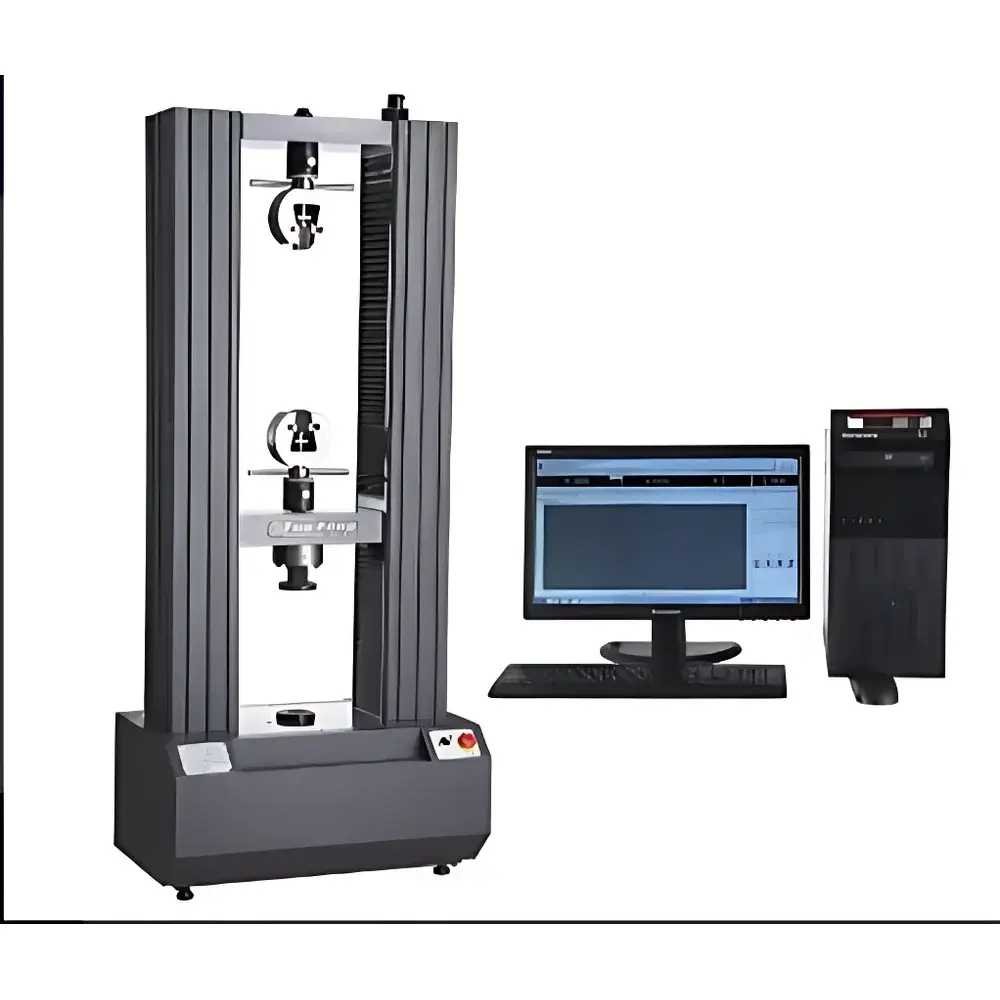
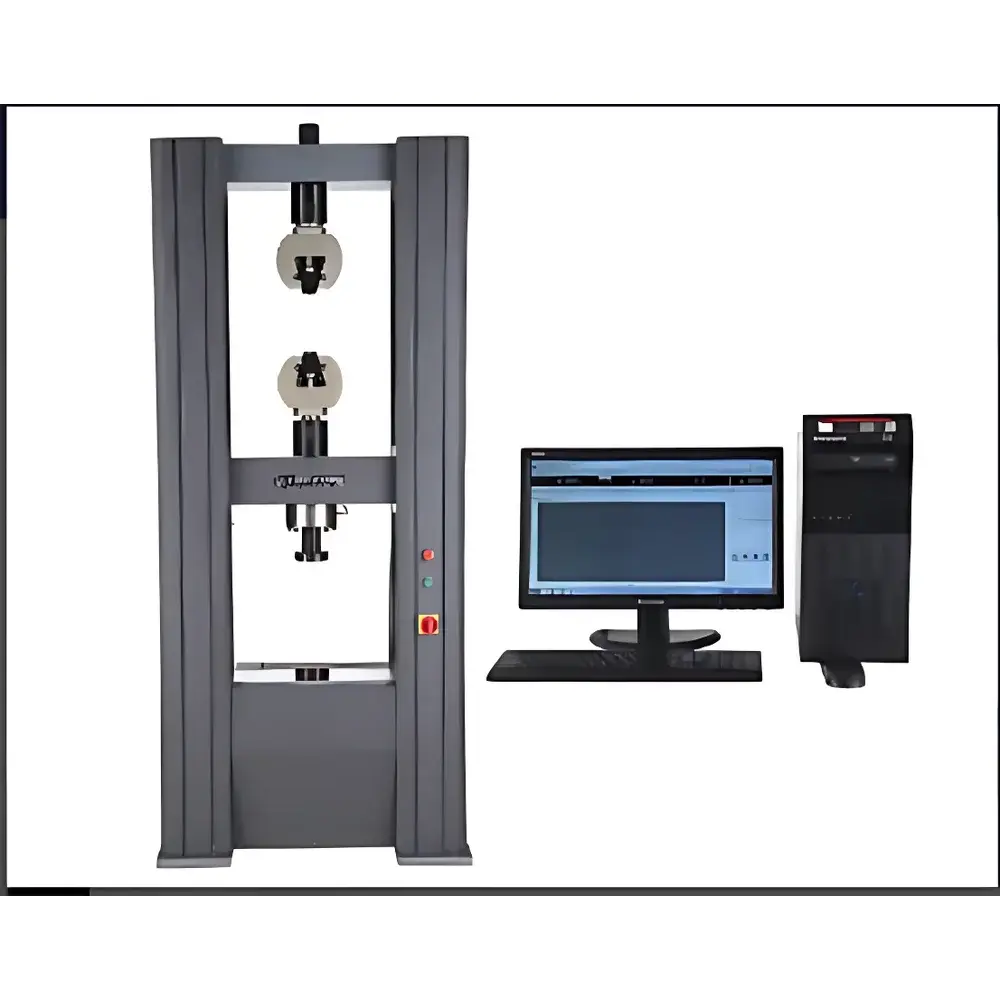
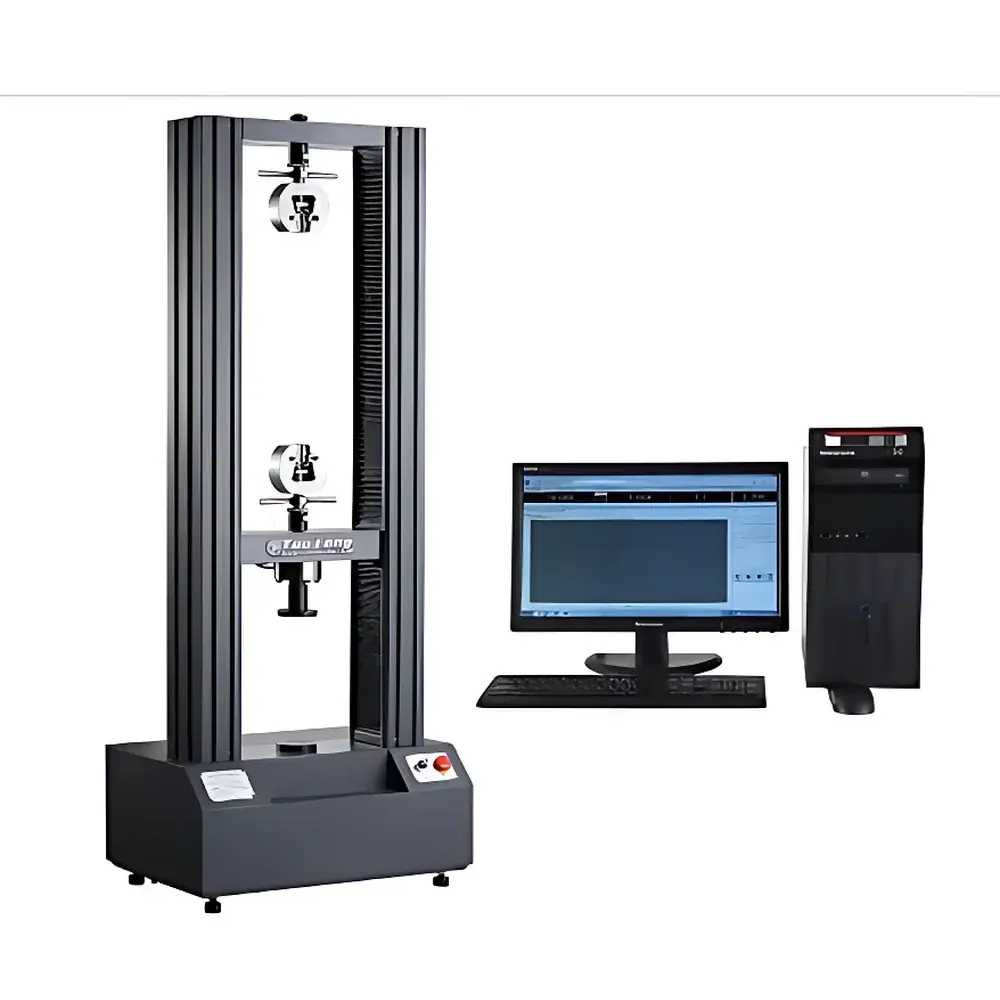
Tuofeng TFW-96 Dual-Column Computer-Controlled Universal Testing Machine for Seat Belt Tensile Testing
| Brand | Tuofeng |
|---|---|
| Origin | Shanghai, China |
| Manufacturer Type | OEM Manufacturer |
| Instrument Type | Electromechanical Universal Testing Machine |
| Model | TFW-96 |
| Force Capacity | 100 kN |
| Accuracy Class | 0.5 |
| Effective Force Range | 0.2–100% of Full Scale |
| Force Measurement Accuracy | ±0.005% of reading |
| Load Cell Resolution | 1 part in ±500,000 full-scale codes (single-range, no switching) |
| Drive System | Imported servo motor with precision worm-gear reducer |
| Lead Screw | High-precision preloaded ball screw |
| Test Width | 500 mm (customizable up to 600 mm) |
| Stroke | 800 mm (extendable) |
| Speed Range | 0.001–500 mm/min (infinitely variable, programmable) |
| Displacement Measurement | Optical encoder, accuracy ±0.005% of reading |
| Strain Measurement | Optional extensometer or large-deformation transducer, accuracy ±0.005% of reading |
| Safety Systems | Electronic limit switches, emergency stop button, overload protection (10% over capacity), dual-speed motorized crosshead control |
| Software | Windows-based, multi-language (English/Chinese), compliant with ASTM E4, ISO 7500-1, GB/T 16491–2008, JJG 475–2008, supports GLP audit trails and user-level access control |
Overview
The Tuofeng TFW-96 is a dual-column, electromechanical universal testing machine engineered for high-fidelity tensile evaluation of automotive safety restraint systems—including seat belts, webbing, buckles, retractors, and anchorage components—under standardized mechanical loading conditions. It operates on the principle of controlled displacement actuation via a high-resolution servo-driven ball-screw system, enabling precise application of axial force while simultaneously measuring load, displacement, and strain. Designed to meet the stringent repeatability and traceability requirements of Tier-1 automotive suppliers and certified test laboratories, the TFW-96 complies with ISO 6892-1 (metallic materials), ISO 13934-1 (textile tensile properties), FMVSS No. 209 and SAE J1531 (seat belt performance), and EN 13595 (protective clothing). Its rigid frame architecture, zero-backlash transmission, and thermally stable load cell ensure long-term measurement integrity across temperature fluctuations typical in production-floor environments.
Key Features
- Dual-column structural design with reinforced welded steel frame, delivering torsional rigidity >2.5 × 10⁶ N·m/rad and minimizing lateral deflection during high-load testing.
- 0.5-class accuracy per ISO 7500-1 and GB/T 16491–2008, verified by national metrology institutes; force resolution maintained at 1/500,000 FS across entire range without range-switching artifacts.
- Programmable speed control from 0.001 to 500 mm/min—enabling quasi-static creep tests (e.g., 1 hr hold at 75% UTS) and dynamic ramp-to-failure protocols per FMVSS 209 Annex A.
- Integrated electronic limit protection, hardware-based emergency stop circuitry, and software-enforced overload cutoff (10% above rated capacity) meeting IEC 61508 SIL 2 functional safety criteria.
- Motorized crosshead with independent fast/slow jog modes and auto-return function—reducing operator intervention and cycle time between sequential specimens.
- Modular fixture interface compatible with ISO 20810-compliant seat belt clamping jaws, pneumatic webbing grips, and rotary torque adapters for retractor lock testing.
Sample Compatibility & Compliance
The TFW-96 accommodates flat, woven, and molded polyamide/polyester seat belt assemblies (widths up to 60 mm), pretensioned anchor plates, and injection-molded plastic buckles. Standard configurations include wedge-action clamps with serrated tungsten-carbide faces and self-aligning spherical seats to eliminate bending moments during axial pull. All test methods adhere to regulatory frameworks including FMVSS 209 (U.S.), ECE R16 (EU), GB 14166 (China), and UN Regulation No. 16. The system supports full compliance documentation packages—including calibration certificates traceable to NIM (National Institute of Metrology, China) and uncertainty budgets per GUM (JCGM 100:2008)—required for ISO/IEC 17025 accreditation audits.
Software & Data Management
Tuofeng’s TensilePro v4.2 software runs natively on Windows 10/11 and provides role-based user authentication, electronic signature support, and 21 CFR Part 11–compliant audit trails for all test parameter changes, result exports, and calibration events. Real-time plotting includes synchronized force–displacement, stress–strain, and time–load overlays. Built-in calculation modules automatically derive breaking strength (kN), elongation at break (%), energy absorption (J), yield offset (0.2%), and modulus (MPa) per ASTM D638 or ISO 527. Raw data exports are available in CSV, XML, and PDF formats; batch reports include statistical summaries (mean, SD, CV%) across up to 99 specimens. Custom script modules allow integration with MES or LIMS platforms via TCP/IP or OPC UA.
Applications
- Tensile rupture testing of seat belt webbing under dry/wet/UV-aged conditions per SAE J2269.
- Dynamic load cycling of retractor mechanisms to assess locking reliability after 5,000+ cycles.
- Peel strength evaluation of stitched or ultrasonically bonded belt terminations.
- Compression testing of energy-absorbing pretensioner cartridges.
- Creep and stress relaxation analysis of nylon-6,6 webbing at elevated temperatures (60°C).
- Validation of weld integrity in steel anchor brackets using controlled displacement ramp-hold-ramp profiles.
FAQ
Does the TFW-96 support automated test sequence execution for multi-step seat belt qualification protocols?
Yes—via TensilePro’s “Test Template” module, users can define cascaded steps (e.g., preload → ramp to 5 kN → hold 60 s → ramp to failure) with conditional branching based on real-time force thresholds.
Can the system be integrated into an existing factory QA network with centralized data logging?
Yes—the machine supports Modbus TCP and Ethernet/IP communication protocols; raw channel data (load, displacement, time) streams at 1 kHz to external SCADA or historian systems.
Is third-party calibration validation supported for ISO/IEC 17025 laboratory accreditation?
Yes—Tuofeng supplies full calibration kits including traceable deadweight standards, verification templates, and uncertainty analysis worksheets aligned with ILAC P14:2019 requirements.
What is the warranty coverage and service response time for overseas customers?
Standard warranty: 24 months parts and labor; extended service contracts include remote diagnostics, annual on-site verification, and priority spare-part dispatch within 72 business hours from regional hubs in Singapore, Hamburg, and Detroit.
Related Products



