
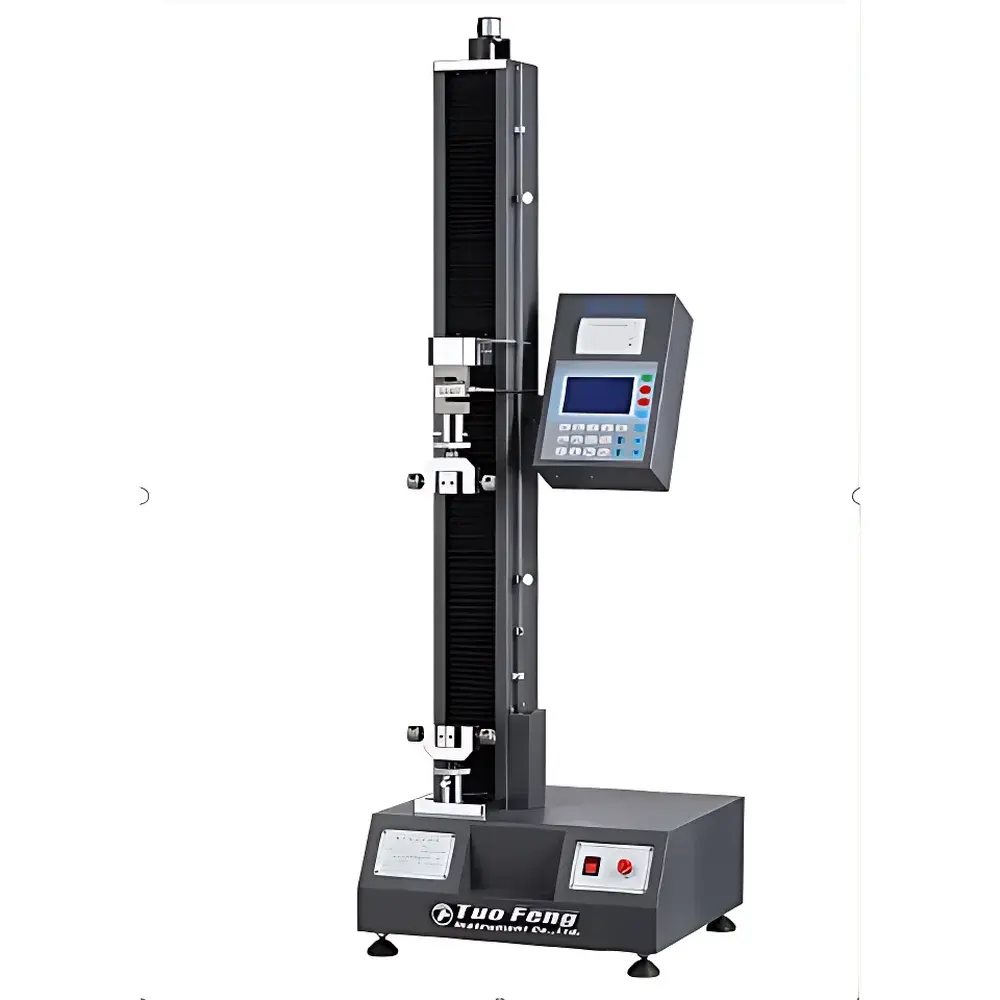
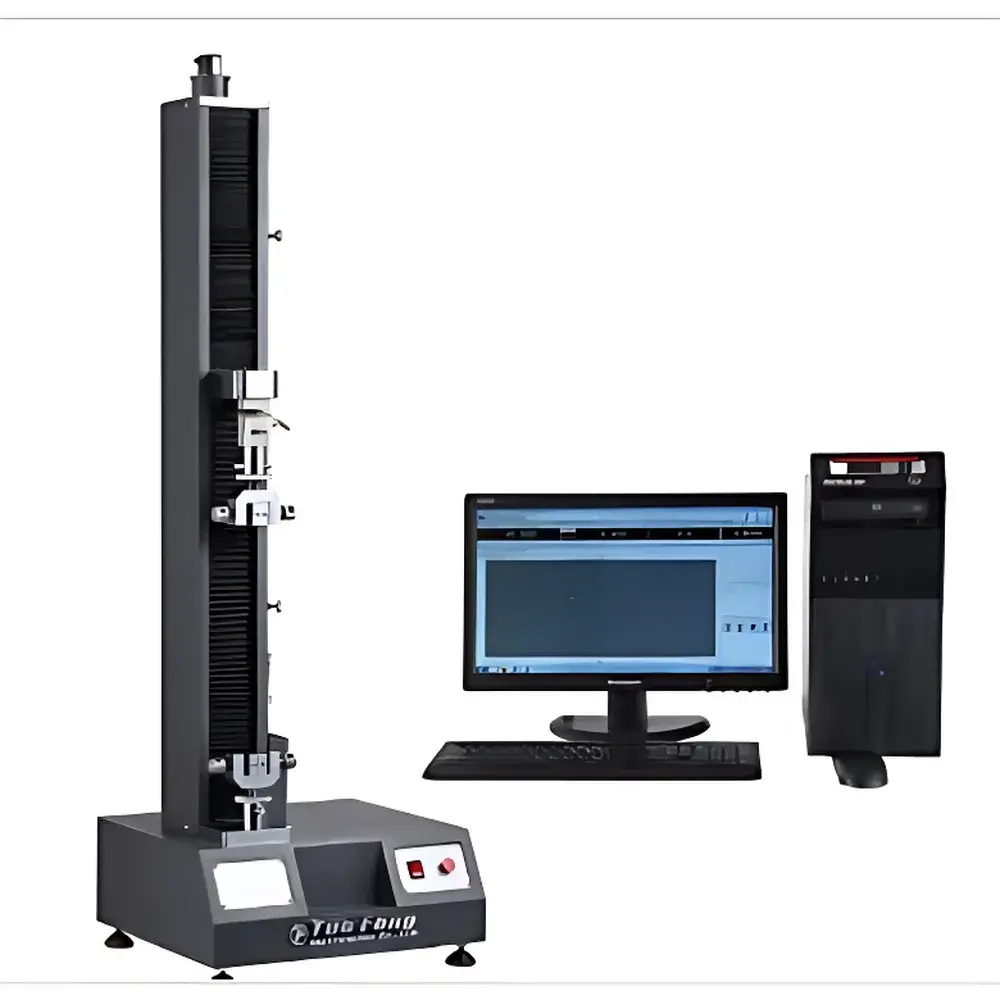
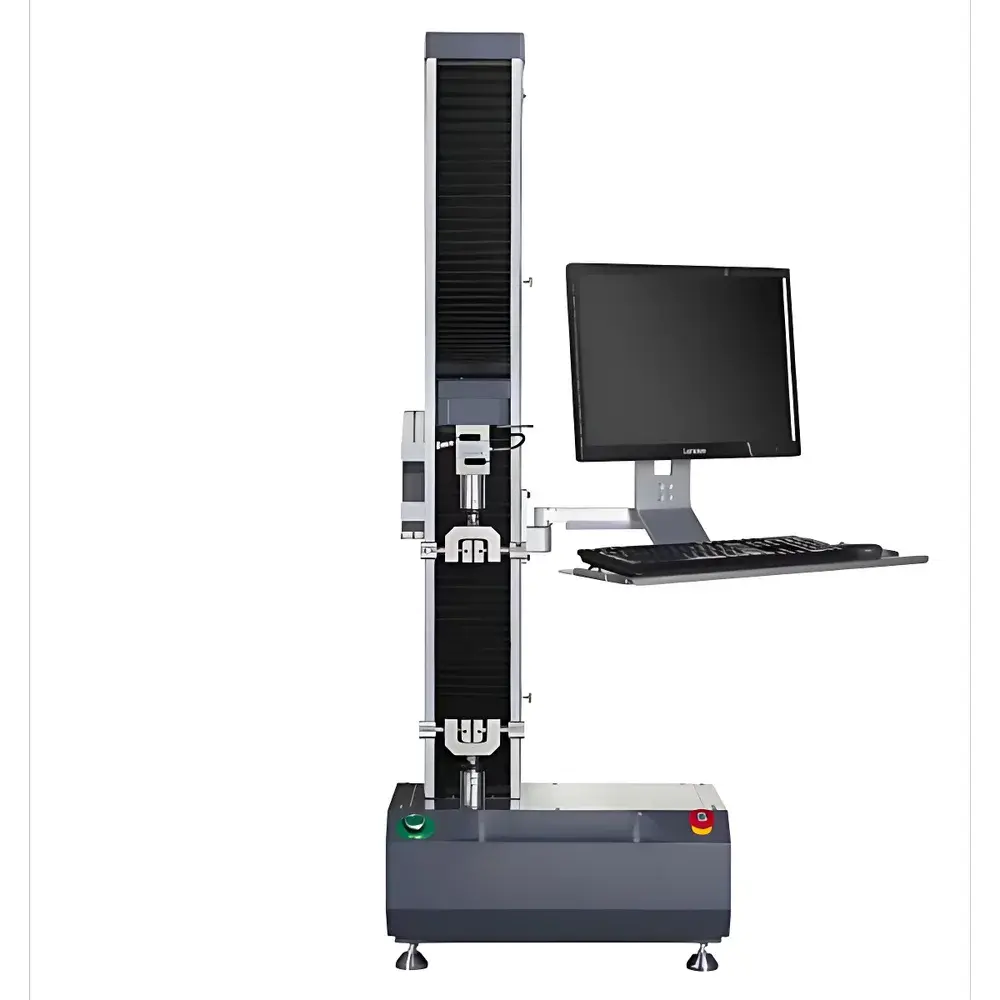
TOFENG TFL-34S Single-Column Electronic Tensile Testing Machine
| Brand | TOFENG |
|---|---|
| Origin | Shanghai, China |
| Manufacturer Type | Direct Manufacturer |
| Model | TFL-34S |
| Instrument Type | Electronic Tensile Testing Machine |
| Maximum Test Load | 5 kN |
| Force Measurement Range | 0.4%–100% of Full Scale (FS) |
| Force Accuracy | ±0.5% of reading |
| Crosshead Travel | 700 mm |
| Displacement Resolution | ±0.5% of reading |
Overview
The TOFENG TFL-34S is a precision-engineered single-column electronic tensile testing machine designed for routine mechanical property evaluation in quality control laboratories, R&D facilities, and production environments. It operates on the fundamental principle of uniaxial force application—applying controlled tensile, peel, tear, or flexural loads to specimens while continuously measuring load and displacement via high-fidelity load cells and optical encoder-based motion feedback. Its rigid yet compact frame architecture ensures minimal deflection under load, supporting high repeatability across repeated test cycles. The system complies with core mechanical testing standards including ISO 6892-1 (metallic materials), ASTM D638 (plastics), ASTM D882 (thin plastic sheeting), ASTM D903 (peel strength), ISO 1184 (paper and board), and GB/T 228.1 (Chinese national standard for metallic materials). Designed for deterministic measurement rather than qualitative assessment, it delivers traceable, audit-ready data essential for GLP-compliant workflows and supplier qualification programs.
Key Features
- Single-column modular chassis with reinforced aluminum alloy uprights and precision-ground steel crosshead rails—optimized for stability at low-to-moderate load ranges (up to 5 kN).
- High-resolution load cell calibrated to ISO 7500-1 Class 0.5 accuracy, offering full-scale resolution of 1/300,000 counts without internal range switching.
- Variable-speed servo-controlled drive system enabling continuous speed adjustment from 0.01 to 500 mm/min, supporting both quasi-static and dynamic loading profiles.
- Optical encoder-based displacement measurement with ±0.5% linearity compliance over the full 700 mm travel range; optional extensometer integration available for strain-critical applications (e.g., modulus determination).
- Dual-mode operation: manual jog control for specimen alignment and automated test sequencing via PC interface—reducing operator-induced variability.
- Integrated safety architecture including electronic limit switches, emergency stop circuitry, overload cutoff (>110% FS), and programmable soft limits within software.
Sample Compatibility & Compliance
The TFL-34S accommodates a broad spectrum of specimen geometries and material classes—including metallic wires and foils (diameters 0.1–3 mm), polymer films and elastomers (thickness ≤ 5 mm), textile yarns and nonwovens, paperboard laminates, adhesive tapes, and medical packaging substrates. Standard fixtures include wedge-action tensile grips, pneumatic peel fixtures, and 90°/180° peel jigs—all configurable for standardized grip spacing per ASTM D3330 or ISO 8510-2. All hardware and firmware are developed to support regulatory documentation requirements: test method traceability, raw data integrity (uneditable binary acquisition logs), and user-accessible audit trails compliant with FDA 21 CFR Part 11 principles when paired with validated software configurations. Calibration certificates conform to ISO/IEC 17025 guidelines and are issued with NIST-traceable reference standards.
Software & Data Management
The Windows-based control and analysis suite (compatible with Windows 10/11 x64) provides ISO 17025-aligned data handling protocols. It supports multiple test modes—including constant-rate-of-extension (CRE), constant-load ramping, creep hold, and cyclic loading—with real-time visualization of load vs. time, load vs. displacement, stress vs. strain, and extension vs. time curves. Units for force (N, kN, lbf), displacement (mm, in), and derived properties (MPa, psi, % elongation) are fully user-selectable and persist across sessions. Raw data exports as CSV or XML files include timestamps, environmental metadata (operator ID, sample ID, test date), and instrument configuration parameters. Reporting templates adhere to ISO 5893 formatting conventions and generate PDF outputs containing graphical overlays, statistical summaries (max/min/mean), and pass/fail flags against user-defined specification limits. Software updates are delivered through secure authenticated channels, with version history and change logs maintained for internal validation purposes.
Applications
This system serves critical functions across regulated and industrial sectors: tensile strength and yield point verification of copper wire used in automotive harnesses; peel adhesion quantification of pressure-sensitive labels per ASTM D3330; tear resistance evaluation of medical-grade Tyvek® packaging; elongation-at-break characterization of biodegradable PLA films; bond strength validation of soldered PCB terminations; and puncture resistance testing of food-grade laminated pouches. In academic settings, it supports undergraduate materials science labs requiring repeatable, low-cost mechanical property instruction. Its open API architecture also permits integration into automated test cells via TCP/IP or Modbus RTU protocols for Industry 4.0 deployment.
FAQ
What standards does the TFL-34S support out of the box?
It natively supports test method templates for ISO 6892-1, ASTM D638, ASTM D882, ASTM D903, ISO 1184, and GB/T 228.1. Custom method definitions can be created using the built-in script editor.
Is the system suitable for testing brittle materials like ceramics or thin glass?
While optimized for ductile and semi-crystalline polymers, metals, and composites, it can accommodate brittle specimens with appropriate fixture selection (e.g., low-inertia grips, reduced crosshead speed) and pre-test calibration verification.
Can I export raw data for third-party statistical analysis?
Yes—acquired force/displacement time-series data is saved in ASCII CSV format with millisecond-level timestamp resolution, fully compatible with MATLAB, Python (NumPy/Pandas), and Minitab.
Does the software meet FDA 21 CFR Part 11 requirements?
The base software includes electronic signature capability, audit trail logging, and role-based access control. Full Part 11 compliance requires site-specific validation documentation and IT infrastructure alignment (e.g., domain authentication, backup policies).
What maintenance intervals are recommended?
Load cell recalibration every 12 months or after 10,000 test cycles; optical encoder inspection every 6 months; mechanical lubrication of lead screws every 3 months under continuous operation.



