
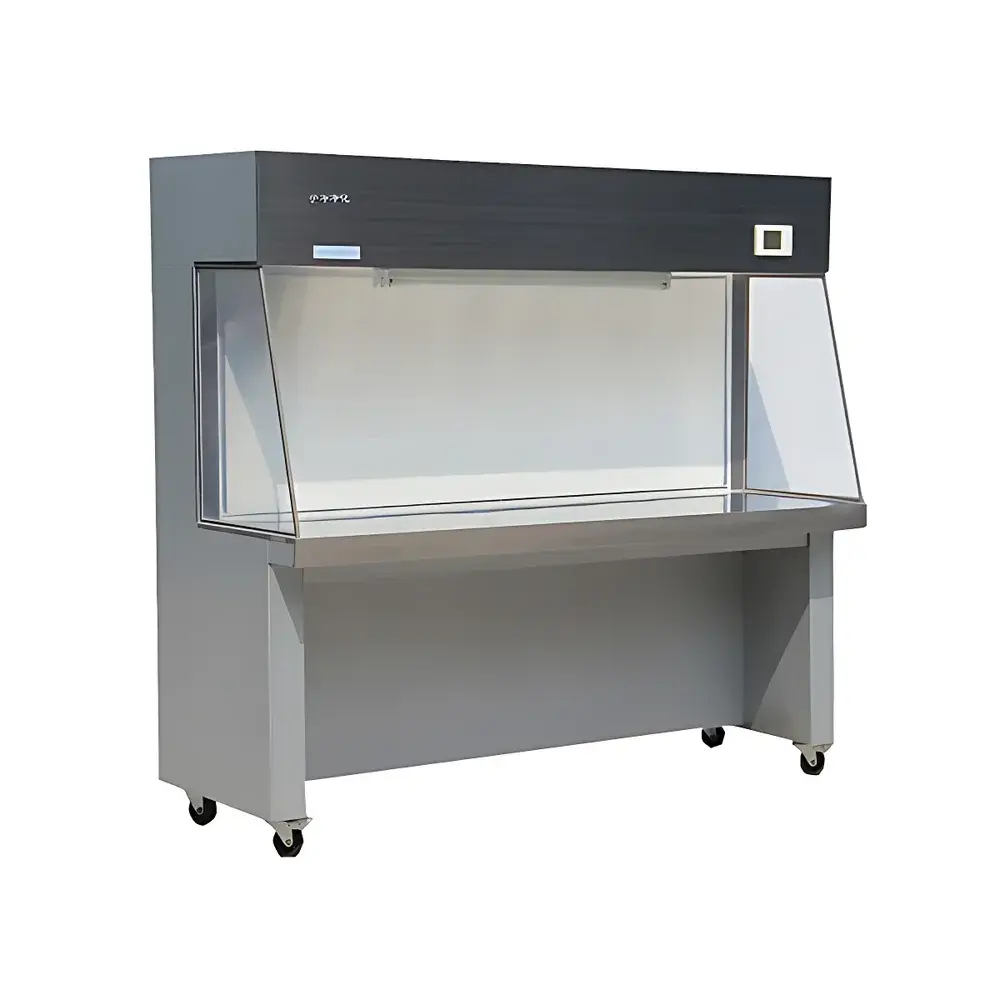
HJ SW-CJ-1Cu Dual-Operator Vertical Laminar Flow Clean Bench
| Brand | HJ Purification |
|---|---|
| Origin | Shanghai, China |
| Manufacturer Type | Direct Manufacturer |
| Equipment Category | Domestic |
| Model | SW-CJ-1Cu |
| Instrument Type | Vertical Laminar Flow Clean Bench |
| Cleanliness Class | ISO Class 5 (100 @ ≥0.5 μm, Fed. Std. 209E) |
| Noise Level | ≤62 dB(A) |
| Operator Capacity | 2 persons |
| Airflow Pattern | Vertical Downflow |
| Pre-filter | Yes |
| HEPA Filter | 1675 × 600 × 38 mm (1 unit) |
| Average Air Velocity | 0.25–0.45 m/s (dual-speed control) |
| Microbial Recovery | ≤0.5 CFU/plate·hour (90 mm Petri dish) |
| Vibration Amplitude | ≤5 μm (peak-to-peak, XYZ axes) |
| Illumination | ≥300 lx |
| Power Supply | AC 220 V / 50 Hz |
| Rated Power | 800 W |
| Net Weight | 150 kg |
| Work Area Dimensions | 1785 × 510 × 600 mm (W×D×H) |
| Overall Dimensions | 1815 × 740 × 1465 mm (W×D×H) |
| Lighting & UV Lamp | 30 W fluorescent × 1, 30 W UV-C × 1 |
| Control Interface | Digital LCD with three-speed fan control (low/medium/high) |
Overview
The HJ SW-CJ-1Cu Dual-Operator Vertical Laminar Flow Clean Bench is an ISO Class 5-certified laboratory containment system engineered for routine aseptic procedures requiring particulate-free working environments. It operates on the principle of vertical laminar airflow—filtered air is drawn through a pre-filter and then forced downward uniformly across the work surface via a high-efficiency particulate air (HEPA) filter (rated at ≥99.99% efficiency for particles ≥0.3 μm), minimizing turbulence and preventing cross-contamination between operator and sample. Designed for dual-user operation in single-face configuration, it supports applications in microbiology, cell culture preparation, pharmaceutical quality control, and diagnostic reagent handling where ambient particulate levels must be reduced to ≤3,520 particles/m³ (≥0.5 μm). Its structural integrity, electromagnetic compatibility, and electrical safety compliance align with IEC 61010-1 and GB 4793.1 standards for laboratory equipment.
Key Features
- Vertical downflow architecture ensures consistent unidirectional airflow across the full work surface (1785 × 510 × 600 mm), eliminating eddy formation and maintaining ISO Class 5 conditions during active use.
- Robust enclosure constructed from pre-painted steel panels with seamless joints; work surface fabricated from brushed 304 stainless steel for corrosion resistance, non-porosity, and ease of decontamination using ethanol, isopropanol, or sodium hypochlorite solutions.
- Dual-lamp system with interlocked fluorescent (30 W) and UV-C (30 W, 254 nm) lamps: UV emission is automatically disabled when the sash is open or during illumination mode, satisfying IEC 62471 photobiological safety requirements.
- Digital LCD controller with three discrete fan speed settings (low/medium/high), enabling precise adjustment of face velocity (0.25–0.45 m/s) to match procedural requirements while optimizing filter service life and energy consumption.
- Integrated dual-stage filtration: a washable aluminum pre-filter captures coarse particulates (>5 μm), extending HEPA filter operational lifespan by up to 40% compared to single-stage configurations.
- Acoustically damped blower assembly maintains noise output ≤62 dB(A) at 1 m distance—within recommended thresholds for ISO 14644-3-compliant cleanroom support zones.
Sample Compatibility & Compliance
The SW-CJ-1Cu accommodates standard laboratory vessels including Petri dishes (up to 150 mm diameter), conical flasks (≤1 L), centrifuge tubes, and multi-well plates without obstruction. Its vibration amplitude (≤5 μm peak-to-peak in X/Y/Z axes) meets ASTM E2500-13 criteria for equipment used in non-GMP but GLP-aligned environments. While not classified as a biosafety cabinet (BSC), it complies with Chinese national standard YY 0569–2011 for clean bench performance testing and satisfies baseline requirements for ISO 14644-1:2015 Class 5 verification protocols. UV lamp intensity is validated per ISO 15858 for germicidal efficacy against Bacillus subtilis spores.
Software & Data Management
This clean bench operates as a standalone hardware platform with no embedded firmware-based data logging. However, its digital control interface supports manual recording of operational parameters—including fan speed selection, runtime, and lamp activation status—for inclusion in laboratory logbooks. When deployed within FDA-regulated facilities, users may integrate usage timestamps and maintenance records into electronic lab notebooks (ELNs) compliant with 21 CFR Part 11 via external audit trails. Routine filter integrity testing (e.g., DOP/PAO scanning) and annual certification per ISO 14644-3 are recommended and fully documentable using third-party calibration services.
Applications
- Aseptic transfer of microbial cultures and fungal isolates in teaching and research laboratories.
- Preparation of media plates, serial dilutions, and inoculation of diagnostic specimens under low-bioburden conditions.
- Assembly and handling of sterile components in medical device manufacturing support areas.
- Non-hazardous reagent dispensing and buffer preparation for HPLC, ELISA, and PCR workflows.
- Support function for ISO Class 7 or Class 8 cleanrooms where localized particle control is required without full-room pressurization.
FAQ
Is the SW-CJ-1Cu certified to ISO 14644-1 Class 5?
Yes—the unit achieves and sustains ≤3,520 particles/m³ (≥0.5 μm) under steady-state operation, verified per ISO 14644-3 test methods.
Can this unit be used for handling pathogenic agents?
No. It provides personnel and product protection only—not environmental protection. Biosafety Level 2+ work requires a certified Class II BSC.
What is the recommended HEPA filter replacement interval?
Under typical usage (8 hrs/day, 5 days/week), replace every 18–24 months—or sooner if differential pressure exceeds 250 Pa across the filter bank.
Does the unit include validation documentation?
Factory-assembled units ship with a Certificate of Conformance and initial airflow uniformity test report. IQ/OQ documentation templates are available upon request.
Is UV lamp intensity monitored or adjustable?
UV output is fixed and non-dimmable; intensity decays predictably over time—annual radiometric verification is advised per ISO/TR 15858.



