
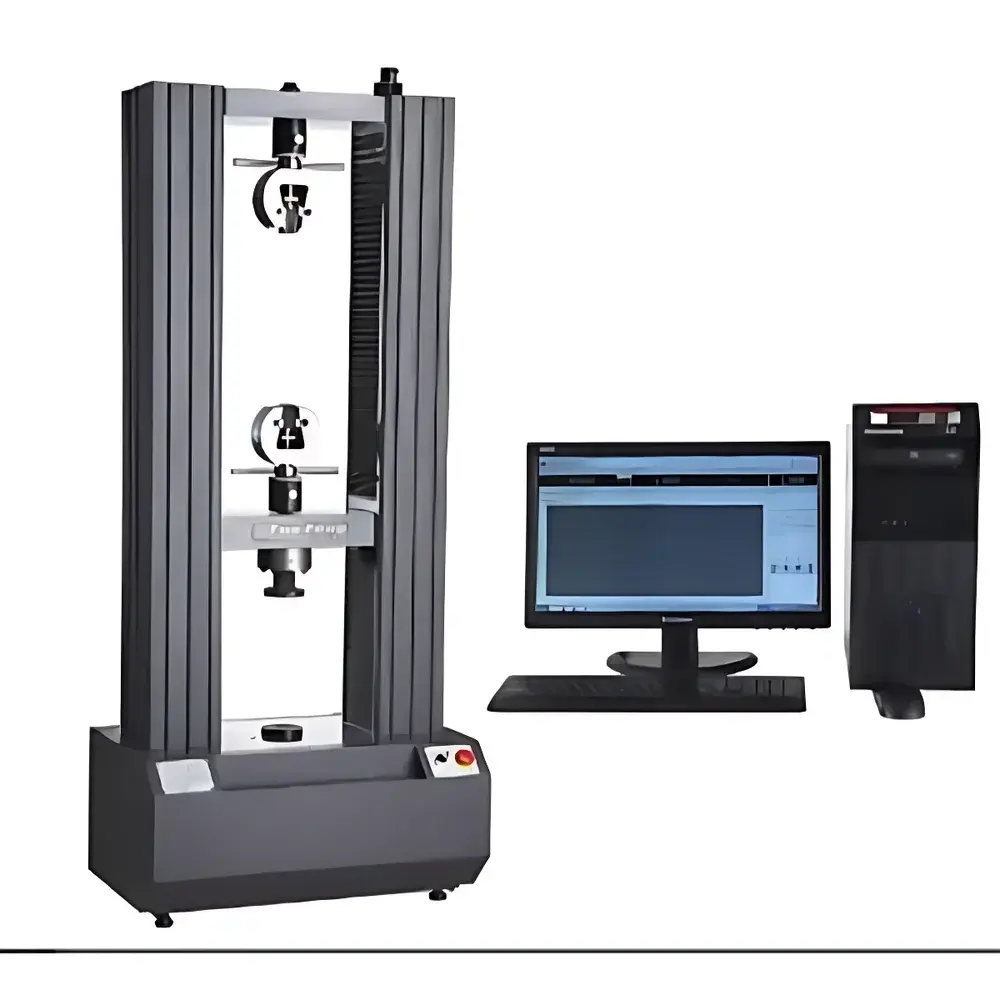
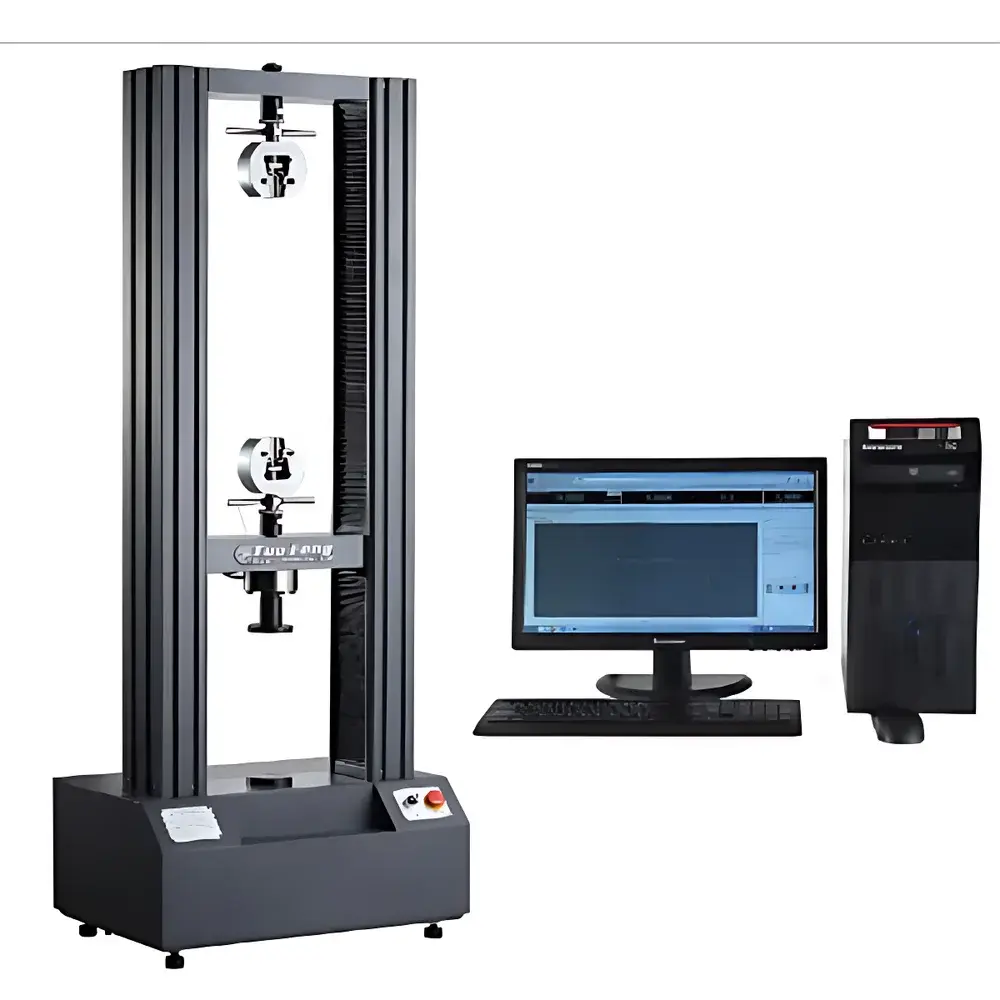
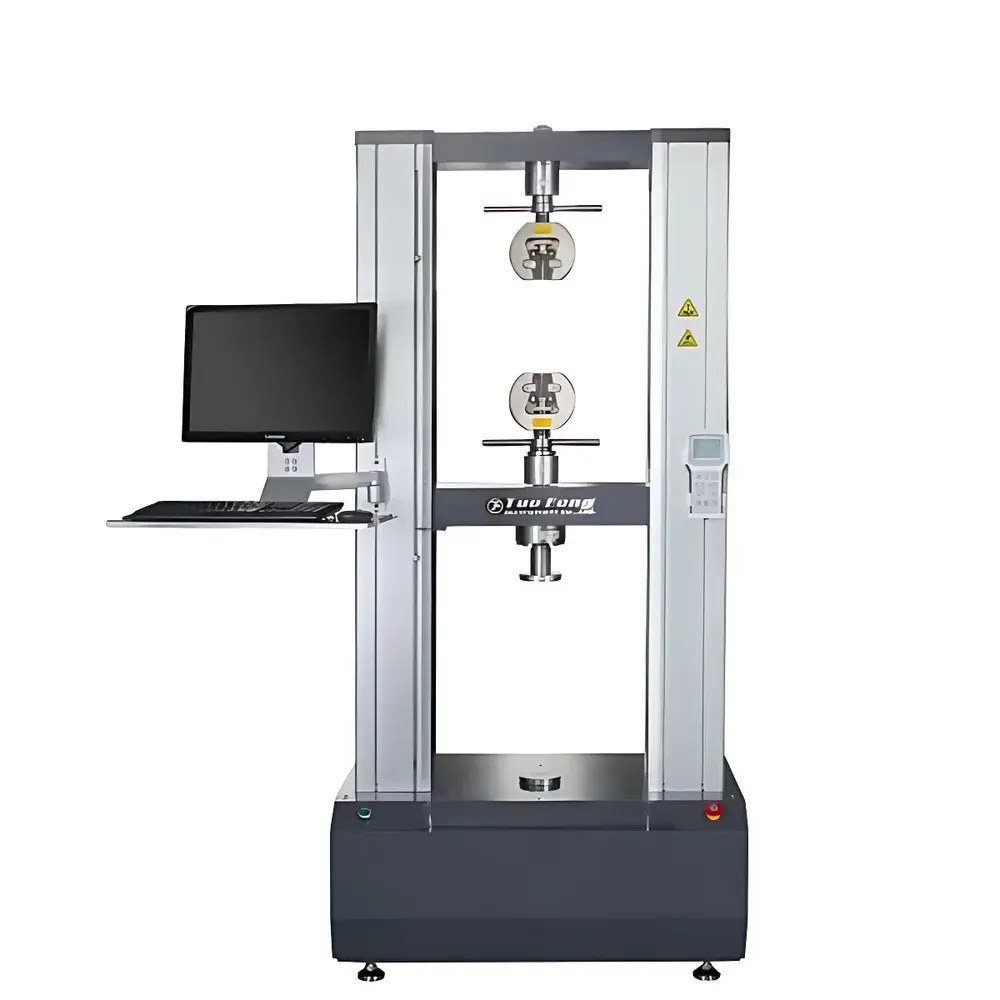
Tuofeng TFW-213 Microcomputer-Controlled Electronic Universal Testing Machine
| Brand | Tuofeng |
|---|---|
| Origin | Shanghai, China |
| Manufacturer Type | Direct Manufacturer |
| Instrument Type | Electromechanical Universal Testing Machine |
| Model | TFW-213 |
| Max Test Load | 20 kN |
| Accuracy Class | 0.5 |
| Effective Force Range | 0.2–100% of Full Scale |
| Force Measurement Accuracy | ±0.005% of Reading |
| Force Resolution | 1/500,000 Full Scale (Fixed, No Range Switching) |
| Drive System | Imported Servo Motor + Worm Gear Reducer |
| Lead Screw | High-Precision Ball Screw |
| Effective Test Width | 600 mm (Customizable) |
| Tensile Stroke | 800 mm (Extendable) |
| Speed Range | 0.001–500 mm/min (Infinitely Variable) |
| Displacement Measurement | Optical Encoder |
| Displacement Accuracy | ±0.005% of Reading |
| Strain Measurement | Optional Extensometer or Large-Deformation Gauge |
| Safety Protection | Electronic Limit Switches, Emergency Stop, Overload Cut-off (10% above capacity) |
| Software | Multi-language (English, Simplified/Traditional Chinese), ASTM/ISO/GB/JIS/DIN/BS Compliant Data Acquisition & Analysis |
Overview
The Tuofeng TFW-213 Microcomputer-Controlled Electronic Universal Testing Machine is a high-precision electromechanical system engineered for static mechanical property evaluation of metallic, polymeric, composite, and elastomeric materials—including optical fiber cable jacketing, buffer tubes, strength members (e.g., aramid yarn, steel wire), and dielectric sheaths. It operates on the principle of controlled axial force application via servo-driven ball-screw actuation, enabling accurate measurement of tensile, compressive, flexural, shear, tear, peel, and puncture responses under standardized loading conditions. Designed in strict compliance with GB/T 16491–2008 (Chinese national standard for electronic universal testing machines) and JJG 475–2008 (verification regulation), the TFW-213 meets ISO 7500-1:2018 (class 0.5 accuracy), ASTM E4, ASTM D638, ASTM D790, IEC 60794-1-2 (optical fiber cable mechanical testing), and EN 10002-1 requirements. Its modular architecture supports traceable calibration, GLP/GMP-aligned audit trails, and full integration into laboratory quality management systems.
Key Features
- 0.5-class force accuracy with ±0.005% reading uncertainty across the full 20 kN range—validated per ISO 7500-1 and certified with NIST-traceable load cells.
- High-resolution displacement sensing (optical encoder, ±0.005% accuracy) and optional strain measurement via clip-on extensometers (ASTM E83-compliant) or non-contact video extensometry for low-modulus cable materials.
- Dual-speed motorized crosshead control (fast return + fine positioning) ensures rapid setup and precise strain-rate control down to 0.001 mm/min—critical for creep and stress-relaxation protocols on polymer-based cable components.
- Rigid, low-deflection frame with 600 mm effective test width accommodates multi-fiber ribbon cables, armored cables, and bundled cable assemblies without lateral constraint artifacts.
- Comprehensive overload protection suite: electronic upper/lower limit switches, hardware emergency stop, and automatic cut-off at 110% of rated capacity—ensuring operator safety and equipment integrity during high-force failure events.
- Modular fixture interface compatible with standardized grips (pneumatic, wedge, vise-type), custom mandrels for bend testing, and specialized fixtures for fiber optic cable tensile proof testing per IEC 60794-1-2-E1.
Sample Compatibility & Compliance
The TFW-213 accommodates specimens ranging from sub-millimeter-diameter optical fibers (with micro-gripping adapters) to 30 mm-diameter armored cables. It supports standardized test geometries defined in IEC 60794-1-2 (tensile, crush, impact, torsion), ITU-T G.652/G.657 (fiber mechanical performance), UL 1581 (wire and cable flammability-related mechanical prep), and MIL-DTL-17 (military coaxial cable qualification). All test methods are fully programmable and repeatable, with built-in validation routines for force zero drift, crosshead alignment, and grip slippage detection. The system complies with FDA 21 CFR Part 11 requirements for electronic records and signatures when configured with audit-log-enabled software modules—making it suitable for regulated QC environments in cable manufacturing and third-party certification labs.
Software & Data Management
The embedded Windows-based testing software provides ISO/IEC 17025-aligned data acquisition and reporting. Users can define multi-step test profiles (e.g., pre-load → ramp → hold → unload) and select from eight real-time display modes: load–time, load–displacement, stress–strain, displacement–time, and dual-curve overlays. Units for force (N, kN, lbf), displacement (mm, in), and strain (% or mm/mm) are freely convertible. Raw data is saved in CSV and XML formats; reports include statistical summaries (mean, SD, CV%), pass/fail flags against user-defined limits, and graphical overlays for batch comparison. All test sessions generate immutable audit logs containing operator ID, timestamp, calibration status, environmental metadata (optional), and digital signatures—fully supporting GLP, GMP, and ISO 9001 documentation requirements.
Applications
- Tensile characterization of optical fiber coatings (acrylate, silicone), buffer tubes (PBT, LSZH), and strength members (aramid, FRP, stainless steel wire) per IEC 60794-1-2-E1.
- Peel strength testing of cable jacket–armor bonding interfaces using modified T-peel or 90° peel fixtures.
- Compression resistance evaluation of loose-tube and ribbon cables under simulated conduit loading (ASTM D5414).
- Creep and stress relaxation analysis of thermoplastic cable jackets at elevated temperatures (via environmental chamber integration).
- Quality conformance verification for ISO/IEC 17025-accredited cable testing laboratories performing type approval, incoming inspection, and lot release testing.
FAQ
Does the TFW-213 support automated test sequence execution for unattended operation?
Yes—the software enables batch-mode scheduling with auto-start triggers, sequential specimen identification (via barcode scanner integration), and conditional logic for pass/fail decision routing.
Can the system be calibrated to meet ISO/IEC 17025 accreditation requirements?
Yes—calibration certificates include uncertainty budgets, traceability to national standards (e.g., NIM, NIST), and full documentation of as-found/as-left data per ISO/IEC 17025 Clause 6.5.
Is remote software support and firmware updates available post-purchase?
Yes—lifetime remote diagnostics, version-controlled firmware upgrades, and secure cloud-based backup of test method libraries are included with no additional licensing fees.
What is the lead time for custom fixture design for non-standard cable geometries?
Standard custom fixtures (e.g., helical clamps, multi-fiber tensioning jigs) are delivered within 15 working days upon receipt of dimensional specifications and material property data.
Does the machine comply with electromagnetic compatibility (EMC) and electrical safety directives for export to EU markets?
Yes—the TFW-213 carries CE marking per 2014/30/EU (EMC Directive) and 2014/35/EU (Low Voltage Directive), with full technical files available for Notified Body review.



