
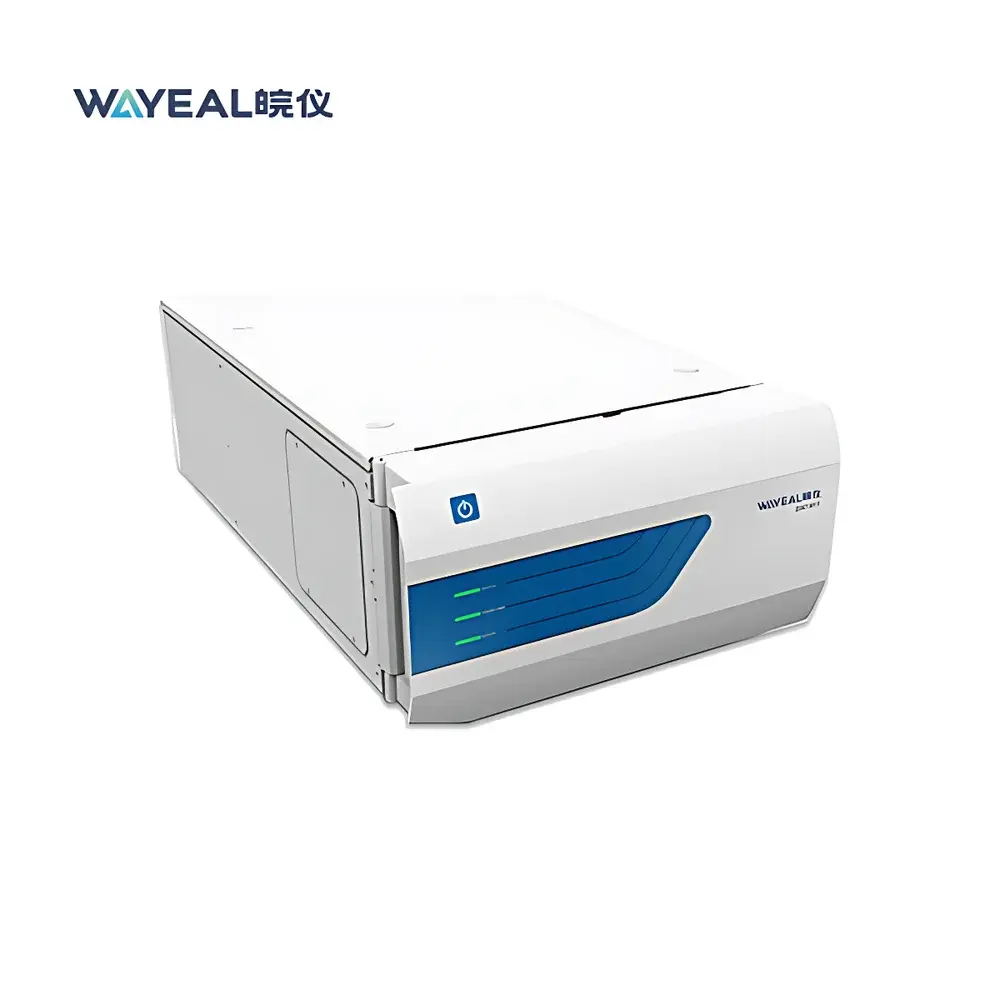
WAYEAL UV-Vis Detector for HPLC Systems
| Brand | WAYEAL |
|---|---|
| Origin | Anhui, China |
| Manufacturer Type | Direct Manufacturer |
| Product Category | Domestic (China-made) |
| Model | UV Detector |
| Instrument Type | Ultraviolet-Visible (UV-Vis) Chromatographic Detector |
| Wavelength Range | 188–900 nm |
| Light Source | Deuterium Lamp (Dual-Lamp Holder: D₂ + Tungsten) |
| Wavelength Accuracy/Reproducibility | ≤ ±0.1 nm |
| Flow Cell Design | Low-Dead-Volume Optimized Optical Flow Cell with Precision-Polished Light Path |
| Detection Modes | Dual-Wavelength Simultaneous Detection, Full-Spectrum Scanning (188–900 nm), Auto Spectral Calibration |
| Leak Detection | Integrated Optical Leak Sensor with Audible/Visual Alarm |
| Compliance | Designed to Support GLP/GMP Data Integrity Requirements (Audit Trail, User Access Control, Electronic Signature Ready) |
Overview
The WAYEAL UV-Vis Detector is a high-performance, dual-lamp ultraviolet-visible absorbance detector engineered for integration into analytical and preparative high-performance liquid chromatography (HPLC) systems. Operating on the principle of Beer–Lambert absorption spectroscopy, it quantifies analyte concentration by measuring attenuation of light intensity at specific wavelengths as eluent passes through a precision-machined flow cell. Its optical architecture incorporates a Czerny–Turner monochromator with holographic grating, enabling continuous wavelength selection across an extended spectral range from 188 nm to 900 nm — covering deep UV (e.g., nucleic acid detection at 260 nm), near-UV (aromatics at 254 nm), and visible-region applications (e.g., dye analysis at 450–650 nm). The detector supports both isocratic and gradient separations and is compatible with standard 1/16″ stainless steel or PEEK capillary interconnections per ISO 8573-1 and ASTM D4294 specifications.
Key Features
- Dual-lamp turret design accommodating deuterium (D₂) and tungsten-halogen (W) lamps, enabling seamless switching without manual lamp replacement or realignment
- Optimized low-dead-volume flow cell (< 1.2 µL internal volume) with fused-silica optical windows and chemically polished quartz light path — minimizing band broadening and preserving chromatographic resolution
- Simultaneous dual-wavelength monitoring (e.g., 220 nm + 254 nm) for ratio-based peak identification and baseline correction in complex matrices
- Full-spectrum scanning mode (188–900 nm) with 1 nm step resolution; spectral acquisition time < 2.5 s per scan
- Onboard spectral calibration algorithm leveraging characteristic emission lines of D₂ (656.1 nm, 486.0 nm) and W (589.3 nm Na-D line reference) — eliminating need for external calibration standards
- Integrated leak detection system with capacitive fluid sensor positioned beneath the flow cell housing; triggers immediate shutdown signal and visual/audible alert upon trace solvent contact
- Robust mechanical architecture compliant with IEC 61000-6-2 (immunity) and IEC 61000-6-3 (emission) for stable operation in shared laboratory environments
Sample Compatibility & Compliance
The detector accommodates standard HPLC mobile phases including aqueous buffers (pH 1.5–10.0), acetonitrile, methanol, THF, and isopropanol — with flow cell wetted materials comprising sapphire, fused silica, and 316L stainless steel. It meets essential requirements for regulated environments: audit trail logging (user actions, method changes, calibration events), role-based access control (administrator/operator modes), and electronic signature readiness per FDA 21 CFR Part 11 Annex 11 guidelines. All firmware and calibration records are timestamped and non-erasable. Device documentation includes full ISO/IEC 17025-aligned validation support files (IQ/OQ/PQ templates) and conforms to ASTM E2500-13 for analytical instrument qualification.
Software & Data Management
Controlled via WAYEAL ChromaLink™ PC software (Windows 10/11, 64-bit), the detector supports method-driven acquisition, real-time spectral overlay, peak purity assessment (using spectral correlation algorithms), and export of raw absorbance data in ASCII, CSV, and .CDF (NetCDF) formats. Software modules include automatic baseline drift correction, peak deconvolution for co-eluting species, and compliance reporting tools for GLP audits. Data integrity safeguards include write-once storage options, cryptographic hash verification of archived runs, and synchronized NTP time stamping across networked instruments.
Applications
- Pharmaceutical QC/QA: Assay of active pharmaceutical ingredients (APIs) per USP <621> and EP 2.2.46; degradation product profiling under ICH Q1A–Q5C stress conditions
- Biopharmaceutical analysis: Quantification of monoclonal antibodies (mAbs) and fragments using 280 nm A280 extinction coefficient; excipient monitoring in formulation buffers
- Environmental testing: PAHs, nitrosamines, and pesticide residues per EPA Method 8330B and ISO 17993
- Food & beverage: Preservative (e.g., benzoic acid, sorbic acid) and colorant (e.g., tartrazine, sunset yellow) quantification per AOAC 992.15 and ISO 14501
- Academic research: Reaction monitoring in flow chemistry setups; kinetic studies requiring millisecond-scale spectral capture
FAQ
What wavelength calibration standards are required?
No external standards are needed. The detector performs autonomous spectral calibration using built-in lamp emission lines and a physics-based grating dispersion model.
Is the flow cell compatible with UHPLC pressures up to 1000 bar?
The standard flow cell is rated to 600 bar; optional high-pressure flow cells (rated to 1000 bar) are available with titanium body construction and zero-dead-volume fittings.
Can this detector be integrated into third-party HPLC systems (e.g., Waters, Agilent, Shimadzu)?
Yes — via analog voltage output (0–1 V, 0–5 V, or 0–10 V), RS-232/485 serial interface, or Ethernet (TCP/IP) with vendor-neutral ASCII command protocol.
Does the software support 21 CFR Part 11 compliance out-of-the-box?
ChromaLink™ v3.2+ includes configurable electronic signature workflows, biometric-ready login modules, and immutable audit logs — fully deployable in validated GxP environments.
What maintenance intervals are recommended for the deuterium lamp?
Typical D₂ lamp lifetime is ≥ 2000 hours under normal use; software tracks cumulative lamp-on time and alerts users 100 hours prior to end-of-life threshold.
Related Products





