
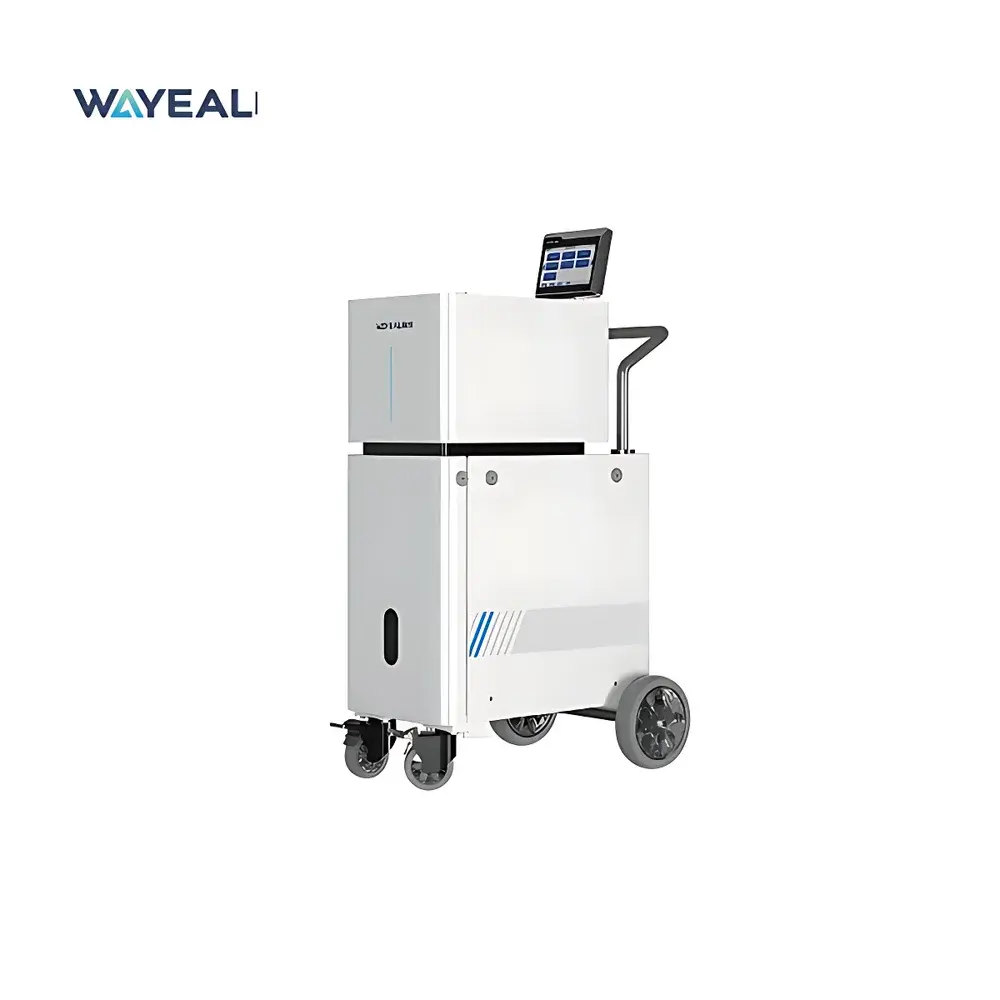
WAYEAL SFJ-16C/D Helium Mass Spectrometer Leak Detector
| Brand | WAYEAL |
|---|---|
| Origin | Anhui, China |
| Manufacturer Type | Original Equipment Manufacturer (OEM) |
| Country of Manufacture | China |
| Model | SFJ-16C / SFJ-16D |
| Base Pump | Rotary Vane Vacuum Pump (SFJ-16C) / Scroll Vacuum Pump (SFJ-16D) |
| Minimum Detectable Leak Rate (Vacuum Mode) | 5.0 × 10⁻¹³ Pa·m³/s |
| Minimum Detectable Leak Rate (Sniffer Mode) | 2.5 × 10⁻⁹ Pa·m³/s |
| Maximum Allowable Test Pressure | 1800 Pa |
| Human-Machine Interface | 7-inch Color TFT LCD Touchscreen |
| Leak Port Connection | DN25 KF |
| Dimensions (W×D×H) | 475 × 714 × 1168 mm |
| Power Supply | AC 220 V (±10%), 50/60 Hz |
| Response Time | <1 s |
| Pump-Down/Startup Time | <95 s |
| Detectable Masses | m/z = 2 (H₂), 3 (³He), 4 (⁴He) |
| Ion Source | Dual Filament, Yttria-Coated Iridium, Auto-Switching |
| I/O Interfaces | RS-232, RS-485, LAN, MES Integration Ready |
| Operating Temperature | 0–40 °C |
| Display Languages | English & Chinese |
| Leak Rate Visualization | Numeric Value, Bar Graph, Real-Time Trend Curve |
| Compliance | Designed for ISO 10110-7, ASTM E1003, and JIS Z 2301 aligned workflows |
Overview
The WAYEAL SFJ-16C/D is a portable helium mass spectrometer leak detector engineered for high-sensitivity, real-time vacuum integrity verification across mission-critical industrial environments. It operates on the principle of magnetic sector mass spectrometry, selectively ionizing helium atoms (and optionally hydrogen or helium-3 isotopes) introduced into the detection chamber via differential pumping stages. The instrument employs quadrupole mass filtering combined with electron impact ionization to resolve and quantify helium ions at mass-to-charge ratios of 2, 3, and 4 — enabling unambiguous discrimination between background hydrogen interference and true helium tracer signals. Its dual-pump architecture (rotary vane for SFJ-16C; oil-free scroll for SFJ-16D) ensures rapid system evacuation while maintaining ultra-high base vacuum stability (<1 × 10⁻⁶ Pa), essential for achieving sub-10⁻¹³ Pa·m³/s detection limits in vacuum-mode testing. Designed for integration into production line QA/QC protocols, cleanroom-compatible assembly validation, and field-deployable maintenance diagnostics, the SFJ-16C/D meets the physical robustness and metrological traceability requirements of semiconductor fab tool certification, lithium-ion battery cell sealing verification, and medical device hermeticity testing.
Key Features
- Portable trolley-mounted chassis with ergonomic handle and locking casters for stable operation across factory floors, cleanrooms, and outdoor service sites
- Dual-mode operation: high-sensitivity vacuum mode (down to 5.0 × 10⁻¹³ Pa·m³/s) and responsive sniffer mode (2.5 × 10⁻⁹ Pa·m³/s) for localized leak localization
- Auto-switching dual filament ion source with yttria-coated iridium emitters — optimized for extended lifetime (>8,000 h) and consistent ion yield under variable gas loads
- Integrated 7-inch capacitive touchscreen HMI supporting multi-language UI (English/Chinese), real-time leak rate trend plotting, and intuitive method navigation
- Intelligent ADC-driven signal processing with adaptive gain control, reducing false positives during transient pressure events or ambient helium fluctuations
- Full digital I/O suite including RS-232, RS-485, and Ethernet (LAN) ports — compatible with SCADA systems, MES platforms (e.g., Siemens Opcenter, Rockwell FactoryTalk), and automated test sequencers
- Onboard fault logging with timestamped event history, audible/visual alarms, and remote status monitoring via optional Wi-Fi module
Sample Compatibility & Compliance
The SFJ-16C/D supports standardized leak testing methodologies per ASTM E1003 (Standard Practice for Leak Detection Using the Mass Spectrometer Leak Detector), ISO 10110-7 (Optics and photonics — Preparation of drawings for optical elements and systems — Part 7: Surface imperfection tolerances), and JIS Z 2301 (Leak testing — Vocabulary and general principles). Its DN25 KF leak port accommodates standard vacuum flanges used in semiconductor process chambers, vacuum insulation panels (VIPs), and high-voltage GIS enclosures. The instrument’s helium-specific detection channel eliminates cross-sensitivity to nitrogen, oxygen, or hydrocarbon vapors common in HVAC, refrigeration, and power transformer applications. All firmware and calibration data are stored in non-volatile memory with write-protection — supporting GLP/GMP audit trails when operated under controlled document management systems.
Software & Data Management
The embedded operating system features deterministic real-time scheduling for sub-second response latency and synchronized data acquisition across analog and digital channels. Leak rate values are logged at user-configurable intervals (10 ms to 60 s) and exported in CSV or XML format via USB or network transfer. Optional PC-based software provides advanced post-processing: spectral baseline correction, multi-point calibration curve fitting (per ISO 15848-2), and compliance reporting templates aligned with FDA 21 CFR Part 11 electronic record requirements. Audit logs record all parameter changes, calibration events, and user logins — with SHA-256 hashing for data integrity verification.
Applications
- Semiconductor: Wafer handling chamber integrity, EUV lithography vacuum subsystem verification, and MEMS package hermeticity screening
- Energy Storage: Sealing validation of prismatic and cylindrical Li-ion battery cells prior to electrolyte filling
- Photovoltaics: Vacuum integrity testing of PVD sputtering chambers and encapsulation laminators
- Medical Devices: Hermeticity confirmation of implantable pacemaker housings, surgical laser modules, and diagnostic imaging detectors
- Power Transmission: SF₆ gas containment verification in high-voltage circuit breakers and GIS substations
- Research & Development: Ultra-high vacuum system commissioning, cryogenic component leak mapping, and thin-film deposition chamber qualification
FAQ
What mass numbers does the SFJ-16C/D detect, and why are multiple masses supported?
The instrument detects m/z = 2 (H₂), 3 (³He), and 4 (⁴He). Supporting hydrogen enables cost-effective preliminary screening where helium supply is constrained; ³He detection allows differentiation from atmospheric ⁴He background in ultra-low-leak scenarios.
Is the SFJ-16C/D compliant with FDA 21 CFR Part 11 for electronic records?
While the base unit provides secure audit logging and user authentication, full Part 11 compliance requires configuration within a validated IT environment — including electronic signatures, role-based access control, and periodic backup validation per organizational SOPs.
Can the instrument be integrated into an automated production line?
Yes — via RS-485 Modbus RTU or TCP/IP Ethernet protocols, it accepts external trigger commands and outputs pass/fail status, raw leak rate, and error codes to PLCs or MES systems without requiring manual intervention.
What is the recommended calibration frequency?
Annual calibration against NIST-traceable helium standards is advised; however, daily zero checks and weekly sensitivity verification using certified leak standards (e.g., 1 × 10⁻⁹ Pa·m³/s) are required for GMP-regulated use.
Does the SFJ-16C/D support helium recycling or recovery?
No — it is designed for open-loop helium tracer application. Closed-loop helium recirculation requires external gas management hardware and is not natively supported by this model.
Related Products




