
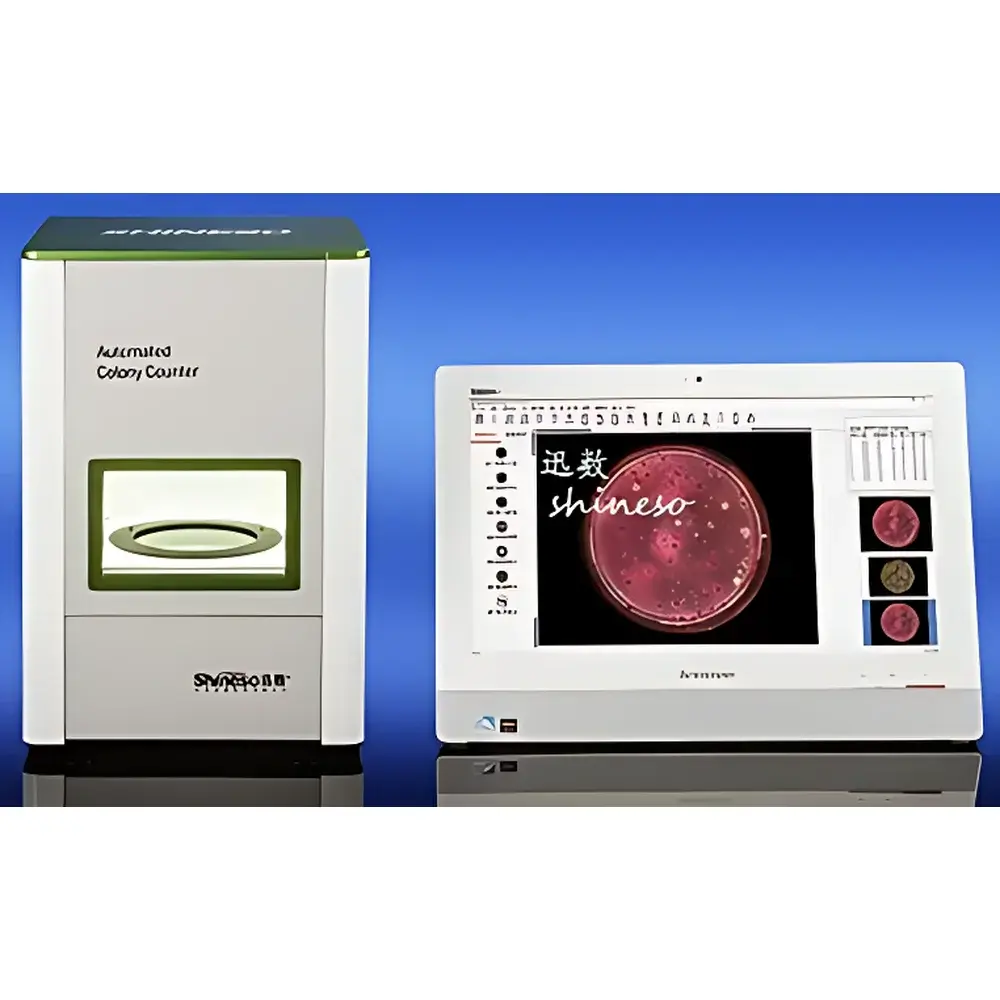
Xunshu iCount 22 Automated Colony Counter
| Brand | Xunshu |
|---|---|
| Origin | Zhejiang, China |
| Manufacturer Type | Original Equipment Manufacturer (OEM) |
| Regional Classification | Domestic (China) |
| Model | iCount 22 |
| Instrument Type | Fully Automated Colony Counter |
| Sample Types | Liquid media, Solid media (pour plate, spread plate, membrane filtration) |
| Petri Dish Capacity | 35–150 mm diameter |
| Counting Speed | 20,000 colonies/sec |
| Detection Resolution | 0.05 mm |
| Imaging System | 8 mm fixed-focus lens, 3.0 MP resolution, 1/2.5″ CMOS sensor, physical pixel count: 5 megapixels |
| Configuration | Main unit + colony analysis software |
Overview
The Xunshu iCount 22 Automated Colony Counter is an entry-level yet technically robust digital imaging system engineered for routine microbial enumeration in clinical, food safety, pharmaceutical quality control, and academic teaching laboratories. It employs high-fidelity monochrome and dual-illumination imaging—combining top-mounted diffuse reflectance lighting with bottom-mounted dark-field and backlight illumination—to maximize contrast and morphological fidelity across diverse colony types, including low-contrast, translucent, or subsurface colonies on agar-based or membrane-filtered plates. Unlike manual or semi-automated systems, the iCount 22 implements a deterministic image segmentation pipeline grounded in grayscale thresholding, edge detection, and adaptive region-growing algorithms, enabling reproducible enumeration without user-dependent visual interpretation. Its fully enclosed optical chamber—constructed from precision-machined aluminum alloy—eliminates ambient light interference and suppresses optical artifacts such as halo effects or specular reflections caused by Petri dish curvature or surface imperfections.
Key Features
- Fully sealed optical enclosure (32 × 34 × 46 cm) with downward-sliding aluminum baffle ensures consistent light-tight conditions during acquisition.
- Dual-path illumination architecture: (1) Top-mounted 96-LED diffuse reflectance array with tunable correlated color temperature (3100–5800 K) and adjustable intensity (50–7000 lux); (2) Bottom-mounted white LED dark-field source (100–5500 lux, CRI ≥ 74%) optimized for edge-enhanced visualization of faint colonies.
- Industrial-grade optical train: 8 mm C-mount fixed-focus lens (distortion <1%, F2.8–F16), paired with a 1/2.5″ CMOS sensor (5 MP physical resolution, 2.2 × 2.2 µm pixel pitch) delivering sub-50 µm spatial resolution at 150 mm plate scale.
- Intuitive dual-mode software interface: “Quick Count” module (seven-button workflow—three one-click presets + four rotary-parameter controls) enables rapid deployment for standard pour/spread/membrane plates; “Advanced Count” mode supports dynamic threshold adjustment and bias estimation for heterogeneous backgrounds or multi-color colony mixtures.
- Comprehensive morphometric analysis: Each detected colony is quantified for equivalent diameter, area, perimeter, circularity, major/minor axis length, and aspect ratio—parameters traceable to ISO 4833-1:2013 and AOAC Official Method 990.12.
Sample Compatibility & Compliance
The iCount 22 accommodates standard microbiological culture formats: pour plates (agar depth ≤ 20 mm), spread plates, and nitrocellulose or mixed-ester membrane filters (diameter 35–150 mm). Its illumination flexibility allows reliable detection of Gram-negative rods (e.g., E. coli), yeasts (Saccharomyces cerevisiae), molds (Aspergillus spp.), and fastidious organisms grown on enriched or selective media (e.g., MacConkey, Sabouraud, or VRBA). The system complies with core regulatory expectations for digital colony enumeration—including ALCOA+ principles (Attributable, Legible, Contemporaneous, Original, Accurate)—and supports audit-ready data integrity through timestamped image capture, parameter logging, and immutable electronic records. While not pre-certified to FDA 21 CFR Part 11, its role-based access control (“Manager”, “Operator”, “Reviewer”), full audit trail, and PDF/Excel export functionality align with GLP and GMP documentation requirements for QC microbiology workflows.
Software & Data Management
The proprietary iCount Analysis Suite runs on Windows 10 and features a modular architecture designed for both operational efficiency and data governance. All image acquisition, processing parameters, manual corrections (e.g., split/merge, contamination masking), and final counts are stored in a local relational database with automatic versioning. Each plate record includes: raw TIFF image, processed binary mask, metadata (sample ID, dilution factor, plate type, operator ID, timestamp), and full morphometric dataset per colony. Export options include ISO-compliant PDF reports (with embedded images and statistical summaries) and Excel-compatible CSV files containing colony-by-colony measurements. Optional integration with LIMS via standardized file I/O protocols is supported. Calibration is performed using certified stage micrometers; users may apply manual correction factors to compensate for minor optical drift or plate thickness variation.
Applications
The iCount 22 serves validated applications across regulated and non-regulated environments: total viable count (TVC) in water and beverage testing per ISO 6222; aerobic plate count (APC) in food matrices per ISO 4833-1; membrane filtration assays for coliforms and Pseudomonas aeruginosa per USP ; environmental monitoring in cleanrooms (ISO 14644-1); and educational labs performing basic bacteriology experiments. Its ability to resolve colonies as small as 0.05 mm enables early-stage detection in time-course studies, while multi-region and “cut-out” analysis modes support selective enumeration within defined zones—for example, inhibition zones in disk diffusion assays or spatially resolved biofilm colony isolation.
FAQ
What petri dish sizes does the iCount 22 support?
It accepts standard circular Petri dishes ranging from 35 mm to 150 mm in diameter, including common sizes such as 90 mm and 100 mm.
Does the system require external calibration standards?
No—the instrument includes built-in calibration routines using on-screen reference grids; however, traceable NIST-traceable stage micrometers are recommended for initial validation and periodic verification.
Can it distinguish between colonies and debris or scratches on the agar surface?
Yes—through combined use of multi-illumination contrast enhancement, size filtering (minimum 0.05 mm), circularity thresholds, and optional manual refinement tools such as “grid removal” for membrane filters and “contamination masking.”
Is the software compatible with networked laboratory environments?
The software operates locally on the included Windows 10 PC; network sharing of result databases or automated folder-based ingestion into LIMS is achievable via configurable file output paths and scheduled exports.
What level of technical training is required to operate the iCount 22?
Basic operation requires under 30 minutes of orientation; the Quick Count interface eliminates parameter tuning for routine samples, while advanced functions remain accessible for experienced users needing fine-grained control over segmentation logic.




