
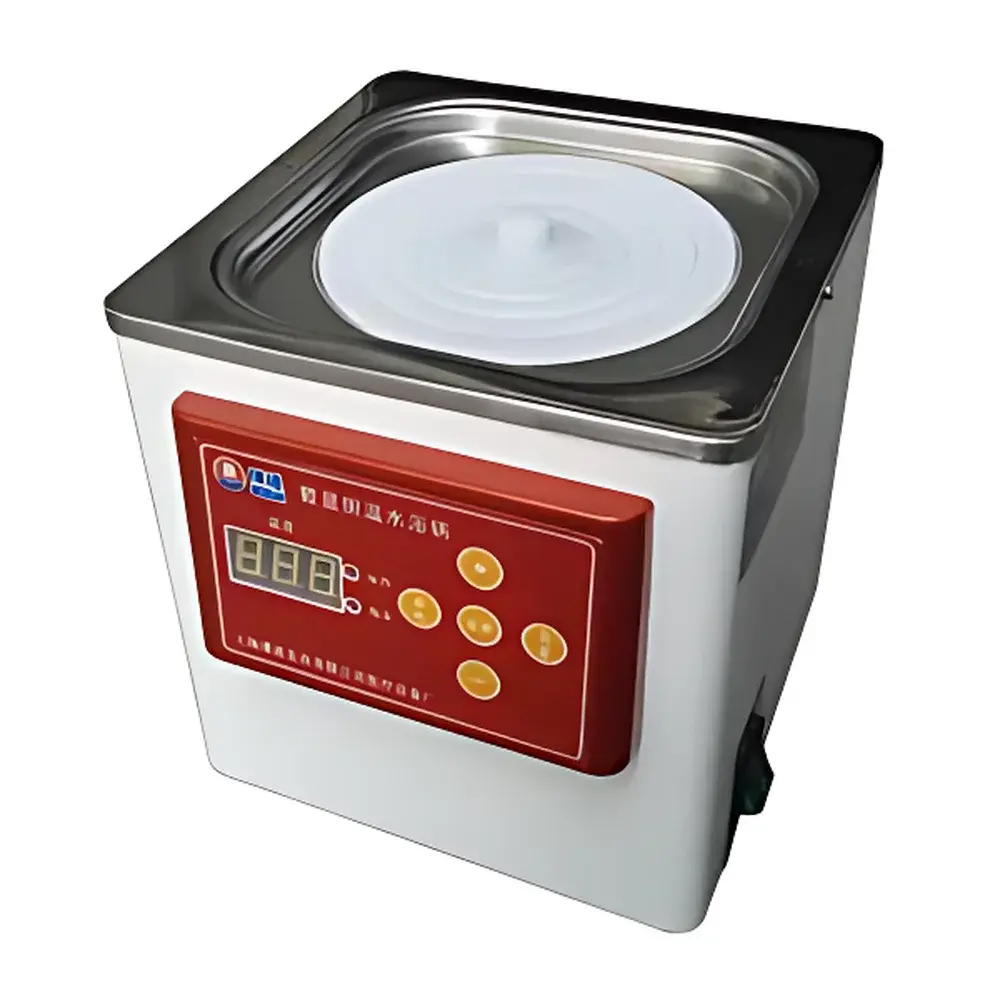
BOXUN HH.S11-1 Precision Constant-Temperature Water Bath
| Brand | BOXUN |
|---|---|
| Origin | Shanghai, China |
| Manufacturer Type | Direct Manufacturer |
| Country of Origin | China |
| Model | HH.S11-1 |
| Dimensions (W×D×H) | 200×200×210 mm |
| Chamber Dimensions (W×D×H) | 160×160×130 mm |
| Power Rating | 0.3 kW |
| Temperature Range | RT+5°C to 100°C |
| Temperature Accuracy | ±1°C |
| Construction | Cold-rolled steel housing with epoxy powder coating |
| Control System | Digital PID controller with high-precision NTC sensor |
| Diagnostic Function | Built-in electronic component self-diagnosis |
Overview
The BOXUN HH.S11-1 Precision Constant-Temperature Water Bath is a compact, single-well laboratory water bath engineered for stable thermal environments in routine analytical, clinical, and research workflows. Operating on the principle of convective heat transfer via immersion in a temperature-controlled water medium, it delivers uniform thermal distribution across the bath chamber with minimal spatial gradient (<0.3°C at setpoint). Designed for applications requiring precise thermal conditioning—such as enzyme activity assays, serum incubation, sample thawing, reagent equilibration, and stability testing—the HH.S11-1 maintains setpoint accuracy within ±1°C across its full operating range of ambient +5°C to 100°C. Its thermally insulated chamber and optimized heater placement minimize energy consumption while ensuring rapid thermal recovery after sample loading.
Key Features
- Robust mechanical architecture: Cold-rolled steel outer casing with electrostatic epoxy powder coating resists corrosion and mechanical abrasion in multi-user lab environments.
- Chemically inert 304 stainless steel inner tank ensures long-term resistance to water oxidation, chloride exposure, and cleaning agents—critical for GLP-compliant laboratories.
- Digital PID temperature control system with NTC thermistor feedback provides stable setpoint maintenance and reduced overshoot during ramp cycles.
- Integrated electronic diagnostic function continuously monitors critical circuit nodes—including heating element continuity, sensor signal integrity, and power supply regulation—to alert users of potential hardware degradation prior to failure.
- Compact footprint (200 × 200 × 210 mm) and shallow working depth (130 mm chamber height) support space-constrained benchtop configurations without compromising thermal uniformity.
- Low thermal inertia design enables consistent temperature stabilization within ≤15 minutes after power-on or setpoint change under standard ambient conditions (23°C, 50% RH).
Sample Compatibility & Compliance
The HH.S11-1 accommodates standard laboratory glassware including test tubes (up to Ø25 mm), centrifuge tubes, and small-volume beakers placed directly into the water bath chamber. Its open-top configuration allows unrestricted access for manual sampling, pipetting, or integration with external probes (e.g., pH or dissolved oxygen sensors). The unit complies with IEC 61010-1:2010 safety requirements for electrical equipment used in laboratory settings. While not certified for use in explosion-proof or sterile processing environments, its construction and control logic align with general Good Laboratory Practice (GLP) documentation standards for temperature-critical procedures. It supports traceable calibration when paired with an external Class A platinum resistance thermometer (PRT) and accredited calibration protocol.
Software & Data Management
The HH.S11-1 operates as a standalone analog-digital hybrid instrument with no embedded firmware logging or network interface. Temperature setpoints and real-time readings are displayed on a 3-digit LED screen. For regulatory environments requiring audit trails—such as those governed by FDA 21 CFR Part 11 or ISO/IEC 17025—the device is compatible with external data loggers (e.g., Omega OM-DAQPRO-5300 series) connected via 4–20 mA or 0–5 V analog output (optional add-on module). All calibration records, maintenance logs, and operational deviations must be manually documented per institutional SOPs. No proprietary software installation or cloud connectivity is required or supported.
Applications
- Clinical diagnostics: Serum and plasma sample incubation prior to immunoassay or coagulation testing (e.g., PT/INR, APTT).
- Pharmaceutical QC: Dissolution medium pre-equilibration per USP , buffer temperature conditioning for HPLC mobile phase preparation.
- Academic research: Bacterial culture maintenance at sub-incubator temperatures, DNA hybridization protocols, and polymerase chain reaction (PCR) reagent thawing.
- Industrial QA: Viscosity reference standard equilibration, paint and coating sample conditioning per ASTM D189 or ISO 2555.
- Environmental testing: Extraction solvent warming for EPA Method 3510C (liquid-liquid extraction) and soil leachate preparation.
FAQ
What is the maximum recommended water fill level for optimal thermal uniformity?
The chamber should be filled to approximately 10 mm below the top rim (i.e., ~120 mm depth) to ensure complete immersion of standard 15-mL conical tubes while maintaining convective circulation efficiency.
Can this unit be used with non-aqueous media such as silicone oil or glycerol?
No. The HH.S11-1 is validated exclusively for deionized or distilled water operation. Use of alternative fluids may compromise sensor accuracy, accelerate corrosion, and void warranty coverage.
Is external temperature calibration verification required before first use?
Yes. Initial verification using a traceable NIST-calibrated reference thermometer is mandatory to confirm compliance with stated ±1°C accuracy specification prior to critical application deployment.
Does the unit include over-temperature protection?
Yes. An independent mechanical high-limit thermostat (cut-off at 110°C) provides fail-safe thermal shutdown independent of the primary PID control loop.
What maintenance intervals are recommended for long-term reliability?
Biannual descaling with 5% citric acid solution is advised for hard-water environments; annual inspection of heater terminals and sensor connections is recommended per ISO/IEC 17025 preventive maintenance guidelines.



