
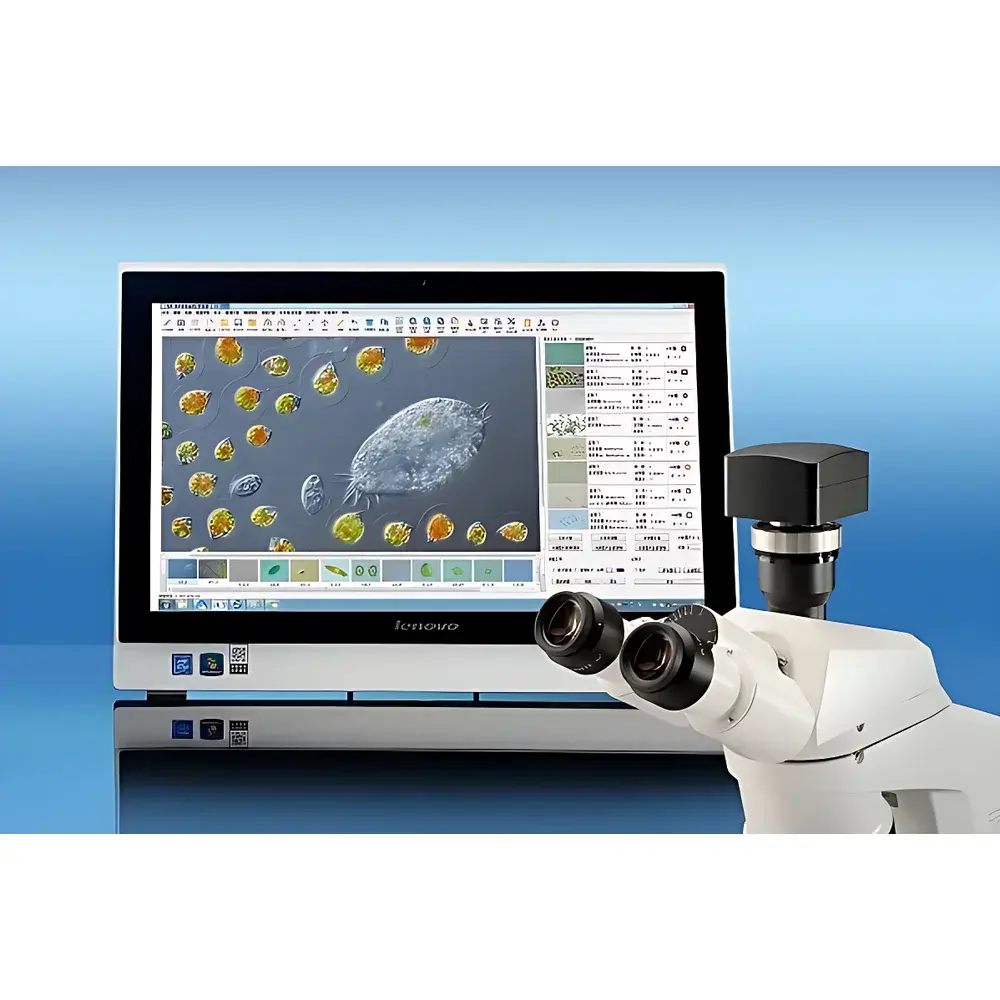
Xunshu Algacount T100 Algal Identification and Enumeration System
| Brand | Xunshu |
|---|---|
| Origin | Zhejiang, China |
| Manufacturer Type | Original Equipment Manufacturer (OEM) |
| Product Category | Domestic |
| Model | Algacount T100 |
| Instrument Type | Algal Identification & Enumeration System |
| Camera Resolution | 6.3 MP (SONY IMX178 CMOS, 1/1.8″ sensor) |
| Pixel Size | 2.4 × 2.4 µm |
| Objective Magnifications | 4×, 10×, 20×, 40× |
| Identification Method | Multidimensional Progressive Similarity Search & Keyword-Based Taxonomic Query |
| Data Interface | USB 3.0 |
| Frame Rate | 15 fps @ 3072 × 2048 |
| Exposure Time Range | 0.244 ms – 2000 ms |
| Dynamic Range / SNR | 425 mV (G-light, 1/30 s) |
| Software Platform | Windows 10-compatible proprietary imaging & analysis suite with role-based user accounts, audit trail logging, and GLP-aligned data integrity controls |
Overview
The Xunshu Algacount T100 Algal Identification and Enumeration System is a purpose-built digital microscopy platform engineered for routine phytoplankton analysis in municipal water utilities, environmental monitoring stations, and freshwater ecology laboratories. It integrates high-fidelity brightfield microscopy with computer vision–driven image acquisition, automated morphometric segmentation, and taxonomically structured database interrogation. Unlike generic image analysis tools, the Algacount T100 implements a domain-specific workflow grounded in limnological practice: from raw microphotograph capture through depth-resolved focus stacking, to multi-scale morphological matching against a curated, georeferenced algal atlas. Its core measurement principle relies on optical digitization of fixed or live planktonic samples under standardized magnification, followed by pixel-level feature extraction—including contour topology, symmetry indices, cell aspect ratio, and colony architecture—enabling reproducible classification across operator skill levels.
Key Features
- Multidimensional Progressive Similarity Search (“XunSao”): A proprietary algorithm that detects cellular boundaries, extracts invariant shape descriptors (e.g., Hu moments, convex hull metrics, texture gradients), and performs hierarchical similarity ranking against >20,000 reference micrographs. Returns top-matching taxa within 3–5 seconds, prioritizing ecologically prevalent species per regional waterbody.
- Four-Tier Taxonomic Database: Structured by phylum → order → genus → species, covering 92% of freshwater algae reported in China’s Seven Major River Systems and 28 key reservoirs, plus marine taxa from the Bohai, Yellow, East China, and South China Seas. Each entry includes annotated color micrographs, hand-drawn schematics, and tabulated morphological/ecological descriptors.
- Workflow-Optimized Enumeration: Supports batch acquisition of up to 200 contiguous fields-of-view at selected magnifications; enables real-time tagging via color-coded markers; auto-aggregates counts across fields by taxon; computes dominance hierarchy, relative abundance (%), and Shannon–Wiener diversity index (H′).
- Advanced Image Synthesis: Implements Z-stack fusion to resolve vertically distributed cells (e.g., colonial Volvocales or filamentous Cyanobacteria) and seamless mosaic stitching for extended-field visualization at 40× resolution without stage repositioning.
- Quantitative Biometry Module: Integrates calibrated micrometry (dual-mode transparent/digital scale bar), geometric modeling libraries for common algal morphotypes (e.g., spherical, cylindrical, fusiform, colonial), and automated biomass estimation using established volume-to-carbon conversion factors (e.g., Menden-Deuer & Lessard, 2000).
Sample Compatibility & Compliance
The Algacount T100 accepts standard U.S. Standard (1″ × 3″) glass microscope slides prepared via Utermöhl sedimentation or membrane filtration protocols. It supports both preserved (Lugol’s iodine-fixed) and live samples imaged under phase contrast or brightfield illumination. All analytical outputs comply with ISO 17025:2017 requirements for method validation documentation, including traceable calibration logs for pixel-to-micron conversion and version-controlled software revision history. User access control, electronic signatures, and immutable audit trails meet GLP and FDA 21 CFR Part 11 criteria for regulated environmental data reporting. The system facilitates generation of compliant reports aligned with national surface water quality standards (e.g., China’s GB 3838-2002, EU WFD Annex V).
Software & Data Management
The embedded Windows 10 application enforces strict role-based permissions: administrators configure instrument parameters, manage taxonomy updates, and review full audit logs; analysts perform sample acquisition and annotation but cannot modify prior entries or delete raw image sets. Every session generates a timestamped metadata bundle containing camera settings, stage coordinates, user ID, and processing history. Statistical outputs—including cell density (cells/mL), biovolume (mm³/L), carbon/nitrogen biomass (µg C/L, µg N/L), Pielou’s evenness (J′), and dominance index (Y)—are exportable in CSV, Excel (.xlsx), or PDF formats with embedded figure annotations. All images retain EXIF headers recording objective magnification, exposure time, and white balance coefficients to support inter-laboratory comparability.
Applications
- Early detection and quantification of bloom-forming cyanobacteria (e.g., Microcystis aeruginosa, Anabaena circinalis) in drinking water source surveillance.
- Seasonal phytoplankton community profiling for trophic status assessment (eutrophication monitoring) under national lake/reservoir monitoring programs.
- Validation of molecular assays (e.g., qPCR, metabarcoding) by providing orthogonal morphological ground-truth data.
- Educational use in undergraduate limnology labs for teaching algal taxonomy, morphometrics, and biodiversity indices.
- Regulatory compliance reporting for wastewater discharge permits requiring phytoplankton composition data.
FAQ
Does the Algacount T100 support automated species-level identification?
No. It provides probabilistic morphological matching against verified reference imagery—not definitive taxonomic assignment. Final identification requires expert verification per ISO 14442:2013 guidelines.
Can the system process samples preserved with formalin?
Yes, though Lugol’s iodine fixation is preferred for optimal contrast and long-term archival stability of chloroplast morphology.
Is third-party software integration possible?
Raw TIFF/RGB image sequences and structured CSV exports enable downstream analysis in MATLAB, R (phyloseq, vegan), or Python (scikit-image, pandas). No direct API is provided.
How frequently is the algal database updated?
Annual taxonomy revisions incorporate newly documented regional strains and nomenclatural changes ratified by the International Code of Nomenclature for Algae, Fungi, and Plants (ICN).
What hardware maintenance is required?
Routine cleaning of optical components per manufacturer instructions; annual recalibration of camera gain/exposure response curves using NIST-traceable grayscale targets is recommended.







