
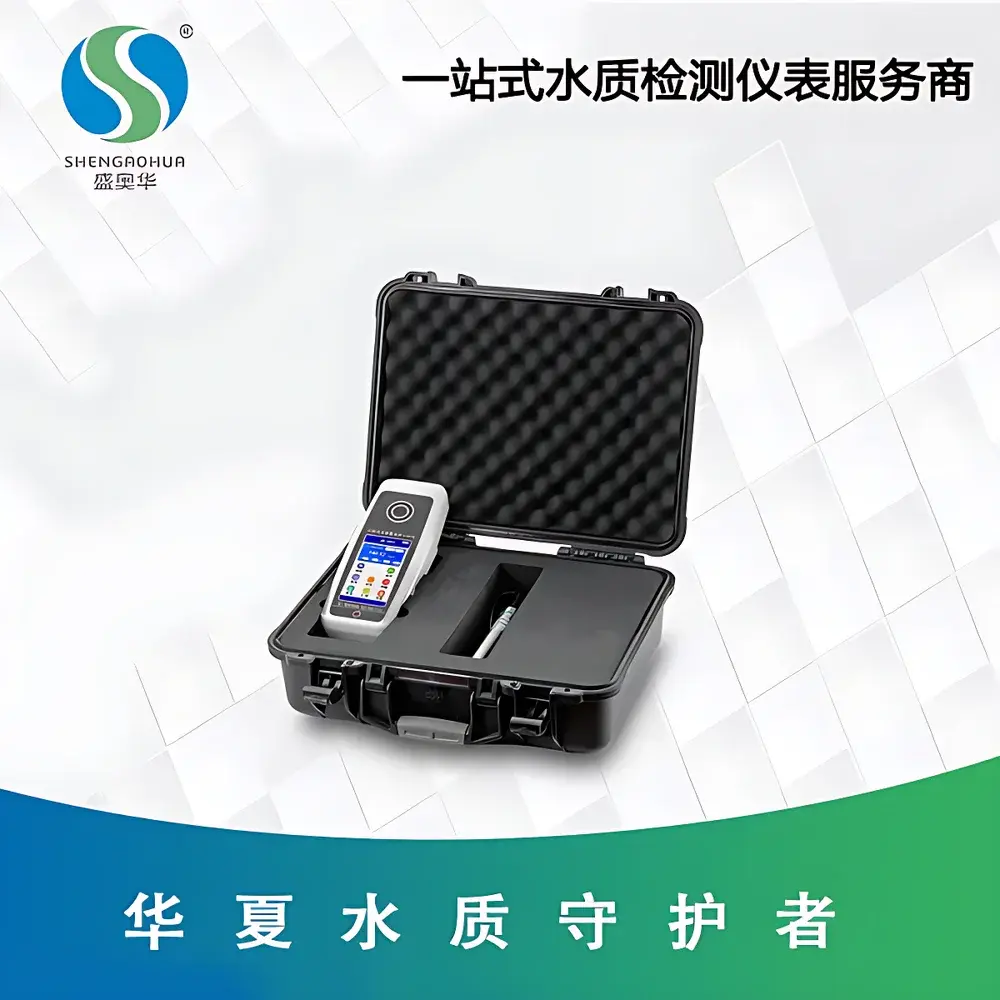
ShengAohua SH-9Y Handheld Chlorophyll-a Fluorometer
| Brand | ShengAohua |
|---|---|
| Origin | Jiangsu, China |
| Manufacturer Type | Direct Manufacturer |
| Model | SH-9Y |
| Measurement Principle | In-situ Fluorescence Detection |
| Measurement Range | 0–50.0 / 0–500.0 µg/L Chl-a |
| Accuracy | <8% FS |
| Repeatability | ±5% |
| Sensor Type | Digital Fluorescence Electrode with Automatic Turbidity & Optical Drift Compensation |
| Display | 3.1-inch Mauve-colored LCD |
| Operating Temperature | 5–45 °C |
| Max Pressure Rating | 1 bar |
| Electrode Diameter | 33.7 mm |
| Electrode Cable Length | 3 m |
| Housing Materials | POM, Nylon, and 316 Stainless Steel |
| Power Supply | DC 5 V ±5%, <50 mA |
| Battery | Rechargeable Lithium-ion (integrated) |
| Data Storage | Internal MicroSD card |
| Dimensions (L×W×H) | 200 × 100 × 35 mm |
| Net Weight | 0.3 kg |
| User Calibration | Single-point calibration supported |
Overview
The ShengAohua SH-9Y Handheld Chlorophyll-a Fluorometer is a field-deployable, in-situ optical instrument engineered for rapid, reagent-free quantification of chlorophyll-a concentration in natural and treated waters. It operates on the principle of excitation-emission fluorescence spectroscopy: a built-in blue LED (typically ~470 nm) excites chlorophyll-a molecules in the sample, and the resulting red fluorescence emission (~685 nm) is detected by a high-sensitivity photodiode. The digital fluorescence electrode integrates real-time signal processing to compensate for optical path attenuation and scattering effects induced by suspended solids or turbidity—enabling robust performance in heterogeneous aquatic matrices without filtration or chemical extraction. Designed for operational simplicity and field durability, the SH-9Y eliminates laboratory-based spectrophotometric workflows while maintaining traceable measurement integrity suitable for routine environmental monitoring and regulatory screening.
Key Features
- Reagent-free operation: No solvent extraction, no acetone handling, no centrifugation—reducing analytical time from hours to seconds.
- Digital fluorescence electrode with embedded compensation algorithms for turbidity and photobleaching drift, ensuring stable signal output across variable water clarity conditions.
- Ergonomic handheld form factor (200 × 100 × 35 mm; 0.3 kg) with IP67-rated housing components and corrosion-resistant 316 stainless steel sensor tip for immersion in freshwater, brackish, and low-salinity marine environments.
- Integrated rechargeable lithium-ion battery supporting >12 hours of continuous field use per charge; power management optimized for low-voltage DC input (5 V ±5%).
- 3.1-inch mauve-backlit LCD with intuitive Chinese/English toggle interface—designed for glove-compatible navigation and immediate parameter verification.
- Onboard MicroSD storage enables timestamped data logging (Chl-a value, date/time, temperature, operator ID), supporting offline review and batch export via USB interface.
Sample Compatibility & Compliance
The SH-9Y is validated for direct immersion measurements in raw surface water, reservoir effluents, aquaculture ponds, wastewater treatment plant influents/effluents, and drinking water distribution systems. Its 1-bar pressure rating permits shallow submersion (<10 m depth) in static or slow-flowing water bodies. While not certified to ISO 10260 or ASTM D3731 as a primary reference method, the fluorometer aligns with EPA Method 445.0 (in situ fluorescence) for screening-level chlorophyll-a assessment. Data acquisition supports GLP-compliant documentation when paired with external lab information management systems (LIMS); audit trails and user-defined calibration logs are retained locally. The device meets CE marking requirements for electromagnetic compatibility (EN 61326-1) and general safety (EN 61010-1).
Software & Data Management
Data export is performed via standard USB 2.0 connection to Windows-based PCs. A dedicated PC utility (Windows 10/11 compatible) allows CSV export of logged datasets—including Chl-a concentration (µg/L), measurement timestamp, ambient temperature, and electrode status flags (e.g., “compensation active”, “low signal”). No cloud dependency or proprietary subscription is required. Calibration history—including date, reference standard value, and offset correction—is stored separately and accessible for internal QA/QC review. Firmware updates are delivered as signed binary packages to ensure system integrity and traceability.
Applications
- Real-time phytoplankton biomass estimation during algal bloom surveillance programs conducted by municipal water authorities and environmental protection agencies.
- Process control in aquaculture facilities—monitoring feed-induced eutrophication and optimizing aeration cycles based on Chl-a trends.
- Pre-treatment assessment at drinking water intakes to inform coagulant dosing and UV disinfection validation.
- Field validation of remote sensing-derived chlorophyll products (e.g., Sentinel-3 OLCI, Landsat-9 OLI-TIRS) through ground-truth point measurements.
- Academic limnology studies requiring spatially dense, non-destructive sampling across lake transects or river longitudinal gradients.
- Third-party environmental testing laboratories performing Tier-1 screening prior to confirmatory HPLC analysis per ISO 10260.
FAQ
Does the SH-9Y require daily calibration?
No—single-point calibration using a certified chlorophyll-a standard solution (e.g., 10 µg/L) is recommended before each deployment session or after extended storage (>7 days). Factory calibration remains stable for ≥6 months under normal field use.
Can the instrument measure chlorophyll-b or pheophytin interference?
No—the SH-9Y is optimized specifically for chlorophyll-a fluorescence. It does not discriminate between chlorophyll homologues or degradation products; users should interpret elevated readings in highly degraded or sediment-rich samples with caution.
Is the electrode compatible with saline water up to seawater salinity?
The sensor is rated for conductivity ≤20 mS/cm. Performance in full-strength seawater (≈50 mS/cm) is not validated; signal quenching and biofouling risk increase significantly above 35 ppt salinity.
How is turbidity compensation implemented electronically?
The electrode incorporates a dual-wavelength detection scheme: one channel measures chlorophyll-specific fluorescence, while a second reference channel monitors broadband backscatter at 780 nm. Ratio-based normalization occurs in real time within the embedded microcontroller.
What is the minimum detectable concentration?
The practical limit of detection (LoD) is approximately 0.5 µg/L Chl-a under clear-water conditions (NTU < 5); LoD degrades linearly with increasing turbidity and may reach ~2.0 µg/L at NTU = 50.







