
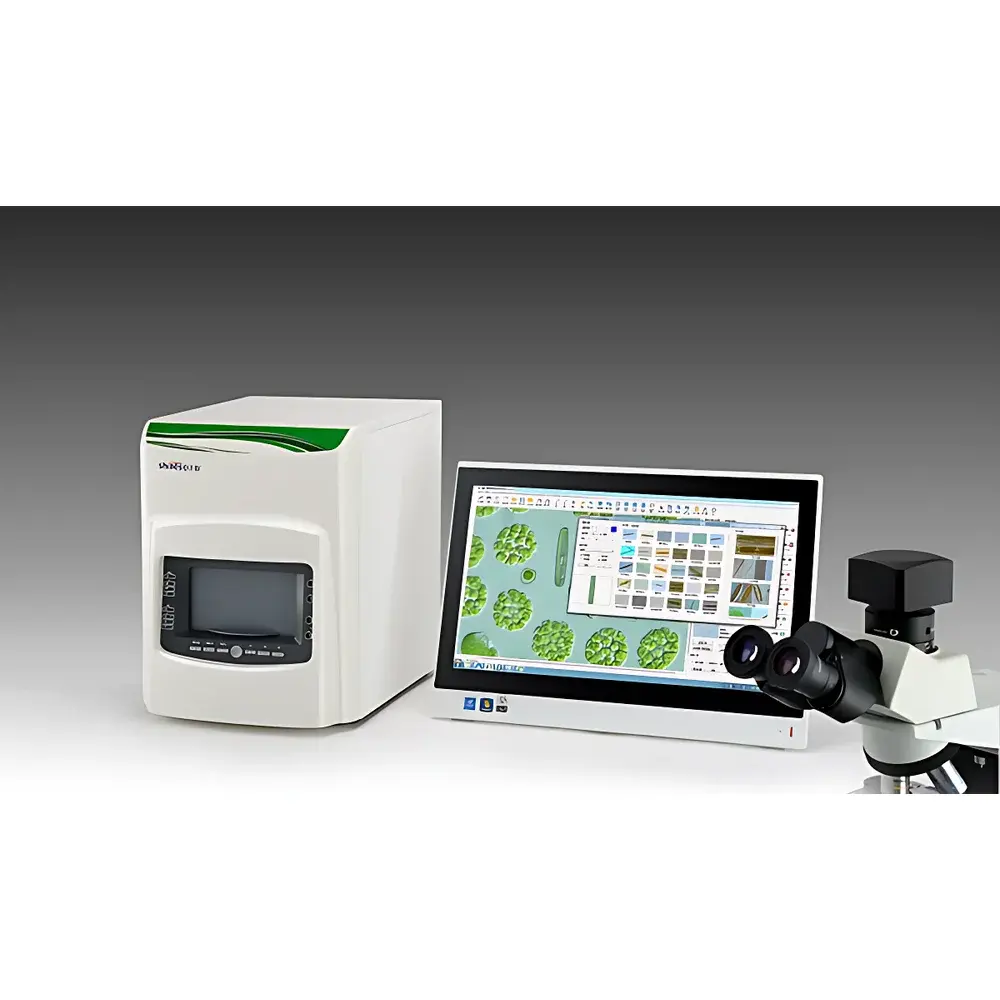
Xunsu Algacount M320 Integrated Colony Counter & Plankton Analysis System
| Brand | Xunsu |
|---|---|
| Origin | Zhejiang, China |
| Manufacturer Type | Direct Manufacturer |
| Product Category | Domestic |
| Model | M320 |
| Price Range | USD 14,000 – 21,500 |
| Instrument Type | Algal and Plankton Counter |
| Camera Resolution | 12 Megapixels |
| Objective Magnifications | 4×, 10×, 40×, 100× |
| Identification Methods | Morphological Search, Taxonomic Classification, Similarity-Based Matching, Confusion-Resolving Comparative Analysis |
Overview
The Xunsu Algacount M320 Integrated Colony Counter & Plankton Analysis System is a dual-function, image-based analytical platform engineered for high-precision microbiological and aquatic ecological monitoring. It combines automated colony enumeration with intelligent plankton identification and quantification—designed specifically for freshwater and marine environmental laboratories conducting routine water quality assessment, algal bloom surveillance, and regulatory compliance testing. The system operates on a robust digital imaging architecture integrating brightfield and darkfield microscopy, multi-layer focus stacking, ultra-wide field-of-view tiling, and deep-learning–enhanced pattern recognition. Its core measurement principle relies on high-fidelity optical capture followed by algorithmic segmentation (e.g., level-set active contour models for colonies; convolutional neural network–driven feature extraction for algal cells), enabling reproducible, operator-independent analysis across diverse sample matrices—including agar plates, membrane filters, 3M™ Petrifilm™ test strips, and wet-mount plankton preparations.
Key Features
- Integrated dual-mode imaging: Simultaneous support for colony counting (on Petri dishes, membrane filters, and commercial test films) and planktonic organism analysis (algae and zooplankton) using a single hardware platform.
- 12-megapixel scientific-grade CMOS camera with USB 3.0 interface, 0.1 ms–15 s exposure control, and real-time dynamic capture at up to 25 fps @ 4000 × 3000 resolution.
- Four-objective magnification turret (4×, 10×, 40×, 100×) compatible with standard biological microscopes; optional adapter kits available for integration with major OEM microscope brands.
- Multi-dimensional progressive algal similarity search (“XunSao” engine): A proprietary CNN-based image recognition module that identifies morphologically analogous algae from a curated database of >20,000 annotated images in ≤5 seconds—prioritizing common and ecologically relevant taxa.
- Confusion-resolving comparative module: Enables side-by-side visual comparison of 2–6 taxonomically similar species with overlayed diagnostic feature maps and concise morphological descriptors.
- Automated multi-plane depth fusion: Captures z-stack sequences and computationally fuses focal planes to generate fully focused, artifact-free images of vertically distributed phytoplankton cells.
- Full-plate colony segmentation using adaptive level-set algorithms—including RGB-constrained color-aware models and multiphase segmentation—optimized for heterogeneous backgrounds and clustered or filamentous colonies.
- Comprehensive biometric analysis: Digital micrometry with auto-calibrating transparent scale bars; geometric modeling–based biomass estimation for over 120 algal and zooplankton morphotypes.
Sample Compatibility & Compliance
The Algacount M320 accommodates standard microbiological and limnological sample formats: pour-plated, spread-plated, and membrane-filtered bacterial cultures; 3M™ Petrifilm™ Aerobic Count, Coliform, E. coli/Coliform, and Staphylococcus aureus test films; and wet-mounted plankton suspensions prepared per APHA Standard Methods 2120B and ISO 17892-1. Its software enforces audit-trail–enabled data integrity protocols aligned with GLP and ISO/IEC 17025 requirements. User-access permissions are role-based (administrator vs. analyst), with immutable electronic records, timestamped metadata, and revision history for all image annotations, counts, and statistical outputs. All exported reports comply with PDF/A-1b archival standards and Excel (.xlsx) formatting suitable for regulatory submission under EPA Method 1603, USP , and China’s HJ 1001–2018 guidelines.
Software & Data Management
The unified software suite comprises three interoperable modules: ColonyCount Pro, AlgaID+, and ZooScan Manager—each governed by a centralized database with ACID-compliant transaction handling. Image acquisition, annotation, measurement, and statistical reporting occur within a single GUI environment supporting multilingual UI (English, Chinese). Critical features include: automatic calibration traceability; batch processing of ≥200 contiguous fields-of-view; dynamic correction of segmentation results via interactive threshold adjustment; and export of raw image stacks, annotated TIFFs, and summary statistics to Excel or PDF with embedded metadata (e.g., objective magnification, exposure time, user ID, timestamp). All quantitative outputs—including cell density (cells/mL), biovolume (µm³/mL), Shannon–Wiener diversity index (H′), Pielou evenness (J′), dominance ratio (Y), and carbon/nitrogen biomass estimates—are computed per internationally accepted equations (e.g., UNESCO-ICES Phytoplankton Manual, Utermöhl 1958, and Wetzel & Likens 2000).
Applications
This system serves environmental monitoring agencies, municipal water utilities, academic limnology departments, aquaculture QA/QC labs, and regulatory testing facilities. Primary use cases include: enumeration of heterotrophic plate counts (HPC) and indicator organisms (e.g., E. coli, coliforms) in drinking water and wastewater effluents; quantitative analysis of cyanobacterial and diatom assemblages during harmful algal bloom (HAB) early-warning programs; taxonomic profiling of zooplankton communities for trophic status assessment (e.g., TSI calculations); biomass estimation for carbon flux modeling in reservoirs and coastal zones; and validation of molecular assays (e.g., qPCR, metabarcoding) against morphologically verified reference counts. Its capability to resolve colonial forms (e.g., Microcystis aeruginosa aggregates), chain-forming diatoms (e.g., Asterionella formosa), and gelatinous protists (e.g., Volvox spp.) makes it especially valuable for studies requiring morphotype-specific metrics.
FAQ
Does the M320 support FDA 21 CFR Part 11 compliance?
Yes—the software implements electronic signature workflows, audit trails with immutable timestamps, and role-based access controls meeting Part 11 requirements for regulated environments.
Can the system quantify colonial or filamentous algae automatically?
Yes—it includes dedicated algorithms for subcellular counting within mucilaginous colonies (e.g., Anabaena, Gloeotrichia) and linear chain segmentation for filamentous taxa (e.g., Oscillatoria, Spirogyra).
Is the algal database customizable for regional species not included in the default library?
Yes—administrators may import validated reference images, taxonomic descriptors, and morphometric templates to extend the database while preserving hierarchical classification integrity.
What microscope brands and models are officially supported?
The system is vendor-agnostic; standard C-mount adapters enable compatibility with Olympus BX series, Nikon Eclipse Ci, Zeiss Axio Lab.A1, and Leica DM series microscopes.
How is measurement accuracy validated across magnifications?
Each objective is individually calibrated using NIST-traceable stage micrometers; software applies pixel-to-µm conversion factors dynamically based on selected magnification and sensor binning mode.







