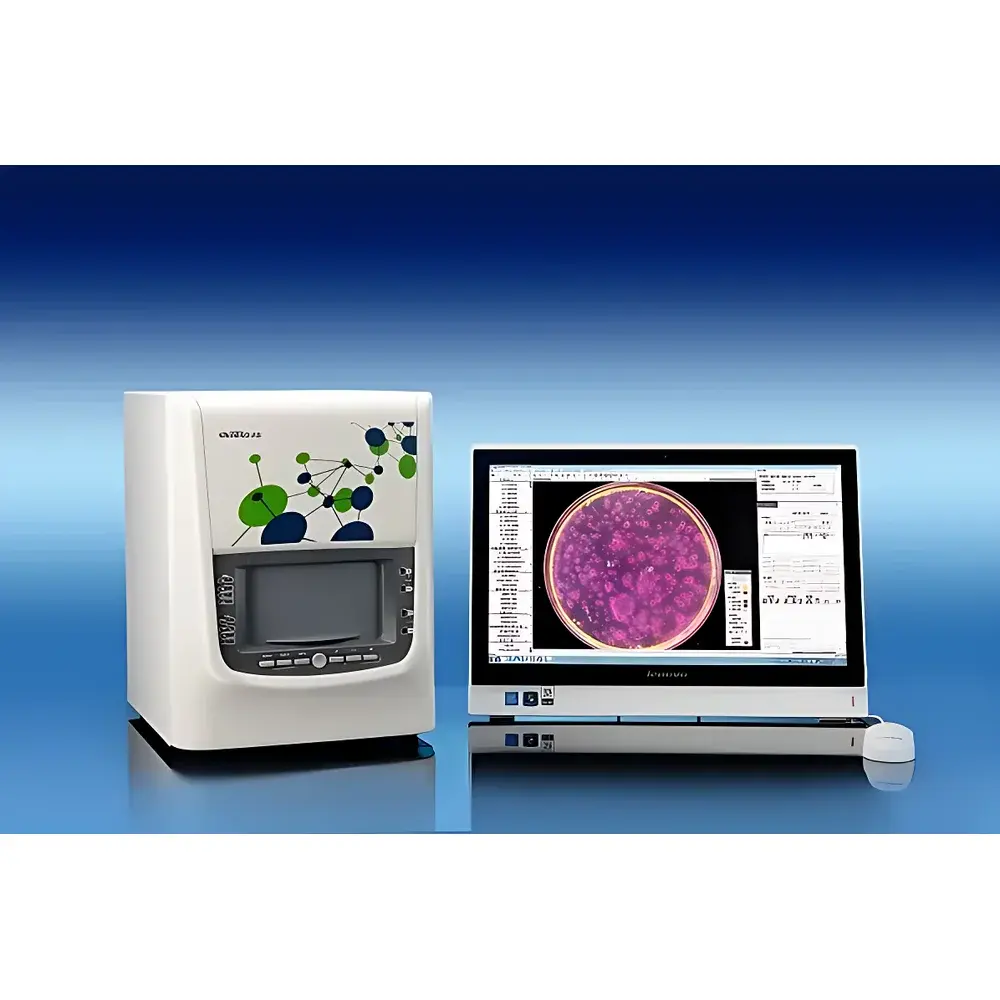
Xunsu FLuo2 Fluorescent Colony Analyzer
| Brand | Xunsu |
|---|---|
| Origin | Zhejiang, China |
| Manufacturer Type | Manufacturer |
| Product Origin | Domestic (China) |
| Model | FLuo2 |
| Instrument Type | Fully Automatic Fluorescent Colony Counter |
Overview
The Xunsu FLuo2 Fluorescent Colony Analyzer is a high-end, fully automated imaging system engineered for precision microbiological analysis under both visible and ultraviolet illumination. It integrates three core analytical capabilities—viable colony enumeration, zone-of-inhibition measurement, and strain selection—into a single platform grounded in quantitative digital image analysis. The instrument operates on the principle of fluorescence excitation and high-fidelity optical capture: dual-wavelength UV illumination (254 nm for sterilization/UV mutagenesis and 366 nm for fluorescence excitation) enables selective visualization of fluorogenic colonies (e.g., Escherichia coli expressing β-glucuronidase on VRBA-MUG agar), while a Sony high-sensitivity, large-area CCD sensor ensures low read-noise acquisition and wide dynamic range—critical for resolving weak or heterogeneous fluorescent signals. Its fully enclosed dark-box architecture eliminates ambient light interference, and the dual-illumination system (top-mounted 360° tunable-color LED array + bottom-mounted dark-field illumination) provides orthogonal contrast enhancement—preserving morphological fidelity across bacterial, fungal, yeast, and actinomycete colonies.
Key Features
- Dual-wavelength UV excitation: Integrated 254 nm lamp for chamber decontamination and UV mutagenesis; dual-side 366 nm UV LEDs for uniform fluorescence excitation of GFP-expressing strains and E. coli on chromogenic media.
- Tunable trichromatic LED illumination: Adjustable correlated color temperature (3500–8500 K) replicates natural spectral rendering—eliminating blue bias common in monochromatic white LEDs and enabling accurate colorimetric assessment of colony pigmentation.
- Optimized optical path: Sealed dark-box design with ergonomic viewing port; top illumination employs diffuse, shadow-free 360° flexible lighting to accentuate surface texture and edge definition; bottom illumination utilizes “crystal-sharp suspended dark-field” optics to resolve hyphal architecture—including differentiation between aerial and substrate mycelia in molds and actinomycetes.
- Advanced image segmentation engine: Incorporates 28 proprietary algorithms, including a level-set active contour model specifically adapted for microbiological imagery—enabling robust segmentation of clustered, irregular, translucent, or low-contrast colonies without user thresholding.
- Multi-modal counting & analysis: Supports pour plates, spread plates, membrane filters, 3M Petrifilm™, spiral plates, multi-well plates, and immunodiffusion plates—with dedicated modules for plaque counting (bacteriophage/lysis plaques), OPKA/SBA assays, clonal colony quantification, and blue-white screening.
Sample Compatibility & Compliance
The FLuo2 accommodates standard microbiological sample formats per ISO 7218, ISO 4833-1, and FDA BAM Chapter 3 protocols—including membrane filtration (black-grid filters), chromogenic agars (e.g., VRBA-MUG per GB 4789.38–2012), antibiotic susceptibility discs (Kirby-Bauer), cup-plate assays, well-diffusion assays, and single-radial immunodiffusion (SRID) plates. Its calibration traceability supports GLP-compliant workflows: built-in calibration tools allow verification against NIST-traceable stage micrometers, and all measurements retain spatial metadata (pixel-to-mm conversion, dilution factor, plate diameter). The system complies with data integrity requirements outlined in FDA 21 CFR Part 11 through audit-trail-enabled software logging (user actions, parameter changes, result exports) and role-based access control.
Software & Data Management
The FLuo2 runs on a dedicated Windows-based analysis suite featuring modular applications: ColonyCounter Pro, SZone Inhibition Analyzer, Antibiotic Potency Calculator (aligned with Chinese Pharmacopoeia 2020 and USP ), and β-Lactamase Detection Module (for sulbactam-sensitive assay validation). Image processing includes adaptive histogram equalization, multi-kernel filtering (Gaussian, median, Sobel), morphological operations, and RGB channel decomposition. All statistical outputs—including colony counts, inhibition zone diameters, area ratios, circularity indices, and morphometric descriptors (diameter, perimeter, aspect ratio, convexity)—are exportable to Excel with full metadata. Database architecture supports hierarchical project organization, keyword-driven search, and batch report generation compliant with ISO/IEC 17025 documentation standards.
Applications
- Fluorescent colony enumeration: Automated detection and counting of weak-fluorescence colonies (e.g., E. coli on MUG-supplemented media) using optimized UV excitation and noise-suppressed CCD acquisition.
- Antibiotic susceptibility testing: Multi-mode inhibition zone measurement—automatic edge detection for sharp zones, circular approximation for fragmented edges, and three-point manual fitting for diffuse boundaries—enabling compliance with CLSI M02-A13 and EUCAST guidelines.
- Strain screening: Morphology-driven selection via size-constrained clustering (e.g., Ashbya gossypii riboflavin producers), multi-color classification (blue/white colony discrimination), and dual-ring analysis (halo-to-colony diameter ratio for enzyme or organic acid producers).
- Fungal quantification: One-click mycelial area, perimeter, major/minor axis, and growth rate calculation—replacing subjective cross-measurement methods with reproducible, operator-independent metrics.
- Immunological & virological assays: Accurate plaque/colony enumeration in OPKA, SBA, and phage titer assays—even under low-contrast or confluent conditions—via watershed-based separation and topology-aware labeling.
FAQ
Does the FLuo2 support regulatory submissions under FDA 21 CFR Part 11?
Yes—the software enforces electronic signature workflows, maintains immutable audit trails, and restricts data modification based on user roles and permissions.
Can it distinguish overlapping or chain-forming colonies without manual intervention?
Yes—its level-set active contour algorithm dynamically partitions adherent or filamentous colonies based on intensity gradients and morphological priors, with adjustable sensitivity for chain-splitting decisions.
Is calibration required before each use?
No—system-level calibration is performed once during installation; however, daily verification using the included calibration slide is recommended for ISO 17025 traceability.
How does it handle grid-patterned membranes or 3M Petrifilm™?
A dedicated “grid-aware segmentation” module suppresses mesh artifacts and isolates colony pixels using morphology-constrained level-set evolution—enabling true one-click enumeration without background subtraction artifacts.
What fluorescence standards are supported out-of-the-box?
The system is pre-configured for common fluorogenic substrates: MUG (366 nm excitation), X-Gal (blue/white screening), and GFP-expressing constructs—custom excitation/emission profiles can be added via user-defined wavelength presets.