
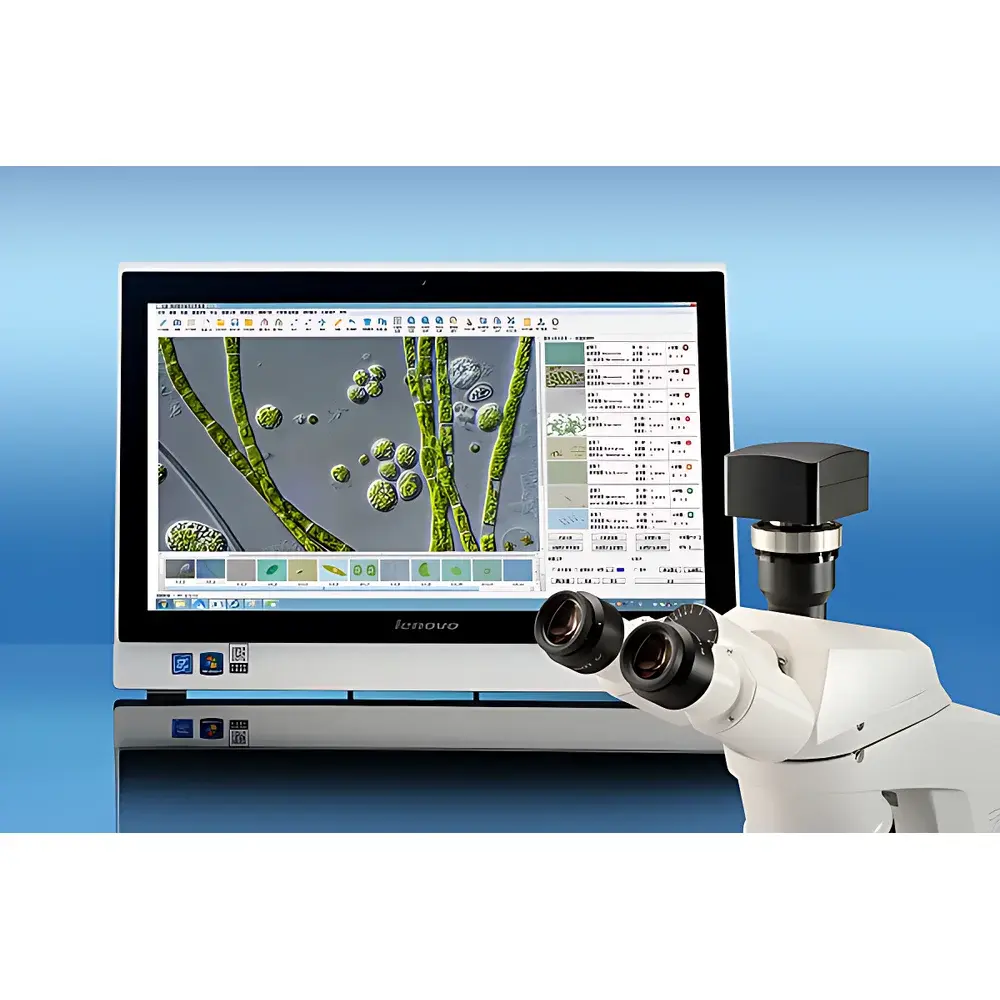
Xunshu Algacount T300 Series Intelligent Algal Identification and Enumeration System
| Brand | Xunshu |
|---|---|
| Origin | Zhejiang, China |
| Manufacturer Type | OEM Manufacturer |
| Regional Category | Domestic (China) |
| Model | Algacount T300 / Algacount T301 |
| Instrument Type | Algal Identification and Enumeration System |
| Camera Resolution | 12 MP (T300), 20 MP (T301) |
| Objective Magnifications | 4×, 10×, 20×, 40× |
| Identification Methods | Morphological Similarity Matching, Taxonomic Classification, Keyword-Based Search, Confusable-Species Discrimination |
Overview
The Xunshu Algacount T300 Series is a dedicated, high-precision digital imaging platform engineered for automated identification, morphometric analysis, and quantitative enumeration of phytoplankton—primarily freshwater and marine microalgae—in environmental monitoring laboratories. Built upon a hybrid optical-digital architecture, the system integrates a research-grade inverted or upright microscope (user-configurable), a calibrated USB 3.0 CMOS imaging module, and a purpose-built software suite grounded in computational morphology and taxonomic informatics. Its core measurement principle relies on high-fidelity digital microscopy coupled with multi-dimensional image feature extraction, enabling objective, reproducible classification based on cellular contour, symmetry, organelle arrangement, colony geometry, and textural signatures (e.g., frustule patterning, gelatinous sheath morphology, flagellar configuration). Designed explicitly for compliance-driven water quality assessment workflows, the Algacount T300 supports standardized reporting aligned with national and regional phytoplankton monitoring protocols—including those referenced in China’s *Environmental Monitoring Technical Specifications for Surface Water and Wastewater* (HJ/T 92–2002) and harmonized with international frameworks such as ISO 17025:2017 for testing laboratory competence.
Key Features
- Multidimensional Progressive Similarity Search: A proprietary image-matching algorithm that detects cell boundaries, extracts invariant geometric and textural descriptors across multiple spatial dimensions, and retrieves top-matching taxa from a curated database of >15,000 annotated microalgal images—within 3–5 seconds. Prioritizes common and ecologically significant species in ranked output.
- Confusable-Species Comparative Interface: Enables side-by-side visual comparison of 2–6 morphologically similar taxa on a single screen, annotated with diagnostic feature maps (e.g., chloroplast shape, pyrenoid position, valve striae density) and concise comparative morphology summaries.
- Four-Tier Taxonomic Database: Structured by Kingdom–Phylum–Order–Family–Genus–Species hierarchy; includes >1,200 freshwater taxa (covering China’s seven major river systems and 28 key lakes/reservoirs) and >800 marine taxa (East, Yellow, Bohai, and South China Seas); each entry validated with ≥3 representative photomicrographs, hand-drawn schematics, and standardized morpho-ecological descriptors.
- Extended Field-of-View Imaging (T301 only): Equipped with a 1-inch Sony IMX183 CMOS sensor delivering 20 MP resolution at up to 15 fps full-frame (5440 × 3648), achieving 5× wider field coverage than conventional 1/1.7″ sensors—reducing slide scanning time and improving statistical representativeness per sample.
- Depth-Fused Microscopy: Captures z-stack sequences across user-defined focal planes and applies pixel-level fusion algorithms to generate fully focused, artifact-free composite images—critical for accurate morphometry of vertically stratified colonies (e.g., Microcystis, Anabaena) or filamentous forms.
- Automated Biomass Estimation: Integrates calibrated micrometry with 27 preloaded geometric models (spheres, ellipsoids, cylinders, prolate spheroids, irregular polyhedra) to compute biovolume (µm³/mL) and derived carbon/nitrogen biomass estimates using standard conversion factors (e.g., Monteiro et al., 2018).
Sample Compatibility & Compliance
The Algacount T300 accepts standard 22 × 22 mm cover-slipped wet mounts, Utermöhl sedimentation chambers, and membrane-filtered concentrates prepared per ISO 8692:2012 (*Water quality — Fresh water algal growth inhibition test*). It accommodates both live and preserved samples (Lugol’s iodine, glutaraldehyde). Software enforces audit-trail logging compliant with GLP principles: all image acquisition parameters (exposure time, gain, white balance), user identity, timestamp, and analytical actions (e.g., species annotation, counting session start/end) are immutably recorded in encrypted SQLite databases. Multi-tiered account management (Administrator, Senior Analyst, Junior Technician) ensures role-based data access control, satisfying internal QA requirements and supporting alignment with ISO/IEC 17025 Clause 7.10 on result reporting integrity.
Software & Data Management
The Algacount software suite operates under Windows 10 (64-bit) and implements a modular architecture: Image Acquisition, MorphoTaxa Engine (identification), QuantifyPro (enumeration), BioVolume+ (biomass modeling), and ReportStudio (template-driven export). All modules adhere to FDA 21 CFR Part 11–compatible electronic record design: digital signatures, version-controlled method templates, automatic backup to network drives, and Excel-compatible .xlsx/.csv export of raw counts, diversity indices (Shannon–Wiener H′, Pielou’s evenness J′), dominance metrics (Berger–Parker d), and biovolume matrices. Raw image sets, annotated count tables, and metadata are archived in ZIP-compressed project folders with SHA-256 checksum validation.
Applications
- Regulatory phytoplankton surveillance in drinking water source protection zones
- Algal bloom forecasting and cyanobacterial toxin risk assessment
- Ecological status evaluation under EU Water Framework Directive (WFD) metrics
- Research on microalgal community succession in eutrophication gradients
- QC/QA of aquaculture feedstock cultures (e.g., Chlorella, Nannochloropsis)
- Validation of flow cytometry-based enumeration against morphological gold standards
- Training and competency assessment for junior aquatic microbiologists
FAQ
Does the system support ASTM D5116 or ISO 14442 for phytoplankton enumeration?
The Algacount T300 does not claim direct conformance to ASTM D5116 (which addresses volatile organic compound emissions) or ISO 14442 (which specifies methods for determining total organic carbon). However, its enumeration methodology follows the procedural logic and statistical rigor outlined in ISO 8692:2012 and national Chinese standards HJ 495–2009 and HJ 1081–2019.
Can the software interface with LIMS platforms?
Yes—via configurable ODBC/JDBC drivers and delimited-text export (.csv), enabling integration with commercial LIMS solutions including Thermo Fisher SampleManager, LabVantage, and custom in-house systems.
Is hardware calibration traceable to NIST or equivalent standards?
Microscope stage calibration is performed using NIST-traceable stage micrometers (0.01 mm divisions); camera pixel size is auto-calibrated per objective via the integrated calibration wizard using certified graticules.
What is the minimum required computing specification?
Intel Core i5-8400 (or equivalent), 8 GB RAM, 256 GB SSD, NVIDIA GeForce GTX 1050 or better GPU recommended for real-time z-stack fusion and mosaic stitching.
How frequently is the algal database updated?
Xunshu releases biannual database updates (Q2 and Q4), incorporating newly validated taxa from peer-reviewed publications and regional monitoring programs, distributed via secure customer portal with version-controlled changelogs.
Related Products







