
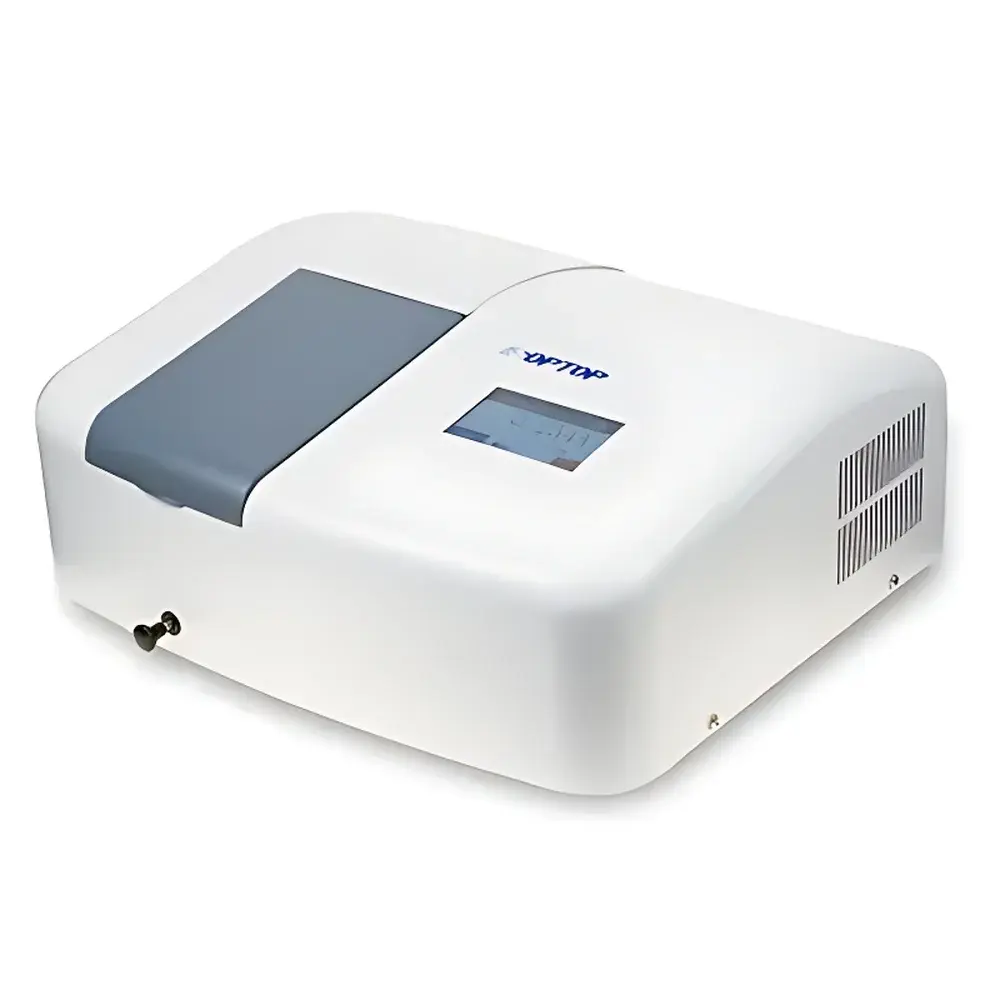
Sunny Hengping UV2200 Dual-Beam Ultraviolet-Visible Spectrophotometer
| Brand | Sunny Hengping Instrument |
|---|---|
| Origin | Shanghai, China |
| Manufacturer Type | Original Equipment Manufacturer (OEM) |
| Country of Origin | China |
| Model | UV2200 |
| Optical Design | Dual-beam |
| Detector | Photodiode Array |
| Wavelength Range | 190–1100 nm (0.1 nm step resolution) |
| Spectral Bandwidth | 4 nm |
| Wavelength Accuracy | ±0.3 nm |
| Wavelength Repeatability | ±0.1 nm |
| Photometric Accuracy | ±0.002 Abs (0–0.5 Abs), ±0.004 Abs (0.5–1.0 Abs) |
| Photometric Repeatability | ±0.001 Abs |
| Stray Light | ≤0.05% T at 220 nm and 360 nm |
| Baseline Flatness | ±0.001 Abs (200–1000 nm) |
| Interface | USB 2.0 |
| Display | 4.3-inch color TFT touchscreen (480 × 272 pixels) |
| Power Supply | 220 V ±10%, 50 Hz / 110 V ±10%, 60 Hz, 90 W |
| Dimensions (W×D×H) | 470 × 380 × 225 mm |
| Net Weight | 10.5 kg |
Overview
The Sunny Hengping UV2200 is a dual-beam ultraviolet-visible (UV-Vis) spectrophotometer engineered for precision quantitative and qualitative analysis in academic, pharmaceutical, environmental, and industrial laboratories. Based on Czerny-Turner (C-T) monochromator architecture with a 1200-line/mm holographic grating, the instrument delivers high optical throughput and spectral fidelity across its full 190–1100 nm wavelength range. The dual-beam optical path compensates for source intensity drift and detector sensitivity variation in real time, ensuring long-term photometric stability and measurement reproducibility—critical for compliance-driven workflows such as those governed by USP General Chapter <851>, ISO 17025, or ASTM E275. Its 4 nm spectral bandwidth conforms to standard method requirements for routine absorbance-based assays, including those specified in EPA Method 415.1 and ISO 7027 for turbidity-corrected quantification.
Key Features
- Dual-beam optical design with real-time reference beam compensation for enhanced baseline stability and reduced drift during extended scans.
- High-resolution 4.3-inch color TFT touchscreen (480 × 272 pixels) enabling intuitive navigation, direct parameter entry, and on-device data review without external PC dependency.
- Fast wavelength scanning mechanism with ≤2 s full-range (190–1100 nm) scan time at 1 nm interval, supporting high-throughput screening and kinetic monitoring.
- Modular lamp architecture: pre-aligned deuterium and tungsten-halogen lamps with flanged socket mounting—lamp replacement requires no optical recalibration or collimation tools.
- Integrated photodiode array detection system optimized for signal-to-noise ratio across UV and visible regions, eliminating mechanical slit-width adjustment.
- USB 2.0 interface for direct connection to Windows-based workstations; supports plug-and-play recognition under Windows 10/11 without proprietary drivers.
- Onboard memory retains calibration settings, method parameters, and up to 500 measurement records—even after power interruption.
Sample Compatibility & Compliance
The UV2200 accommodates standard 10 mm pathlength cuvettes (quartz, glass, or plastic), micro-volume adapters (down to 50 µL), and optional fiber-optic probes for remote or in-situ measurements. It supports liquid, solution-phase, and transparent solid samples compliant with ISO 9001-controlled sample handling protocols. For regulated environments, the optional GMP-compliant audit trail module provides timestamped, user-identifiable logs of all critical operations—including method edits, calibration events, data exports, and result modifications—fully traceable per FDA 21 CFR Part 11 requirements. All firmware and software revisions are version-controlled and documented per ICH Q5A and GLP Annex 11 principles.
Software & Data Management
UV-Solution software (v3.2+, included) is a validated, Windows-native application offering six core operational modes: Photometric Measurement, Spectrum Scanning, Kinetic (Time) Scanning, Quantitative Analysis, DNA/Protein Analysis, and Multi-Wavelength Analysis. Advanced spectral processing includes Savitzky-Golay smoothing, derivative spectroscopy (1st–3rd order), peak valley detection, overlay comparison, and coordinate transformation. All reports conform to ISO/IEC 17025 documentation standards—exportable as PDF (print-ready), Excel (.xlsx), BMP, or CSV formats. Data integrity is reinforced via password-protected user roles (Operator, Supervisor, Administrator), electronic signatures, and encrypted local database storage. Optional IQ/OQ documentation packages support installation and operational qualification for laboratory validation projects.
Applications
- Pharmaceutical QC: Assay of active pharmaceutical ingredients (APIs) per USP monographs using single- or multi-point calibration curves.
- Environmental testing: Nitrate, phosphate, and heavy metal ion quantification via colorimetric methods (e.g., APHA Standard Methods 4500-NO3−-B).
- Biochemical analysis: Rapid nucleic acid and protein concentration determination at 260/280 nm with built-in A260/A280 ratio calculation and extinction coefficient customization.
- Materials science: Bandgap estimation of semiconductor nanoparticles via Tauc plot construction from diffuse reflectance-derived absorbance data.
- Food & beverage: Color index evaluation (e.g., AOAC 993.02), preservative quantification (e.g., benzoic acid at 228 nm), and antioxidant capacity assays (e.g., DPPH radical scavenging).
- Educational labs: Teaching fundamental spectroscopic principles—including Beer-Lambert law validation, spectral interference studies, and solvent effect analysis.
FAQ
Does the UV2200 support regulatory compliance for GxP environments?
Yes—when equipped with the optional Audit Trail Module, the system meets 21 CFR Part 11 requirements for electronic records and signatures, including secure user authentication, immutable activity logs, and change history tracking.
Can the instrument perform simultaneous multi-wavelength measurements?
It supports sequential multi-wavelength acquisition at up to 10 user-defined wavelengths per sample, with full data export and statistical reporting per wavelength set.
Is the photodiode array detector temperature-stabilized?
The detector operates within a thermally shielded compartment; while not actively cooled, its design minimizes thermal noise drift over ambient temperature ranges of 15–30 °C.
What validation documentation is available for IQ/OQ/PQ protocols?
Sunny Hengping provides standardized IQ/OQ test scripts, calibration certificates traceable to NIST standards, and equipment specification documents aligned with ISO/IEC 17025 Annex A.2.
How is wavelength accuracy verified and maintained?
Factory calibration uses holmium oxide and didymium oxide reference filters; users may perform periodic verification using NIST-traceable holmium oxide solution (SRM 2034) following ASTM E275 guidelines.





