
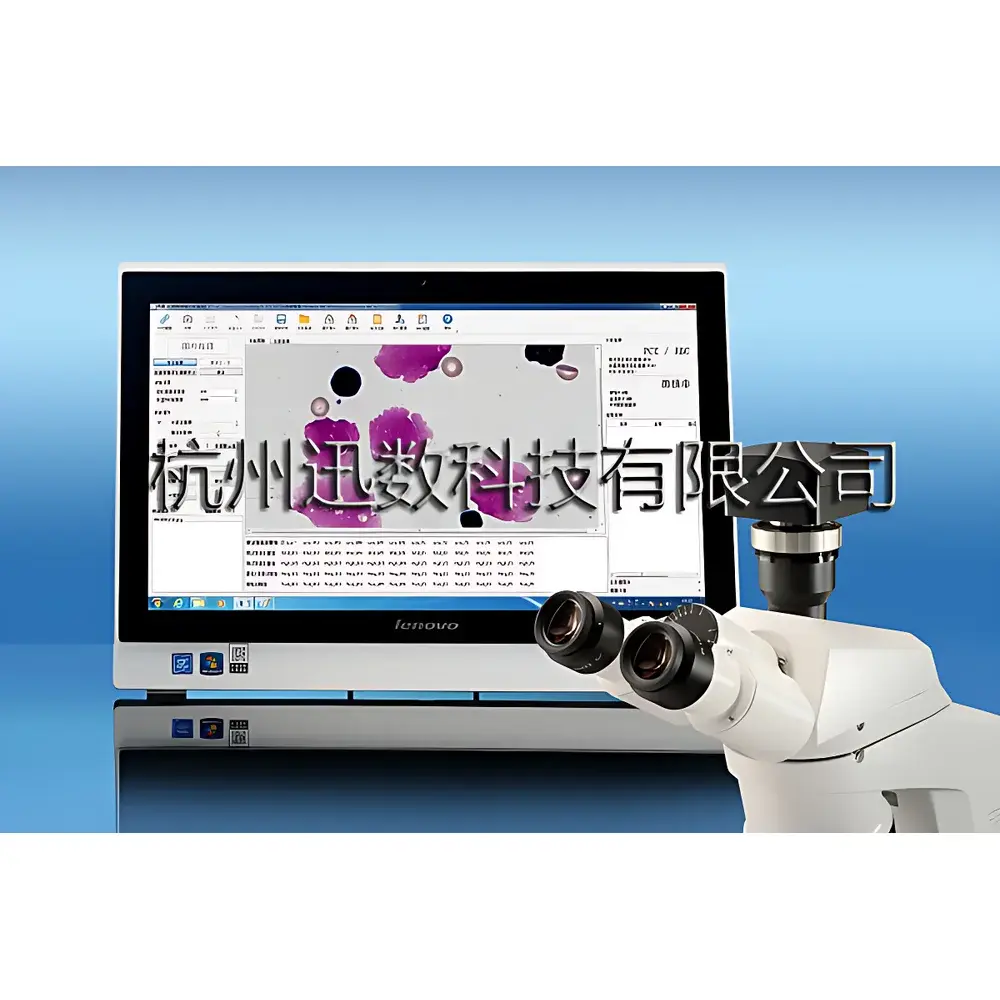
Xunshu MCN-2 Erythrocyte Micronucleus Intelligent Analysis System
| Brand | Xunshu |
|---|---|
| Origin | Zhejiang, China |
| Manufacturer Type | Manufacturer |
| Region of Origin | Domestic (China) |
| Model | MCN-2 |
| Pricing | Upon Request |
Overview
The Xunshu MCN-2 Erythrocyte Micronucleus Intelligent Analysis System is a dedicated digital image analysis platform engineered for standardized in vivo micronucleus testing in mammalian erythrocytes. It operates on the principle of high-fidelity color image acquisition and adaptive stochastic resonance–enhanced weak-signal recognition—specifically optimized for Giemsa-stained bone marrow or peripheral blood smears from rodent models. Unlike flow cytometry–based or fluorescence-based alternatives, the MCN-2 leverages conventional brightfield microscopy infrastructure already present in most toxicology and regulatory laboratories, converting it into a calibrated digital imaging station via a C-mount adapter and scientific-grade CCD camera. Its analytical core implements ISO 10993-3, OECD TG 474, and GB/T 21805–2008–compliant protocols for polychromatic erythrocyte (PCE) identification, normochromatic erythrocyte (NCE) classification, and micronucleus (MN) detection within PCEs. The system does not require fluorescent staining, antibody labeling, or specialized optical filters—reducing assay cost, complexity, and inter-laboratory variability.
Key Features
- Stochastic Resonance–Driven Weak-Color Cell Recognition: Overcomes low-contrast segmentation challenges in Giemsa-stained smears by amplifying sub-threshold chromatic signals through a bistable nonlinear system; quantified via mutual information entropy at the output stage.
- Deep Learning–Augmented Cell Classification: Trains on user-selected representative NCE and PCE morphologies to establish robust, specimen-specific feature templates—enabling consistent discrimination across varying staining intensity and slide preparation quality.
- High-Throughput Automated Scanning: Processes 200 microscope fields (100–300 images per slide) in ≤60 seconds; identifies and extracts ≥2,000 PCEs with micronucleus annotation and calculates MN frequency (MN‰) and PCE/(PCE+NCE) ratio with <2% intra-assay CV.
- Full Traceability Architecture: Each detected PCE cell is digitally geotagged with its original coordinate (x,y), field ID, and slide index—allowing one-click zoom-and-verify validation against raw image data.
- FDA 21 CFR Part 11–Ready Software Environment: Enforces electronic signatures, role-based access control (administrator/operator tiers), immutable audit trails, and PDF/Excel export with cryptographic hash integrity verification.
- Hardware-Integrated Imaging Workflow: Includes Sony ExView HAD ICX285AQ(C) 2/3″ CCD sensor (1.4 MP, 6.45 µm pixel pitch), USB 2.0 interface, 15 fps @ 1360×1024, adjustable exposure (0.12 ms–240 s), and real-time white balance calibration.
Sample Compatibility & Compliance
The MCN-2 is validated for use with Giemsa-stained mouse or rat bone marrow smears and peripheral blood preparations. It supports standard OECD 474-compliant experimental designs—including concurrent negative (vehicle), positive (e.g., cyclophosphamide), and three-tier dose groups (high/medium/low), with separate male/female data stratification (6 slides per sex per group). All image acquisition and analysis parameters comply with GLP requirements for genetic toxicology studies submitted to regulatory agencies including the U.S. EPA, EMA, and NMPA. Raw image archives, processed cell arrays, and statistical outputs are stored in timestamped project files with SHA-256 checksums to ensure data integrity and reproducibility.
Software & Data Management
The proprietary Xunshu Micronucleus Analysis Suite (v5.2+) provides end-to-end workflow automation—from live microscope preview and batch image capture to statistical reporting. Electronic records are stored in encrypted SQLite databases with automatic daily backups. Audit logs record every user action: login/logout timestamps, parameter adjustments, manual corrections, report generation events, and deletion attempts—with operator ID, workstation IP, and session duration. Reports export as tamper-evident PDFs (with embedded metadata and digital signature) or structured Excel files (.xlsx) containing raw counts, ratios, confidence intervals, and descriptive statistics per group. Multi-user account management allows administrators to assign permissions, enforce password policies, and freeze inactive accounts without data loss.
Applications
- Regulatory genotoxicity screening per ICH S2(R2), OECD 474, and ISO 10993-3 guidelines
- In vivo micronucleus assay for pharmaceutical, agrochemical, and industrial chemical safety assessment
- Academic research on clastogenic and aneugenic mechanisms in hematopoietic tissues
- Quality control of cytogenetic laboratories seeking ISO/IEC 17025 accreditation
- Training platform for standardized microscopist competency evaluation and inter-laboratory proficiency testing
FAQ
Does the MCN-2 require a specific brand or model of microscope?
No—it interfaces with any standard upright or inverted brightfield microscope equipped with a trinocular port and C-mount adapter.
Can the system analyze human peripheral blood samples?
While primarily validated for rodent models per OECD 474, protocol adaptation for human samples is possible under laboratory-developed test (LDT) validation per CLIA and ISO 15189 requirements.
Is the software compatible with Windows 11 and 64-bit systems?
Yes—the current release supports Windows 10 (64-bit) and Windows 11 (64-bit); legacy support for Windows 7 is maintained but deprecated.
How is data backup and long-term archival handled?
Project files are self-contained folders containing images, metadata, and analysis logs; users may configure automated network or NAS backups via Windows Task Scheduler.
What validation documentation is provided with the system?
Xunshu supplies IQ/OQ documentation templates, software verification reports, and a traceable calibration certificate for the CCD sensor—supporting GxP-compliant installation and operational qualification.
Related Products




