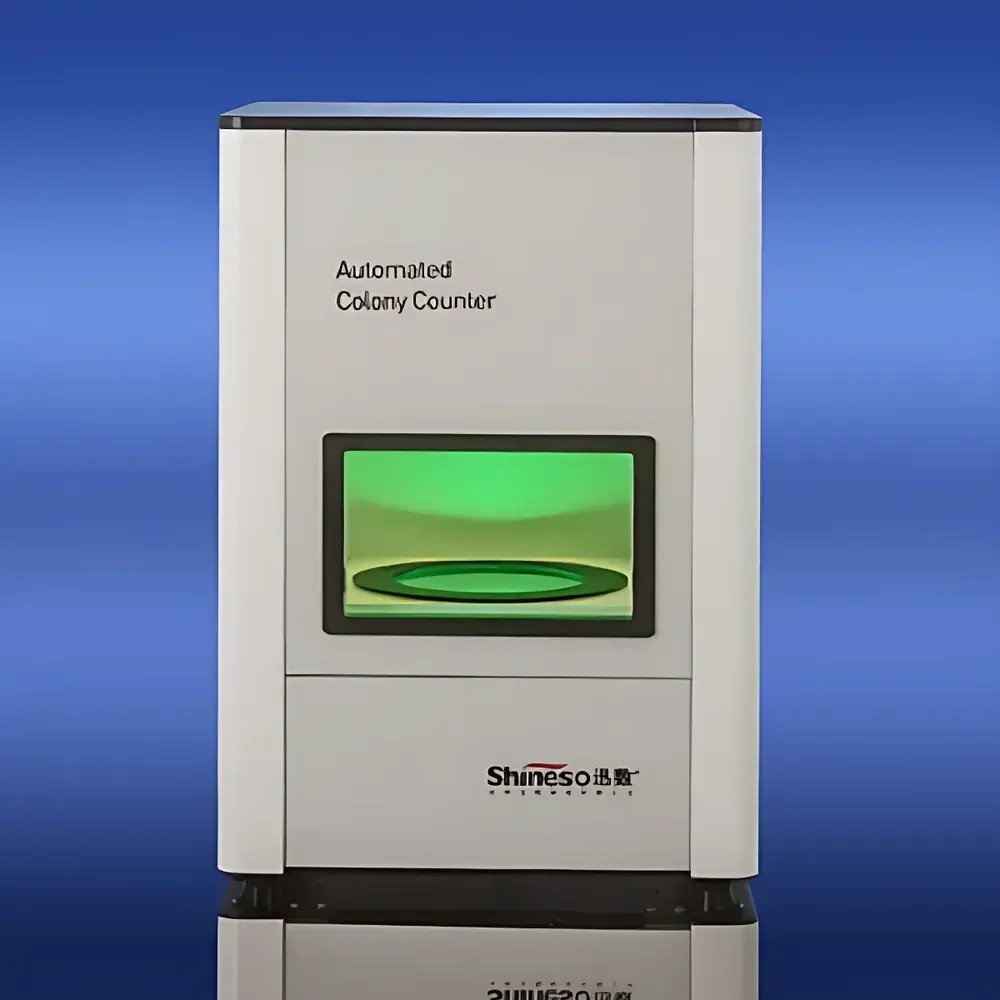
Xunshu Czone 12 AI-Powered Automated Colony Counter and Zone-of-Inhibition Analyzer
| Brand | Xunshu |
|---|---|
| Origin | Zhejiang, China |
| Manufacturer Type | Direct Manufacturer |
| Instrument Type | Fully Automated Colony Counter & Zone-of-Inhibition Measurement System |
| Sample Types | Petri dishes, membrane filters, and microbiological test films |
| Sample Diameter Range | 35–150 mm |
| Counting Speed | 20,000 colonies/sec |
| Resolution | 0.01 mm |
| Imaging System | 12 mm fixed-focus lens, 10 MP, 200 lp/mm resolution, f/1.8–f/32, C-mount |
| Sensor | 1/1.8" color CMOS, 20 MP, 1.4 × 1.4 µm pixel size |
| Illumination Modes | Triple-path optical system — suspended dark-field, chromatic translucent backlight (5 selectable colors), and gradient diffuse top-light |
| Software Suite | AI Colony Counting Module, Classical Colony Analysis Module, Automatic Zone-of-Inhibition Detection Module, Antibiotic Potency Assay Module (Chinese Pharmacopoeia 2025 Edition compliant) |
Overview
The Xunshu Czone 12 is a high-precision, fully automated colony counter and zone-of-inhibition (ZOI) analyzer engineered for regulatory-compliant microbiological quantification in pharmaceutical, food safety, environmental monitoring, and antimicrobial efficacy laboratories. It employs digital image acquisition coupled with deep learning–based segmentation and boundary detection algorithms to deliver objective, reproducible colony enumeration and ZOI measurement—without manual threshold tuning or operator-dependent interpretation. The instrument operates on the principle of high-fidelity optical imaging under controlled multi-spectral illumination, followed by pixel-level classification and morphometric analysis. Its architecture supports GLP/GMP-aligned workflows through built-in audit trail, role-based access control, and electronic record integrity safeguards per FDA 21 CFR Part 11 requirements.
Key Features
- Triple-path illumination system: Suspended dark-field (blue/white LED array), chromatic translucent backlight (5 independently controllable wavelengths), and gradient diffuse top-light—each optimized for specific sample types and contrast enhancement.
- High-resolution imaging chain: 12 mm C-mount fixed-focus lens (200 lp/mm resolution at f/4), paired with a 20 MP, 1/1.8″ color CMOS sensor (1.4 µm pixel pitch), enabling sub-0.01 mm spatial resolution and accurate edge delineation of both opaque colonies and transparent inhibition zones.
- AI-powered colony detection engine: Trained on >20 years of real-world user-collected colony imagery across diverse media, growth conditions, and contamination profiles; delivers robust segmentation for clustered, low-contrast, micro-colonies (<0.1 mm), glossy or translucent colonies, and filter membranes with heterogeneous background.
- Multi-algorithm ZOI detection: “Auto-Detect” (edge-gradient based), “Circle-Fit Approximation” (for irregular or fragmented zones), and “Three-Point Manual Circle” (for low-contrast boundaries); all calibrated against pharmacopeial reference standards.
- Pharmacopeia-compliant antibiotic potency calculation: Implements Chinese Pharmacopoeia 2025 Edition two-dose and three-dose assay protocols, including parallel-line analysis, slope-ratio computation, and statistical validation of linearity and precision (repeatability ≤0.002 mm, inter-unit variation ≤0.2%).
Sample Compatibility & Compliance
The Czone 12 accommodates standard microbiological sample formats: agar plates (pour, spread, or streak), nitrocellulose or mixed-ester membrane filters, and commercial rapid-test films (e.g., 3M Petrifilm™). It supports plate diameters from 35 mm to 150 mm—including stacked or inverted orientations—without mechanical repositioning. All illumination modes meet ISO 4833-1:2013 and AOAC Official Method 977.27 requirements for uniformity (≥90% illuminance homogeneity) and spectral stability. UV-C disinfection module (265 nm, ozone-free, 100,000 h LED lifetime) ensures bioburden control between runs. The system is validated for use in environments requiring compliance with USP , , , and EU GMP Annex 11 data integrity expectations.
Software & Data Management
The embedded software suite enforces ALCOA+ principles (Attributable, Legible, Contemporaneous, Original, Accurate, Complete, Consistent, Enduring, Available). A four-tier user role model—System Administrator, Data Reviewer, Test Operator, and Audit Approver—governs access to functions such as image import, analysis execution, result editing, report finalization, and archive sealing. Every action—including login/logout, file creation, parameter adjustment, and report export—is immutably timestamped and logged in an open-read audit trail. Raw images, processed masks, statistical outputs, and PDF/Excel reports are stored as encrypted project files with SHA-256 checksum verification. Backup and restore operations support external NAS or removable SSD media with CRC-32 transmission validation. Searchable metadata indexing enables retrieval by date range, sample ID, operator name, or assay type.
Applications
- Quantitative microbial load assessment in raw materials, finished products, and environmental swabs per ISO 7218 and ISO 6887 series.
- Antibiotic susceptibility testing (AST) and minimum inhibitory concentration (MIC) surrogate analysis via ZOI diameter correlation.
- Validation of sterilization processes (e.g., autoclave cycle efficacy, filter integrity) using challenge organisms.
- Quality control of probiotics, starter cultures, and fermented foods requiring strain-specific colony morphology discrimination.
- Regulatory submission support for FDA IND/NDA, EMA MAA, and NMPA registration dossiers where digital image-based colony enumeration is required.
FAQ
Does the Czone 12 comply with FDA 21 CFR Part 11 for electronic records and signatures?
Yes. The system implements role-based authentication, audit-trail logging, electronic signature capture for review/approval steps, and cryptographic hash protection of raw data—fully satisfying Part 11 Subpart B requirements.
Can the AI model be retrained with proprietary laboratory data?
No. The AI inference engine is pre-trained and locked; however, users may define custom classification rules (color, size, texture thresholds) within the Classical Analysis Module without altering core model weights.
What calibration standards are supported for ZOI measurement verification?
NIST-traceable stainless-steel gauge disks (diameters 5–30 mm, ±0.001 mm tolerance) and certified antibiotic-impregnated disk sets (e.g., Oxoid, BD BBL) are recommended for daily performance qualification.
Is remote software update capability available?
Firmware and application updates require authenticated USB media import; no internet-connected update channel is implemented to preserve network air-gap security in regulated labs.
How is data integrity ensured during power failure or unexpected shutdown?
All active analyses write intermediate results to non-volatile memory every 3 seconds; upon restart, the system resumes from last stable checkpoint without loss of image or metadata.