
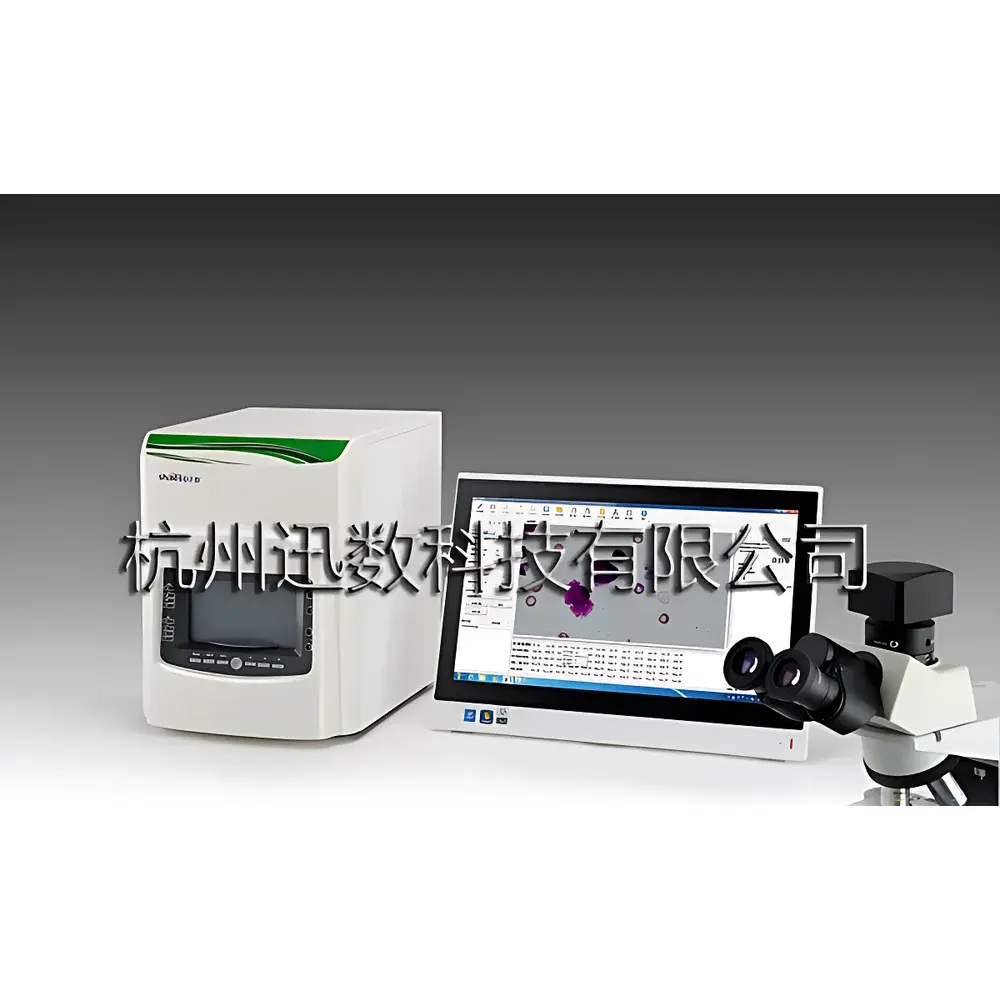
Xunshu GenTox 2 Micronucleus Analysis & Colony Counting System
| Brand | Xunshu |
|---|---|
| Origin | Zhejiang, China |
| Manufacturer Type | Original Equipment Manufacturer (OEM) |
| Country of Origin | China |
| Model | GenTox 2 |
| Pricing | Upon Request |
Overview
The Xunshu GenTox 2 Micronucleus Analysis & Colony Counting System is a dual-function, regulatory-compliant digital imaging platform engineered for standardized genotoxicity and microbiological testing in GLP- and ISO/IEC 17025-accredited laboratories. It integrates two independently validated analytical modules—micronucleus scoring for mammalian erythrocytes and automated colony enumeration—within a single hardware architecture. The micronucleus module operates on the principle of high-fidelity color image acquisition from standard trinocular microscopes, leveraging C-mount coupling to a scientific-grade CCD camera and applying supervised machine learning algorithms trained on Giemsa-stained erythrocyte morphology per Chinese National Standard GB/T 21805–2008 and OECD Test Guideline 474. The colony counting module employs dual-illumination optical design (top-mounted scene-adaptive LED array and bottom-mounted suspended dark-field illumination) combined with a 16-megapixel CMOS sensor and multi-model segmentation algorithms—including level-set optimization and dynamic contrast resonance—to resolve morphologically heterogeneous colonies on diverse agar media (pour plates, spread plates, membrane filters, spiral plates, 3M™ Petrifilm™, and multi-well formats). Both modules share a unified audit-trail framework compliant with FDA 21 CFR Part 11, EU Annex 11, and ISO 13485 data integrity requirements.
Key Features
- Dual-Modality Architecture: Simultaneous support for micronucleus assay (PCE/NCE classification and micronucleus detection) and colony enumeration without hardware reconfiguration.
- Microscope-Integrated Imaging: Utilizes existing laboratory trinocular microscopes via C-mount adapter; eliminates need for dedicated microscope purchase while maintaining optical fidelity.
- Deep Learning-Based Cell Classification: Trained convolutional neural networks distinguish polychromatic erythrocytes (PCE) and normochromatic erythrocytes (NCE) with adaptive feature extraction; achieves >98% concordance with expert manual scoring across ≥200 fields of view.
- Real-Time Resonance Image Enhancement: Stochastic resonance processing enhances low-contrast micronuclei against cytoplasmic background, improving detection sensitivity without compromising specificity.
- Four-Tier Role-Based Access Control: System Administrator, Data Administrator, Operator, and Reviewer roles enforce strict separation of duties—consistent with ALCOA+ principles (Attributable, Legible, Contemporaneous, Original, Accurate, Complete, Consistent, Enduring, Available).
- Full Audit Trail Logging: Immutable records capture user identity, timestamp, sample ID, parameter settings, statistical outputs, modifications, deletions, and report generation events—exportable as tamper-evident PDF or CSV.
- Multi-Algorithm Colony Segmentation: Six preconfigured counting modes (e.g., “Small-Colony Priority”, “Same-Color Colony Isolation”, “Agar Background Rejection”) plus adaptive level-set and inverse watershed algorithms for complex colony topologies.
- Optical Integrity Assurance: 254 nm UV sterilization lamp integrated into dark chamber; calibrated 8 mm fixed-focus lens (150 lp/mm resolution); automatic white balance and exposure control across variable lighting conditions.
Sample Compatibility & Compliance
The GenTox 2 supports standardized sample types defined in international regulatory frameworks: mouse or rat bone marrow smears for micronucleus assays (OECD 474, ICH S2(R2), GB/T 21805); and standard microbiological culture plates including TSA, PCA, VRBA, and selective media used in Ames test (OECD 471), mutagenicity screening, and environmental monitoring. All software workflows comply with ISO/IEC 17025:2017 clause 7.7 (results reporting), CLSI EP23-A validation guidelines, and FDA Guidance for Industry on Analytical Procedures and Methods Validation (2015). Electronic records meet 21 CFR Part 11 Subpart B requirements for electronic signatures, system validation, and record retention. The system has been validated for use in laboratories operating under GLP (OECD Principles), GMP (ICH Q5C), and CNAS accreditation scopes.
Software & Data Management
Both micronucleus and colony analysis modules run on a unified Windows 10–based application suite protected by hardware-bound USB encryption dongle. Data storage follows a three-tier model: raw image files (TIFF/RAW), processed metadata (SQLite relational database), and finalized reports (PDF/A-2b or Excel .xlsx). Each image retains embedded EXIF metadata including acquisition time, exposure parameters, lens calibration ID, and operator login token. All reports embed dynamic watermarks indicating reviewer approval status and cryptographic hash verification. Data export supports batch archival to network-attached storage (NAS) or LIMS integration via HL7 v2.5 or ASTM E1384-compliant XML schema. Backup routines execute daily incremental snapshots with SHA-256 checksum validation; archived datasets are retained for ≥30 years per internal SOP-DM-003.
Applications
- Regulatory genotoxicity testing: In vivo micronucleus assays per OECD 474 for pharmaceutical, agrochemical, and industrial chemical safety dossiers.
- Ames test automation: High-throughput scoring of His− Salmonella typhimurium revertants across multiple strains (TA98, TA100, TA1535, TA1537) and metabolic activation conditions (±S9).
- Environmental mutagen screening: Quantitative analysis of airborne particulates, wastewater effluents, and soil extracts using standardized bacterial reverse mutation protocols.
- Quality control in biopharmaceutical manufacturing: Rapid enumeration of bioburden in raw materials, in-process samples, and final product sterility testing.
- Academic research in genetic toxicology: Longitudinal studies of dose-response relationships, clastogenic vs. aneugenic mechanisms, and inter-laboratory reproducibility assessment.
- Food safety laboratories: Enumeration of total viable counts, coliforms, and pathogenic indicators (e.g., E. coli O157:H7, Listeria monocytogenes) on selective media.
FAQ
Can the GenTox 2 be validated for use in FDA-regulated submissions?
Yes—the system supports full IQ/OQ/PQ documentation packages aligned with ASTM E2500-13 and GAMP 5. All software modules undergo periodic revalidation per internal SOP-VAL-002.
Does the micronucleus module require proprietary microscope hardware?
No—it interfaces with any trinocular microscope equipped with C-mount port, enabling cost-effective reuse of existing instrumentation.
How does the system ensure data integrity during multi-user operation?
Through immutable audit trails, role-based permissions, electronic signatures, and cryptographic hashing of all report exports—fully traceable to individual operators and timestamps.
Is remote access or LIMS integration supported?
Yes—secure HTTPS API endpoints allow controlled integration with major LIMS platforms (e.g., LabWare, STARLIMS, Thermo Fisher SampleManager) via RESTful web services.
What training and technical support options are available?
Xunshu provides on-site installation qualification, operator certification workshops, annual software updates, and 24/7 remote diagnostics via encrypted VNC channel—supported by ISO 9001-certified service infrastructure.




