
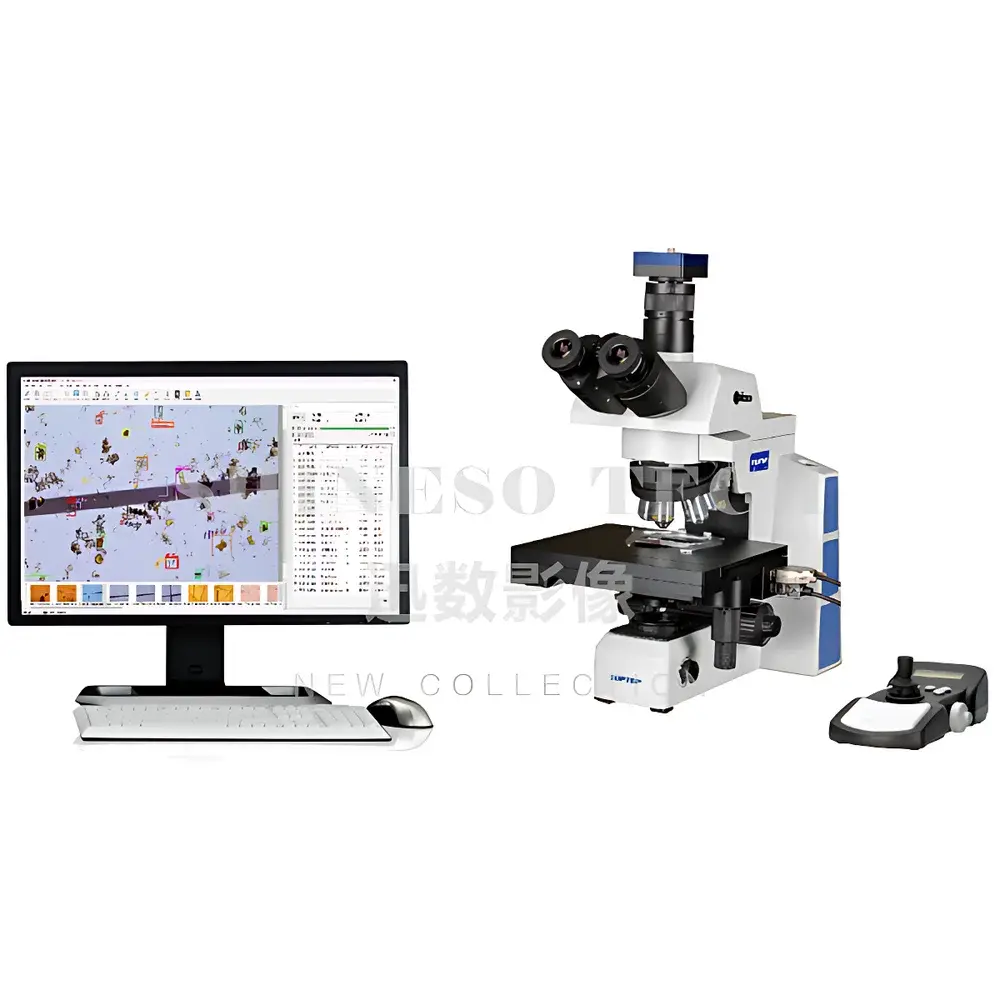
Xunshu AlgaeAI 700 Automated Plankton Classification and Enumeration System
| Brand | Xunshu |
|---|---|
| Origin | Zhejiang, China |
| Manufacturer Type | Original Equipment Manufacturer (OEM) |
| Product Category | Domestic |
| Model | Xunshu AlgaeAI 700 |
| Pricing | Upon Request |
Overview
The Xunshu AlgaeAI 700 Automated Plankton Classification and Enumeration System is a fully integrated digital microscopy and artificial intelligence platform engineered for standardized, reproducible, and audit-ready phytoplankton and zooplankton analysis in freshwater and marine environmental monitoring laboratories. At its core, the system combines high-precision automated scanning microscopy with a proprietary deep learning inference engine trained on taxonomically validated plankton image datasets. It operates on the principle of supervised convolutional neural network (CNN) classification—where morphological features (e.g., cell symmetry, frustule ornamentation, colony geometry, flagellar configuration, chloroplast topology) are extracted from high-resolution micrographs and mapped to taxonomic identities using multi-layer feature hierarchies. Unlike rule-based or threshold-driven image segmentation tools, AlgaeAI 700 employs end-to-end trainable architectures that generalize across variable optical conditions—including partial occlusion, defocus blur, low contrast, overlapping cells, and heterogeneous background debris—enabling robust enumeration under real-world field sample constraints.
Key Features
- Automated scanning microscopy platform built around Olympus BX43 research-grade upright microscope with UIS2 infinity-corrected optics and semi-apochromatic objectives (4×, 10×, 20×, 40×)
- High-accuracy XYZ motorized stage with ≤±1 µm bidirectional repeatability and 0.1 µm minimum step resolution; supports full-slide, grid-based, or randomized field-of-view acquisition protocols
- Global shutter camera with <0.20 µm/pixel spatial sampling; Z-stack acquisition enabled via closed-loop piezoelectric focus drive (0.156 µm resolution, ≤±0.4 µm repeatability)
- AlgaeAI deep learning engine trained on >145 phytoplankton taxa (Chlorophyta, Cyanobacteria, Bacillariophyta, Cryptophyta, Dinophyta, etc.) and 60+ zooplankton species; average per-species identification accuracy ≥95% under local validation conditions
- Real-time visualization pipeline: dynamic bounding-box annotation, live statistical dashboard (phylum/class/species count, relative abundance, cell density, biovolume), and progress-indicating UI elements
- Interactive correction interface allowing manual addition, deletion, or reclassification of detected objects—with immediate recalculation of derived metrics (Shannon diversity index, Pielou evenness, dominance ratio, biomass estimates)
- Robust handling of challenging imaging artifacts: intelligent deconvolution of overlapped/clustered cells; contextual inference for partially visible or edge-truncated organisms; probabilistic reconstruction of out-of-focus or low-contrast specimens
Sample Compatibility & Compliance
The AlgaeAI 700 complies with multiple national and technical standards governing aquatic ecological assessment, including SL 733–2016 “Technical Specification for Phytoplankton Monitoring in Inland Waters”, HJ 1215–2021 and HJ 1216–2021 “Determination of Phytoplankton in Water Quality—Microscopic Counting Methods Using Filter Membrane and 0.1 mL Sedimentation Chamber”, GB 17378.7–2007 “Specifications for Marine Monitoring—Part 7: Biological Monitoring”, and the “Methods for Monitoring and Analysis of Water and Wastewater” (4th Edition). It supports standard Utermöhl-style sedimentation chambers, membrane filtration preparations, and direct wet-mount slides. The system accommodates specimen size ranges from 3 µm to 1000 µm and handles cell densities up to 1011 cells/L without loss of detection fidelity. All raw images, annotated metadata, processing logs, and final reports are stored in a timestamped, immutable format compliant with GLP data integrity requirements.
Software & Data Management
The embedded software suite provides full traceability across the analytical workflow—from acquisition through classification to reporting. Each image retains embedded EXIF metadata (objective magnification, Z-position, exposure time, stage coordinates) and AI-generated annotations (confidence scores, bounding polygons, taxonomic IDs). Statistical outputs include absolute and relative counts, mean morphometric parameters (length, width, height, diameter, area, volume), biovolume summations, and ecological indices (Shannon–Wiener, Simpson dominance, Margalef richness). Reports export in PDF, Excel, and CSV formats with configurable templates aligned to regulatory submission formats. Audit trails record all user interventions (e.g., manual corrections, parameter adjustments), supporting FDA 21 CFR Part 11–compliant environments when deployed with appropriate IT governance controls.
Applications
The AlgaeAI 700 serves as a primary tool in routine water quality surveillance programs operated by municipal drinking water utilities, environmental protection agencies, reservoir management authorities, and academic limnology laboratories. Typical use cases include long-term trend analysis of eutrophication indicators (e.g., cyanobacterial bloom dynamics), compliance verification against nutrient discharge permits, baseline biodiversity assessments prior to infrastructure development, and rapid response screening during harmful algal bloom (HAB) events. Its capacity to quantify both phytoplankton and zooplankton enables trophic cascade evaluation and food web modeling. The integrated expert database further supports training and competency development for junior analysts and field technicians engaged in standardized ecological monitoring.
FAQ
Does the system require specialized taxonomic expertise to operate?
No. The interface is designed for routine laboratory personnel; species identification and quantification are fully automated. Taxonomic knowledge is only required for optional verification or refinement steps.
Can the AI model be retrained with user-specific regional species?
Yes. Xunshu provides one complimentary local algorithm customization service, enabling integration of regionally relevant taxa not covered in the default library.
Is raw image data preserved alongside processed results?
Yes. All original TIFF/JPEG acquisitions, along with annotated versions and processing history, are retained in a structured directory hierarchy with SHA-256 checksums for integrity verification.
How does the system handle mixed freshwater/marine samples?
The software includes separate taxonomic modules for freshwater and marine plankton, each searchable by hierarchical classification (phylum → order → genus → species) or morphology-based similarity matching.
What level of IT infrastructure is required for deployment?
The system ships with a dedicated workstation (Intel Core i9-12900, 32 GB RAM, 4 GB GPU, dual-storage configuration) optimized for real-time inference; no cloud dependency or external server is required for core functionality.







