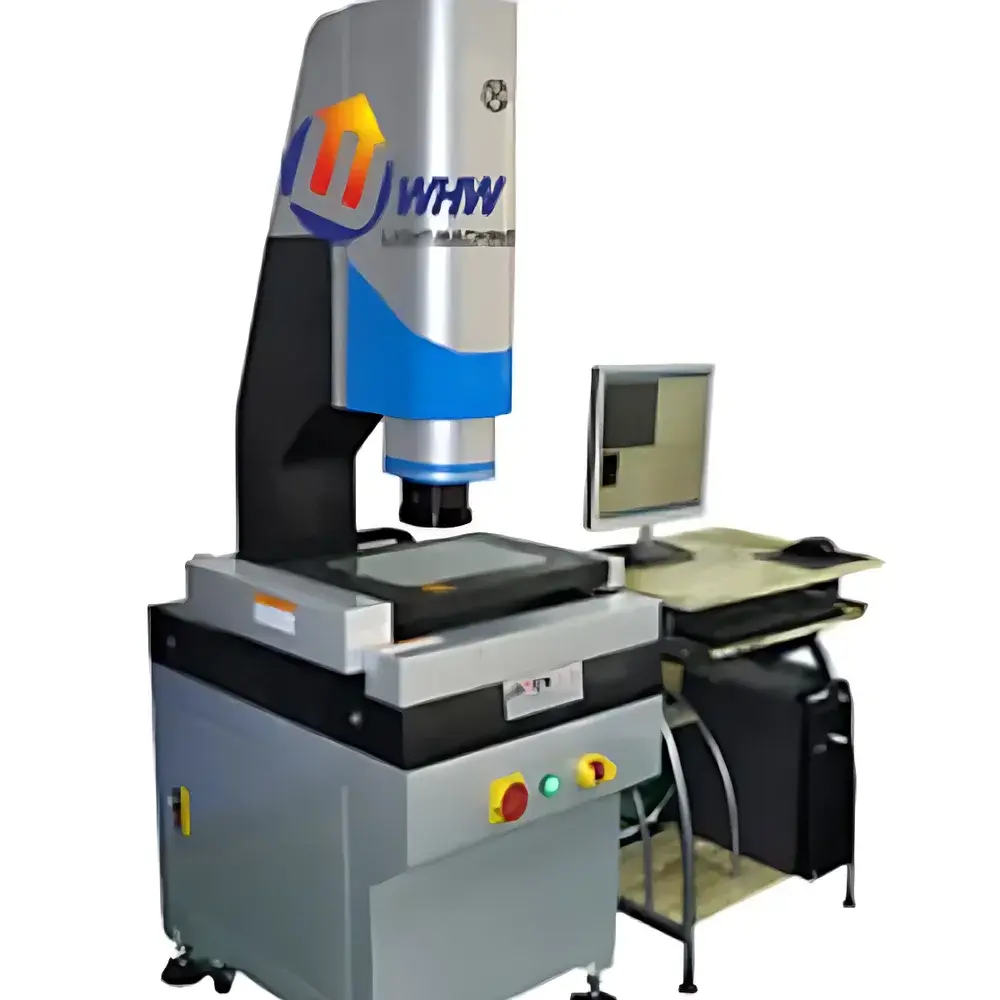
YANRUN YR-Q3020 Intelligent Automatic Vision Measuring Machine
| Brand | YANRUN |
|---|---|
| Origin | Shanghai, China |
| Manufacturer Type | Manufacturer |
| Model | YR-Q3020 |
| Operation Mode | Fully Automatic |
| Travel Range (X×Y×Z) | 300 × 200 × 200 mm |
| Overall Dimensions (L×W×H) | 880 × 650 × 1712 mm |
| Measurement Accuracy | X/Y-axis ≤ (3 + L/200) µm |
| Encoder Resolution | 0.5 µm (high-precision linear encoder) |
| Camera | Sony color CCD sensor |
| Optical System | Motorized zoom lens (optional laser probe for height/thickness measurement) |
| Illumination | Programmable LED ring light (surface illumination) and contour backlight with intensity control synchronized to magnification |
| Software | Proprietary automatic vision metrology software |
| Power Supply | AC 220 V ±10%, 50 Hz |
| Environmental Requirements | Temperature 20 °C ±3 °C |
Overview
The YANRUN YR-Q3020 Intelligent Automatic Vision Measuring Machine is a high-precision coordinate metrology system engineered for non-contact, two-dimensional and three-dimensional geometric inspection of machined parts, stamped components, PCBs, precision molds, and optical elements. It operates on the principle of digital image correlation—capturing high-resolution images via a calibrated Sony color CCD sensor, then applying sub-pixel edge detection algorithms to determine feature coordinates relative to a stabilized granite base and motorized XYZ stage. The system integrates a motorized zoom lens with real-time magnification feedback, enabling automated scale calibration across the full optical range. Its modular optical architecture supports optional laser displacement sensors for Z-axis profiling and thickness evaluation of transparent materials such as float glass or quartz wafers—making it suitable for applications demanding both planar geometry verification and surface topography assessment under controlled environmental conditions (20 °C ±3 °C, 45–75 % RH).
Key Features
- Fully automated measurement cycle: programmable part loading/unloading sequence, auto-focus, auto-lighting adjustment, and multi-point alignment routines reduce operator dependency and improve inter-operator repeatability.
- High-stability mechanical platform: granite base with precision-ground air-bearing guideways ensures minimal thermal drift and vibration transmission during extended measurement sessions.
- Dynamic illumination control: dual-channel LED lighting system—ring-type surface illumination and coaxial contour backlight—adjusts intensity automatically based on objective magnification and material reflectivity, optimizing edge contrast for accurate sub-pixel feature extraction.
- Linear encoder-based positioning: high-resolution 0.5 µm linear encoders on all three axes provide closed-loop positional feedback, supporting traceable dimensional measurements compliant with ISO 10360-7 and VDI/VDE 2617 Part 6 standards.
- Modular sensor integration: standardized mounting interface allows field-upgradable addition of tactile probes or confocal chromatic sensors for hybrid measurement strategies without hardware redesign.
Sample Compatibility & Compliance
The YR-Q3020 accommodates workpieces up to 300 mm × 200 mm in footprint and 200 mm in height, with mass capacity optimized for fixtures weighing ≤5 kg. It supports opaque metallic and polymer components, translucent plastics, and fully transparent substrates—including soda-lime glass, borosilicate glass, and sapphire wafers—via combined white-light imaging and optional laser triangulation. All measurement routines adhere to fundamental principles outlined in ISO 1101 (geometrical tolerancing), ISO 14289 (digital image metrology validation), and ASTM E2923-22 (standard guide for verifying optical coordinate measuring systems). The system’s environmental operating envelope (20 °C ±3 °C, 45–75 % RH) aligns with ISO 230-2 recommendations for volumetric performance testing of CMMs.
Software & Data Management
The proprietary vision metrology software provides a Windows-based GUI with scripting support (VBScript and Python API), enabling custom inspection routines, GD&T evaluation (position, profile, flatness, parallelism), and statistical process control (SPC) charting. Measurement data is stored in vendor-neutral XML format with embedded calibration metadata, including lens distortion coefficients, pixel pitch, and encoder compensation tables. Audit trails record user login, program execution timestamp, parameter modifications, and result exports—supporting compliance with FDA 21 CFR Part 11 requirements when configured with electronic signature modules and role-based access control. Raw image archives and measurement logs are exportable for third-party analysis or GLP/GMP documentation workflows.
Applications
- Quality assurance of micro-machined medical device components (e.g., stent struts, catheter hubs) requiring micron-level form and position verification.
- PCB and FPC inspection: solder paste volume estimation, pad coplanarity, drill hole location accuracy, and fiducial mark registration.
- Optical component metrology: lens center thickness, bevel angle, and edge chip detection on plano-convex lenses and IR windows.
- Automotive supplier PPAP submissions: first-article inspection reports with full GD&T annotation, tolerance stack-up analysis, and Cpk/Ppk calculation.
- Academic research labs: quantitative morphological analysis of MEMS structures, thin-film substrate warpage, and additive manufacturing lattice defect mapping.
FAQ
What standards does the YR-Q3020 comply with for measurement traceability?
The system conforms to ISO 10360-7 for vision-based CMM verification and supports calibration using certified gauge blocks and step gauges traceable to NIM (China National Institute of Metrology) or equivalent national metrology institutes.
Can the YR-Q3020 measure features on curved or reflective surfaces?
Yes—through adaptive lighting control, multi-angle illumination sequencing, and surface-normal compensation algorithms embedded in the software; however, highly specular or low-contrast surfaces may require application-specific contrast enhancement protocols.
Is the software compatible with enterprise MES or QMS platforms?
Yes—the system supports OPC UA and TCP/IP-based data exchange protocols, enabling direct integration with Siemens Opcenter, PTC ThingWorx, or ETQ Reliance for automated report ingestion and nonconformance workflow triggering.
Does the system require periodic recalibration by the manufacturer?
Annual verification against reference artifacts is recommended per ISO/IEC 17025 guidelines; however, end-users may perform intermediate performance checks using the built-in self-diagnostic routines and certified calibration plates.
What is the typical lead time for factory acceptance testing (FAT)?
Standard FAT includes environmental stabilization, volumetric error mapping, and five-part repeatability verification—typically completed within two business days prior to shipment.