
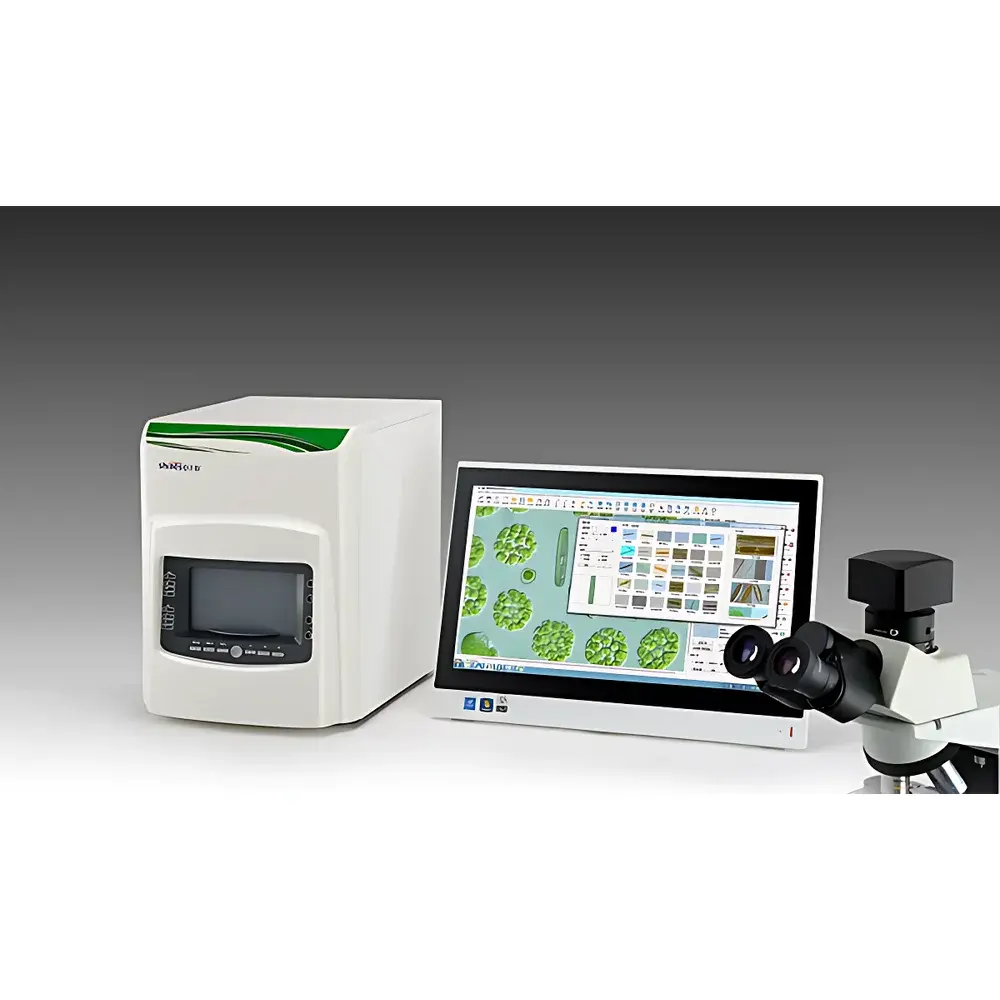
Xunsu Algacount M520 Integrated Colony Counter and Plankton Analysis System
| Brand | Xunsu |
|---|---|
| Origin | Zhejiang, China |
| Manufacturer Type | OEM Manufacturer |
| Product Origin | Domestic (China) |
| Model | M520 |
| Price Range | USD 14,000–21,000 |
| Instrument Type | Algal and Plankton Counter |
| Camera Resolution | 12 MP (SONY 1-inch CMOS sensor) |
| Microscope Magnifications | 4×, 10×, 40×, 100× |
| Identification Methods | Morphological Search, Taxonomic Classification, Similarity-Based Matching, Confusion-Resolving Comparative Analysis |
Overview
The Xunsu Algacount M520 Integrated Colony Counter and Plankton Analysis System is a dual-function, research-grade imaging platform engineered for high-precision microbiological and aquatic ecological monitoring. It combines automated colony enumeration—compliant with ISO 4833-1:2013, ISO 7218:2017, and USP /—with advanced digital plankton analysis grounded in morphometric image recognition and taxonomic database integration. Unlike conventional single-purpose instruments, the M520 employs synchronized optical imaging, multi-plane focus fusion, and ultra-wide-field acquisition to resolve spatially distributed microorganisms across heterogeneous liquid layers—critical for accurate phytoplankton and zooplankton quantification in freshwater, estuarine, and marine samples. Its core architecture integrates three calibrated optical paths: top-lit diffuse white illumination for colony contrast enhancement, bottom-lit dark-field suspension imaging for transparent plankton visualization, and UV (254 nm) sterilization capability for chamber decontamination. The system operates on a deterministic image segmentation framework—leveraging level-set active contour models and RGB-constrained multi-phase segmentation—to ensure reproducible detection of overlapping, low-contrast, or irregularly shaped colonies and cells without user-dependent thresholding.
Key Features
- Triple-illumination optical design: Switchable top diffuse LED (360° uniform lighting), bottom dark-field suspension illumination, and UV disinfection mode—each independently adjustable in intensity.
- 12-megapixel SONY 1-inch CMOS sensor with 15 fps at full resolution (5440 × 3648), enabling real-time dynamic observation and batch capture of high-fidelity plankton imagery.
- Multi-layer depth fusion: Automated z-stack alignment and fusion to generate extended-depth-of-field images—essential for resolving vertically stratified algal cells in water column samples.
- Ultra-wide-field stitching: Seamless horizontal and vertical tiling of ≥20 adjacent fields-of-view per slide, eliminating manual panning and ensuring representative sampling coverage.
- Seven adaptive segmentation algorithms for microalgal counting—including dynamic thresholding, color-space clustering, and contour-guided region growing—optimized for monoculture biomass estimation (e.g., Chlorella, Nannochloropsis).
- Integrated MIC microscopic cell analysis software for subcellular morphometry, including organelle segmentation, flagellar length measurement, and chloroplast density mapping.
- Multi-tiered security architecture: Role-based access control (administrator, analyst, technician), audit-trail logging per session, and immutable electronic records compliant with GLP and FDA 21 CFR Part 11 requirements.
Sample Compatibility & Compliance
The M520 supports standardized sample formats across environmental microbiology and limnological workflows: pour plates, spread plates, membrane filters (including black-grid Millipore and 3M Petrifilm™), and direct wet-mount plankton preparations. For plankton analysis, it accommodates Lugol’s-fixed, formalin-preserved, and live unstained specimens mounted on standard 22 × 22 mm coverslips. All image acquisition and analysis protocols align with ASTM D5905–22 (Standard Practice for Microscopic Examination of Waterborne Algae), ISO 14442:2020 (Plankton Enumeration by Image Analysis), and China’s HJ 1081–2019 (Technical Specification for Algal Monitoring in Surface Water). Database taxonomy follows AlgaeBase and WoRMS nomenclature standards, with hierarchical classification structured at phylum, order, genus, and species levels—validated against reference collections from China’s Seven Major River Basins and Four Marginal Seas.
Software & Data Management
The proprietary Algacount Suite comprises four interoperable modules: ColonyCounter Pro, PhytoID Expert, ZooID Assistant, and MIC CellAnalyzer. Each module enforces traceable data lineage: every image file embeds EXIF metadata (timestamp, objective magnification, illumination mode, operator ID), while statistical outputs retain full provenance—linking raw pixels to final counts, biovolume estimates, and diversity indices (Shannon–Wiener, Pielou evenness, dominance index). Data export options include ISO-compliant CSV, Excel (.xlsx), and PDF report templates preconfigured for regulatory submission. All databases are locally hosted and encrypted; cloud synchronization is disabled by default to meet institutional IT security policies. Audit logs record all user actions—including parameter edits, manual corrections, and database modifications—with timestamps and IP addresses retained for ≥18 months.
Applications
The M520 serves as a primary analytical instrument in municipal water quality laboratories (for coliform screening and cyanobacterial bloom assessment), academic limnology departments (quantifying phytoplankton succession and trophic state indices), aquaculture health monitoring programs (detecting pathogenic vibrios and dinoflagellate cysts), and pharmaceutical cleanroom environmental monitoring (viable particle enumeration per ISO 14644-1). Its dual-capability design eliminates cross-contamination risks between microbial culture work and planktonic sample handling—critical for accredited testing facilities operating under CNAS-CL01:2018 or ISO/IEC 17025:2017. Field-deployable configurations (optional ruggedized chassis and battery pack) support mobile monitoring campaigns along river transects or coastal surveys.
FAQ
Does the M520 comply with ISO/IEC 17025 method validation requirements?
Yes—the system includes built-in calibration tools (NIST-traceable stage micrometer, grayscale reference chart), documented uncertainty budgets for size and count measurements, and software verification reports for each major release.
Can the plankton database be updated with newly discovered or region-specific taxa?
Yes—users may import custom image sets with associated taxonomic metadata via the “User-Defined Taxon Builder” module, preserving original resolution and EXIF integrity.
Is remote software support available for troubleshooting image segmentation issues?
Yes—secure remote desktop access (AES-256 encrypted) can be enabled per lab policy; all sessions are logged and require dual-factor authentication.
What is the minimum detectable cell size for microalgae under 40× objective?
At 40× magnification with optimal focus fusion, the system reliably resolves features ≥2.3 µm in diameter—validated using polystyrene microsphere standards (Bangs Laboratories, Cat. No. CP02N).
How does the “multi-dimensional progressive similarity search” differ from conventional template matching?
It applies convolutional neural network (CNN)-derived feature embedding—not pixel correlation—enabling robust identification despite rotation, scale variance, or partial occlusion, with retrieval latency ≤3.5 seconds from a 28,000-image reference corpus.
Related Products







