
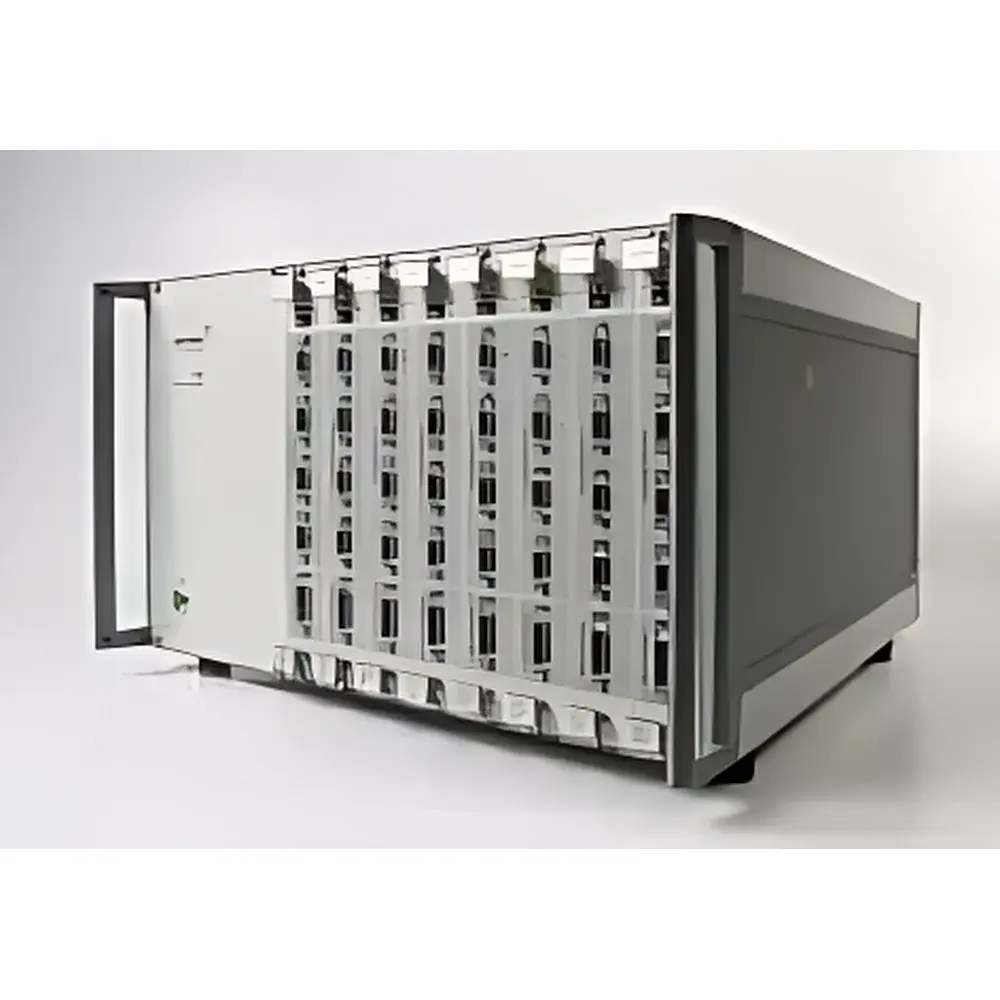
Solartron Analytical 1455/1451 Multi-Channel Frequency Response Analyzer (FRA) for Electrochemical Impedance Spectroscopy
| Brand | Solartron Analytical |
|---|---|
| Origin | United Kingdom |
| Model | 1455 / 1451 |
| Frequency Range | 10 Hz – 1 MHz (1455), 10 Hz – 100 kHz (1451) |
| Frequency Resolution | 1 / 65,000,000 |
| DAC Sampling Rate | 40 MHz |
| Accuracy | ±0.1% magnitude, ±0.1° phase |
| Phase Resolution | 0.01° |
| RMS Signal Amplitude | 3 V – 50 V |
| Waveform Options | Single-sine, multi-sine (FFT-based) |
| Input/Output Interface | Ethernet per module |
| Expandable Channels | 1–8 independent FRA units per system |
| Auxiliary Voltage Analyzer Ports | 4 (requires 14702A/14703A option with 1470E) |
Overview
The Solartron Analytical 1455/1451 Multi-Channel Frequency Response Analyzer (FRA) is a precision-engineered platform designed for high-fidelity electrochemical impedance spectroscopy (EIS) and dynamic system characterization in research and industrial electrochemistry laboratories. Built upon a dual-mode signal generation architecture—combining high-resolution single-sine correlation and multi-sine fast Fourier transform (FFT) analysis—the instrument delivers exceptional fidelity across wide frequency bands while maintaining rigorous phase and magnitude accuracy. The 1455 variant supports measurements from 10 Hz to 1 MHz, optimized for low-to-mid-frequency battery interface studies, corrosion kinetics, and coated-metal systems; the 1451 extends low-frequency stability down to 10 Hz with a 100 kHz upper limit, making it especially suited for slow-diffusion-controlled processes such as solid-state electrolyte characterization or polymer-electrolyte membrane fuel cell (PEMFC) cathode layer analysis. Each FRA module operates as an autonomous measurement node with dedicated Ethernet connectivity, enabling synchronized, time-stamped data acquisition across distributed electrochemical cells without bus contention or timing skew.
Key Features
- Dual-mode excitation architecture: Selectable single-sine correlation (for maximum noise rejection at critical frequencies) or multi-sine FFT-based analysis (for rapid full-spectrum sweeps, particularly effective below 1 Hz)
- Ultra-high frequency resolution of 1 part in 65 million, achieved via a 26-bit direct digital synthesizer (DDS), ensuring reproducible identification of narrow resonance peaks and subtle interfacial transitions
- Real-time adaptive integration: Automatic adjustment of integration time per frequency point based on signal-to-noise ratio, minimizing measurement duration without compromising uncertainty budgets
- Modular scalability: Systems support 1–8 independent FRA modules in a single rack; each module features isolated analog front-end, galvanically decoupled inputs, and IEEE 802.3-compliant Ethernet interface for deterministic latency and remote orchestration
- High-voltage and high-current capability: When integrated with the 1470E potentiostat/galvanostat platform, the system supports up to 10 V / 4 A per channel; optional parallel DC+AC channel configuration enables simultaneous high-power DC loading (up to 28 A total) and low-amplitude AC perturbation for stack-level EIS of fuel cell arrays or large-format Li-ion modules
- Four auxiliary voltage analyzer ports (with 14702A/14703A options) allow concurrent monitoring of individual electrode potentials during full-cell EIS, supporting differential analysis of anode/cathode contributions under operational bias
Sample Compatibility & Compliance
The 1455/1451 FRA platform is compatible with standard three-electrode electrochemical cells, rotating disk electrodes (RDE), symmetrical Li-metal cells, PEMFC single cells and short stacks, solid oxide fuel cell (SOFC) test rigs, and aqueous/non-aqueous battery half-cells. It interfaces seamlessly with Solartron’s 1470E multi-channel potentiostat and third-party hardware via analog trigger lines and digital I/O. All firmware and embedded control logic comply with IEC 61000-4 electromagnetic compatibility standards. Data acquisition workflows meet GLP and GMP documentation requirements when used with compliant software environments—full audit trail support, electronic signature readiness, and 21 CFR Part 11–compliant user access controls are available through optional IQ/OQ/PQ validation packages. Measurement traceability aligns with ISO/IEC 17025 calibration practices for impedance instrumentation.
Software & Data Management
Control and analysis are performed using CorrWare™ and SMaRT™ software suites, which provide scripting-capable experiment sequencing, real-time Nyquist/Bode visualization, Kramers–Kronig validation, and equivalent circuit modeling (ECM) with nonlinear least-squares fitting (Levenberg–Marquardt algorithm). Raw time-domain waveforms and complex impedance spectra are stored in HDF5 format with embedded metadata (timestamp, temperature, current density, SOC/SOH context if linked to battery cyclers). Export options include ASTM E29-22–compliant CSV templates, IMPEDANCE.MAT for MATLAB® interoperability, and S-parameter files for RF co-simulation. Remote monitoring and batch processing are supported via RESTful API endpoints and Python SDK bindings.
Applications
- Quantitative deconvolution of charge-transfer resistance, double-layer capacitance, and Warburg diffusion elements in Li-ion battery electrodes
- In situ monitoring of SEI growth dynamics during formation cycling under variable temperature and SOC conditions
- Corrosion rate estimation and coating integrity assessment on steel, aluminum, and magnesium alloys per ASTM G106 and ISO 16773-2
- Proton exchange membrane hydration state mapping via low-frequency impedance dispersion analysis
- Electrocatalyst degradation tracking in PEM water electrolyzers through repeated high-frequency arc evolution
- Multi-electrode array impedance tomography for spatially resolved conductivity profiling in solid-state batteries
FAQ
What distinguishes the 1455 from the 1451 model?
The 1455 offers extended high-frequency capability up to 1 MHz, ideal for characterizing fast interfacial processes such as conductive polymer switching or nanoscale oxide film relaxation. The 1451 prioritizes ultra-low-noise performance below 100 Hz, with enhanced low-frequency phase stability for long-duration diffusion-limited measurements.
Can the 1455/1451 operate independently of a potentiostat?
Yes—each FRA module functions as a standalone signal generator and lock-in detector. However, for controlled-potential or controlled-current EIS, integration with a compatible potentiostat (e.g., 1470E) is required.
Is synchronization across multiple FRA modules hardware-triggered?
Yes—modules support TTL-compatible external start triggers and share a common 10 MHz reference clock input, ensuring sub-microsecond timing alignment across all channels.
Does the system support real-time Kramers–Kronig validation during acquisition?
Yes—SMaRT software performs on-the-fly causality and linearity checks using discrete Hilbert transform methods, flagging non-stationary or noisy segments before final export.
How is calibration traceability maintained across field deployments?
Each unit ships with NIST-traceable calibration certificates covering magnitude/phase response, gain flatness, and noise floor across its full operating range. Field recalibration kits (including precision RC standards and buffered reference cells) are available under Solartron’s Metrology Support Program.





