
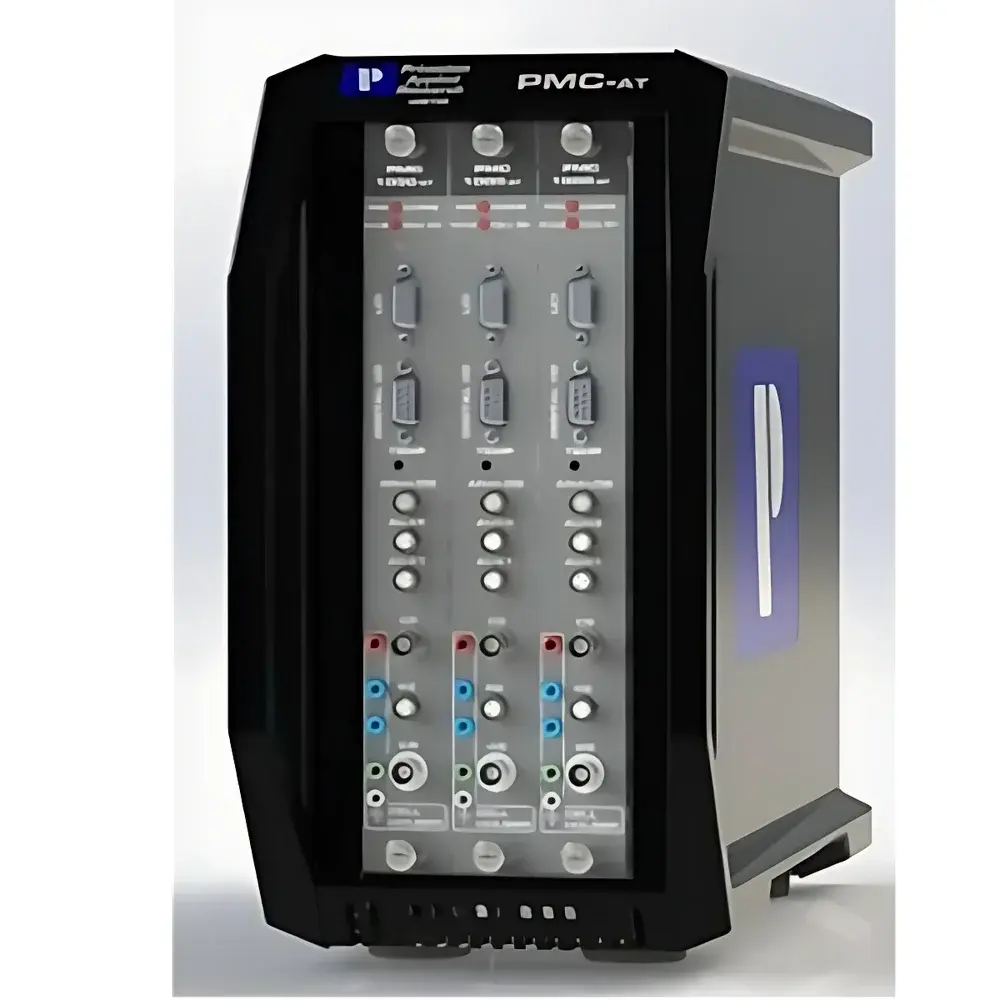
Princeton Applied Research PMC-1000 AT Multi-Channel Electrochemical Workstation
| Brand | Princeton Applied Research |
|---|---|
| Origin | United Kingdom |
| Manufacturer Type | Authorized Distributor |
| Origin Category | Imported Instrument |
| Model | PMC-1000 AT |
| Instrument Type | Electrochemical Workstation |
| Channel Architecture | Modular Multi-Channel (Up to 3 Slots) |
| Current Range | ±2 A to ±2 nA |
| Current Accuracy | ±0.2% of reading |
| Potential Accuracy | ±0.2% of full scale |
| Potentiostatic Range | ±10 V |
| Galvanostatic Range | ±2 A (expandable to ±20 A internal / ±30 A external) |
| EIS Frequency Range | 10 µHz – 1 MHz |
| Voltage Resolution | 150 nV (24-bit ADC) |
| Current Resolution | 30 fA (24-bit ADC) |
| Low-Current Extension (LCI) | 122 aA |
| Analog Inputs | 2 (including thermistor interface) |
| Analog Outputs | 2 |
| Digital I/O | 1 input, 4 outputs |
| Communication | Ethernet-based modular chassis architecture |
| Electrode Connections | CE, WE, RE, SE + dual auxiliary voltage dividers (8-wire configuration) |
| Supported Techniques | CV, LSV, SSLV, CA, CP, CC, CR, LPR, Tafel, PEIS, GEIS, SWV, DPV, FP, Arbitrary Waveform, iR Compensation, Ohmic Drop Correction, Looping & Variable Parameter Sequencing |
Overview
The Princeton Applied Research PMC-1000 AT is a high-performance, modular multi-channel electrochemical workstation engineered for precision, scalability, and experimental flexibility in advanced electrochemical research and industrial R&D environments. Built upon a robust Ethernet-connected 3-slot chassis architecture, the system supports simultaneous, independent or synchronized operation of up to three electrochemical modules—each capable of full potentiostatic, galvanostatic, and electrochemical impedance spectroscopy (EIS) control. Its core measurement principle relies on real-time digital signal processing coupled with 24-bit analog-to-digital conversion across all voltage and current channels, enabling sub-nanovolt potential resolution (150 nV) and femtoampere current resolution (30 fA), extendable to 122 aA via optional Low-Current Extension (LCI) hardware. The system’s ±10 V potentiostatic range, ±2 A base current capability (scalable to ±20 A internally or ±30 A externally), and ultra-broad 10 µHz–1 MHz EIS bandwidth make it suitable for demanding applications including battery electrode kinetics, corrosion mechanism studies, sensor development, and fundamental interfacial charge-transfer analysis.
Key Features
- Modular 3-slot chassis with Ethernet-based communication—enables remote configuration, synchronization, and distributed control across multiple instruments.
- Independent channel operation with full parameter autonomy: each slot supports dedicated WE/CE/RE/SE connections, dual auxiliary voltage dividers, and 8-wire polarization wiring for precise槽压 (cell voltage) and overpotential control.
- 24-bit ADCs on all primary voltage and current measurement paths—guaranteeing high dynamic range and low-noise acquisition across 10 programmable current ranges (±2 A to ±2 nA).
- Integrated thermistor interface for real-time temperature monitoring and compensation—critical for kinetic studies compliant with ASTM G102 and ISO 9223 standards.
- Dedicated analog inputs/outputs (2×AI, 2×AO) and digital I/O (1×DI, 4×DO) for seamless integration with environmental chambers, flow cells, or third-party data acquisition systems.
- Built-in 10 A current amplifier; optional 20 A internal or 30 A external amplifiers for high-current battery cycling and electrolysis validation.
- Direct-to-disk NAS-compatible data storage—ensures uninterrupted long-term experiments (e.g., 72+ hour EIS aging tests) with timestamped, metadata-embedded binary files.
Sample Compatibility & Compliance
The PMC-1000 AT accommodates standard three-electrode configurations (working, counter, reference) as well as four-electrode setups with secondary sensing electrodes (SE) for uncompensated resistance (Ru) quantification. It supports aqueous, non-aqueous, molten salt, and solid-state electrolyte systems—including pouch, coin, and Swagelok-type cells. The system complies with key regulatory and quality frameworks relevant to electrochemical instrumentation: data integrity features align with FDA 21 CFR Part 11 requirements (audit trail, electronic signatures, user access control), while measurement traceability adheres to ISO/IEC 17025 principles. All EIS protocols are compatible with ASTM E1466 (impedance spectroscopy for corrosion), ASTM D1148 (rubber aging), and USP (electrochemical sensor qualification).
Software & Data Management
Operation is managed through the integrated VersaStudio software platform—a Windows-based application supporting both script-driven automation and GUI-guided method development. The software includes pre-validated technique libraries (CV, LSV, Tafel, LPR, PEIS, GEIS, SWV, DPV, arbitrary waveform generation) with built-in iR compensation algorithms (current-interrupt, positive feedback, and EIS-based). All experiments generate time-stamped, hierarchical HDF5-formatted datasets containing raw waveforms, processed spectra, metadata (user, timestamp, instrument ID, calibration history), and audit logs. Data export supports CSV, MATLAB (.mat), and Python-compatible formats. Optional GLP/GMP modules provide electronic lab notebook (ELN) integration, SOP enforcement, and 21 CFR Part 11-compliant signature workflows.
Applications
- Battery R&D: Half-cell and full-cell cycling, differential capacity analysis (dQ/dV), state-of-charge estimation, SEI growth kinetics, and impedance evolution during calendar/cycle aging.
- Corrosion Science: Polarization resistance (LPR), electrochemical noise analysis (ENA), localized corrosion mapping, and coating degradation assessment per ASTM G5/G102.
- Electrocatalysis: Oxygen reduction reaction (ORR), hydrogen evolution (HER), CO2 reduction (CO2RR) activity screening with rotating disk electrode (RDE) synchronization.
- Sensor Development: Amperometric biosensor calibration, redox polymer characterization, and microelectrode array validation.
- Fundamental Kinetics: Charge transfer resistance (Rct), double-layer capacitance (Cdl), and Warburg diffusion modeling from multi-frequency EIS datasets.
FAQ
What is the maximum number of independent electrochemical cells the PMC-1000 AT can control simultaneously?
The system supports up to three fully independent channels via its 3-slot modular chassis—each channel operates as a standalone workstation with dedicated potentiostat/galvanostat and EIS capabilities.
Does the system support true four-electrode (WE/RE/CE/SE) measurements for uncompensated resistance correction?
Yes—each channel provides dedicated SE input with synchronized voltage acquisition, enabling real-time Ru calculation and automatic iR compensation during dynamic techniques.
Can the PMC-1000 AT perform long-duration EIS measurements at ultra-low frequencies (e.g., below 1 mHz)?
Yes—the 10 µHz lower limit allows multi-hour impedance acquisitions for slow processes such as passive film formation or solid electrolyte interphase (SEI) evolution.
Is third-party hardware integration (e.g., gas chromatographs, thermal chambers) supported?
Yes—via analog I/O and digital triggers, the system synchronizes with external devices for coupled operando measurements, including temperature-controlled EIS and EC-GC hyphenation.
How is data integrity ensured for regulated environments (e.g., pharmaceutical or battery certification labs)?
VersaStudio’s optional GxP module delivers 21 CFR Part 11 compliance, including role-based access, immutable audit trails, electronic signatures, and secure data archiving with checksum verification.
Related Products





