
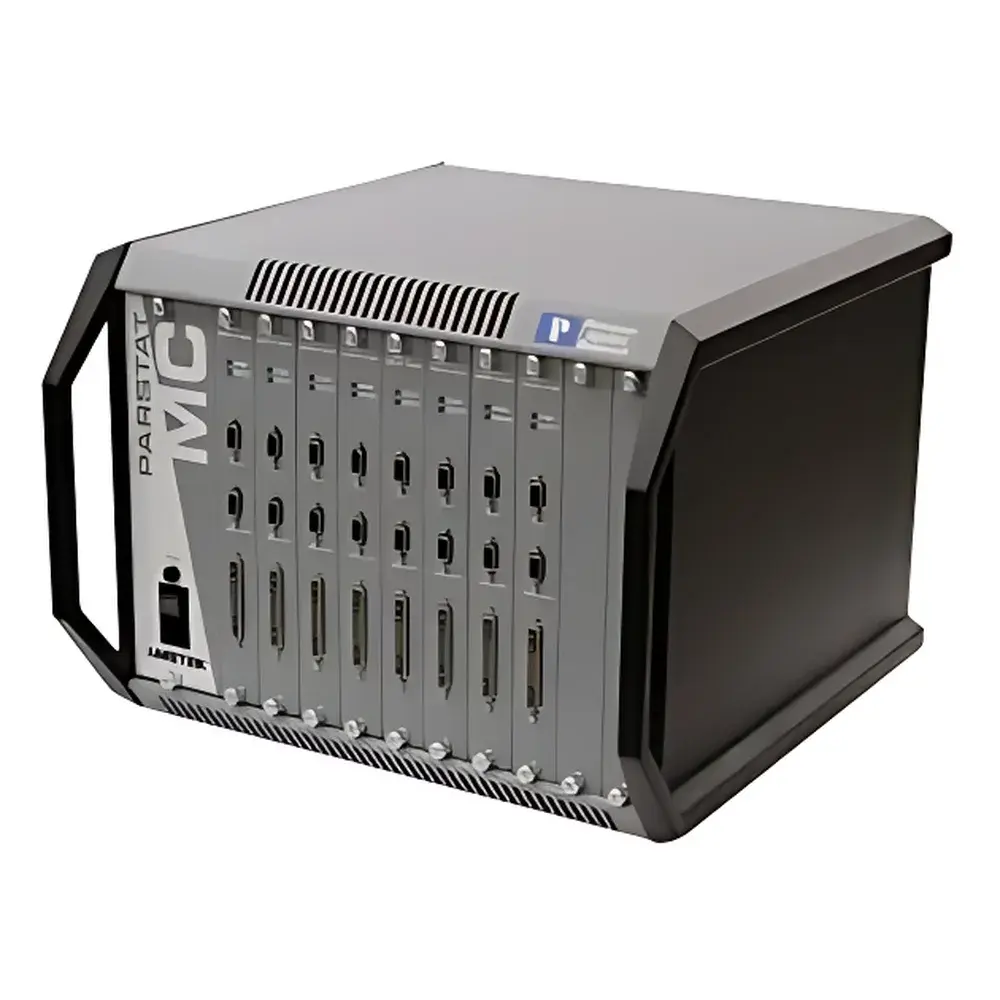
Princeton Applied Research PARSTAT MC Multi-Channel Electrochemical Workstation
| Brand | Princeton Applied Research |
|---|---|
| Origin | USA |
| Model | PMC2000 / PMC1000 / PMC500 |
| Instrument Type | Electrochemical Workstation |
| Current Range | 4 nA – 2 A |
| Current Accuracy | ±0.2% of reading, ±0.2% of range (down to 4 nA) |
| Potential Accuracy | ±0.2% of reading, ±2 mV |
| Potentiostatic Range | ±30 V |
| EIS Frequency Range | 10 µHz – 7 MHz |
| Data Acquisition Rate | up to 500 kS/s (per channel), 1 MS/s (burst mode) |
| Auxiliary Voltage Measurement | 6-wire remote sensing |
| Channel Capacity | Up to 8 independent, hot-swappable channels per mainframe |
Overview
The Princeton Applied Research PARSTAT MC is a high-performance, modular multi-channel electrochemical workstation engineered for precision, scalability, and experimental flexibility in advanced electrochemical research and industrial quality control. Based on over five decades of expertise in potentiostat/galvanostat design and electrochemical instrumentation, the PARSTAT MC implements true parallel electrochemical measurement architecture—enabling simultaneous, independent operation of up to eight fully isolated channels within a single mainframe. Each channel functions as a standalone, high-fidelity electrochemical analyzer, supporting standard techniques including cyclic voltammetry (CV), chronoamperometry (CA), chronopotentiometry (CP), linear sweep voltammetry (LSV), and full-frequency-range electrochemical impedance spectroscopy (EIS). The system operates on a galvanostatic/potentiostatic feedback principle with digital signal processing and analog front-end optimization, ensuring minimal crosstalk, low noise floor (<100 fA RMS), and stable baseline performance across wide dynamic current ranges—from femtoampere-level corrosion monitoring to ampere-scale battery cycling.
Key Features
- Modular channel architecture: PMC500 (±500 mA / 2 µA), PMC1000 (±2 A / 4 nA, 120 fA resolution), and PMC2000 (±30 V compliance, 10 µHz–7 MHz EIS) modules are field-installable and hot-swappable without interrupting active experiments on other channels.
- True parallelism: All channels operate synchronously with independent timing, potential/current control, and data acquisition—no shared hardware bottlenecks or software arbitration delays.
- High-fidelity signal integrity: 24-bit ADCs, programmable analog filtering, and active guarding minimize electromagnetic interference and cable-induced artifacts—critical for low-current microelectrode or thin-film measurements.
- Extended EIS capability: Full frequency coverage from ultra-low 10 µHz (for slow diffusion-controlled processes) to 7 MHz (for double-layer and coating characterization), with phase accuracy <0.3° and magnitude error <0.1%.
- 6-wire auxiliary voltage sensing: Enables precise, IR-compensated measurement of individual cell terminals in multi-cell stacks or dual-electrode configurations—essential for battery pack diagnostics and electrode kinetics deconvolution.
- Robust mechanical and thermal design: Aluminum chassis with forced-air cooling and thermally stabilized reference circuitry ensures long-term stability under continuous operation at ambient temperatures from 15–35°C.
Sample Compatibility & Compliance
The PARSTAT MC supports a broad range of electrochemical cells—including standard three-electrode beaker cells, rotating disk electrodes (RDE), flow cells, microfluidic interfaces, and custom-built battery test fixtures. Its floating ground architecture permits simultaneous testing of multiple working electrodes in a shared electrolyte bath—ideal for comparative catalyst screening or localized corrosion studies. The system complies with key international standards for electrochemical instrumentation, including ASTM G5, G59, G102 (corrosion testing), ISO 16773 (coating impedance), and IEC 62660-1 (Li-ion battery cycling). When operated with audit-trail-enabled VersaStudio software and configured with user access controls, it meets GLP and GMP documentation requirements per FDA 21 CFR Part 11 for regulated QC environments.
Software & Data Management
VersaStudio is the native, Windows-based application suite delivering comprehensive experiment definition, real-time visualization, automated calibration, and post-acquisition analysis. It includes built-in equivalent circuit modeling (ECM) for EIS fitting using nonlinear least-squares regression (Levenberg–Marquardt algorithm), differential capacitance mapping, and Tafel slope extraction. Raw data is stored in vendor-neutral binary format (.vmp) with embedded metadata (timestamp, instrument ID, technique parameters, environmental conditions). Export options include CSV, TXT, and MATLAB-compatible .mat files. Version-controlled project files support collaborative workflows, while optional network licensing enables centralized deployment across laboratory workstations. Software updates are delivered via secure HTTPS and validated against NIST-traceable reference cells.
Applications
- Battery R&D: Parallel cycling of cathode/anode half-cells, formation protocol validation, SEI growth kinetics, and impedance tracking across state-of-charge.
- Corrosion science: Multi-site monitoring of pitting initiation, inhibitor efficiency screening, and galvanic coupling behavior in alloy systems.
- Electrocatalysis: High-throughput evaluation of catalyst libraries under identical mass transport and temperature conditions.
- Sensors & biosensors: Real-time amperometric detection with low-noise nA–pA sensitivity and fast transient capture.
- Coatings & corrosion protection: EIS-based barrier property assessment of polymer films, conversion coatings, and self-healing systems.
- Fuel cell membrane characterization: In-situ proton conductivity mapping and interfacial charge transfer resistance quantification.
FAQ
Can channels be added or replaced while experiments are running?
Yes. Each PMC module is hot-swappable—mechanically and electrically isolated—allowing installation or removal without power cycling the mainframe or interrupting active measurements on other channels.
Is the system compatible with third-party electrochemical cells or accessories?
Yes. Standard BNC and banana-jack connectivity, along with configurable analog I/O ports, enable integration with external potentiostats, temperature controllers, gas flow meters, and in-situ spectroelectrochemical cells.
What level of EIS data quality can be expected at sub-millihertz frequencies?
At 10 µHz, the system achieves >12-hour measurement stability with <0.5% amplitude drift and phase reproducibility within ±0.4° across repeated scans—validated using certified RC ladder standards.
Does VersaStudio support automated sequence programming for unattended overnight testing?
Yes. Users can define multi-step protocols—including conditional branching, parameter sweeps, and pass/fail criteria—with email alerts triggered upon completion or deviation.
How is calibration traceability maintained?
Factory calibration uses NIST-traceable reference resistors and voltage sources; users may perform periodic verification using the integrated self-test routine and external calibrators compliant with ISO/IEC 17025.





