
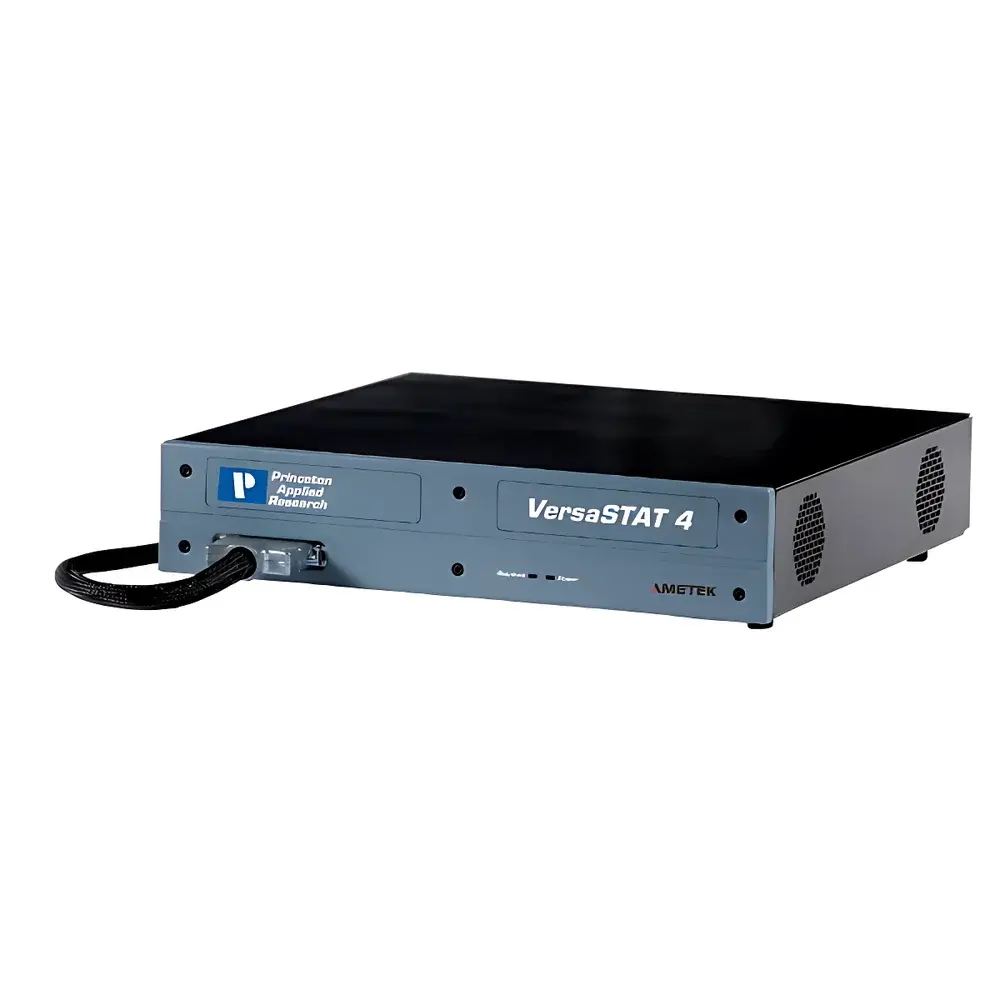
VersaSTAT3A/4A Electrochemical Workstation by Princeton Applied Research
| Brand | Princeton Applied Research |
|---|---|
| Origin | Slovakia |
| Model | VersaSTAT3A / VersaSTAT4A |
| Instrument Type | Electrochemical Workstation |
| Channel Count | Single-Channel |
| Current Range | 200 nA – 650 mA (2 A optional) |
| Current Accuracy | ±0.2% of reading |
| Potential Accuracy | ±0.2% of reading ± 2 mV |
| Potentiostatic Range | ±10 V |
| EIS Frequency Range | 10 µHz – 1 MHz |
Overview
The VersaSTAT3A and VersaSTAT4A electrochemical workstations, engineered by Princeton Applied Research (a division of AMETEK), represent a rigorously validated platform for quantitative electrochemical analysis in academic research, industrial R&D, and quality control laboratories. These instruments operate on the fundamental principles of potentiostatic and galvanostatic control—precisely regulating electrode potential or current while measuring the complementary variable—to enable thermodynamic, kinetic, and interfacial characterization of electrochemical systems. Designed for high reproducibility and long-term stability, the VersaSTAT series supports a broad spectrum of techniques including cyclic voltammetry (CV), linear sweep voltammetry (LSV), chronoamperometry (CA), chronopotentiometry (CP), electrochemical impedance spectroscopy (EIS), and corrosion-specific protocols such as Linear Polarization Resistance (LPR) and Tafel analysis. The architecture integrates a high-bandwidth (1 MHz) potentiostat/galvanostat with a built-in frequency response analyzer (FRA), enabling seamless transition between DC and AC electrochemical measurements without external hardware reconfiguration.
Key Features
- High-fidelity analog front-end: 3 × 16-bit simultaneous data acquisition at up to 500 kS/s, with 10 µs time resolution and programmable automatic noise filtering
- Precision electrochemical control: ±10 V compliance range, ±650 mA standard current output (expandable to ±2 A), and <350 ns rise time for rapid transient capture
- Ultra-low-noise differential electrometer: Input impedance ≥1012 Ω, input bias current ≤5 pA, CMRR ≥60 dB at 100 kHz
- Advanced signal integrity: ≥8 V/µs slew rate, dynamic IR compensation (positive feedback and adaptive algorithms), and real-time stability optimization modes
- Flexible electrode configuration: Support for two-, three-, and four-electrode cells with dedicated guard and ground connections for minimized stray capacitance
- Integrated digital I/O: Five TTL inputs and two TTL outputs for synchronized external triggering (e.g., flow cell valves, light sources, or auxiliary detectors)
Sample Compatibility & Compliance
The VersaSTAT3A/4A is compatible with conventional electrochemical cells (e.g., standard three-electrode configurations), microelectrodes, rotating disk electrodes (RDE), and custom-designed flow cells or in-situ battery test fixtures. Its wide dynamic current range—from 200 nA (with 6 pA resolution) to 650 mA (or 2 A with optional module)—enables studies spanning passive film formation on coated metals to high-current-density fuel cell catalyst evaluation. The system meets CE marking requirements and conforms to IEC 61010-1 safety standards for laboratory electrical equipment. While not inherently 21 CFR Part 11–compliant, its VersaStudio software architecture supports audit-trail-enabled configurations when deployed under validated GxP environments (e.g., GLP-compliant corrosion testing per ASTM G59, G102, or ISO 17475).
Software & Data Management
VersaStudio software serves as the unified control, acquisition, and analysis environment for all VersaSTAT models. It provides intuitive method setup wizards for standardized techniques (e.g., ASTM G59 LPR, ASTM G106 EIS), customizable scripting via Python-compatible macro language, and export-ready data formatting (CSV, TXT, binary). The software supports full traceability—including operator ID, timestamped parameter logs, and raw waveform metadata—essential for regulatory documentation. Four tiered editions (VersaSTAT100 to VersaSTAT400) allow progressive feature unlocking aligned with evolving experimental complexity and budget constraints. All versions maintain backward compatibility with legacy methods and support USB plug-and-play connectivity on Windows 10/11 platforms (minimum requirement: dual-core CPU, 4 GB RAM, SSD storage recommended for high-frequency EIS).
Applications
- Corrosion Science: Quantitative assessment of coating degradation, inhibitor efficiency, and localized corrosion mechanisms using LPR, EIS, and potentiodynamic polarization per ASTM G5, G102, and ISO 9223
- Energy Materials: Characterization of battery electrode kinetics (Li-ion, Na-ion, solid-state), fuel cell catalyst activity, and supercapacitor charge storage mechanisms
- Biosensors & Bioelectrochemistry: Amperometric detection, enzyme kinetics, and redox protein electron transfer studies leveraging low-noise nA-pA sensitivity
- Nanomaterial Electrochemistry: Voltammetric profiling of nanowire arrays, graphene-modified electrodes, and single-entity electrochemistry experiments
- Electroplating & Electropolishing: Real-time monitoring of deposition efficiency, bath composition stability, and interface nucleation behavior
FAQ
What distinguishes VersaSTAT3A from VersaSTAT4A?
The VersaSTAT4A includes enhanced hardware-level synchronization capabilities for multi-instrument setups (e.g., coupling with potentiostats and impedance analyzers), expanded memory for extended EIS sweeps, and native support for high-speed auxiliary analog inputs (200 kHz sampling) — features optimized for advanced battery cycling and operando electrochemical studies.
Is external Faraday cage shielding required?
While not mandatory, use of a grounded Faraday enclosure is strongly recommended for sub-nA current measurements or low-amplitude EIS below 100 mHz to mitigate electromagnetic interference and ensure measurement fidelity.
Can the system perform true four-electrode (Kelvin) measurements?
Yes — the instrument’s dedicated sense leads and high-input-impedance electrometer enable accurate potential monitoring independent of current-carrying leads, critical for low-resistance electrolyte or conductive substrate studies.
Does VersaStudio support automated sequence execution across multiple samples?
Yes — via batch method scripting and TTL-triggered sample changer integration, users can define unattended multi-cell testing sequences with conditional logic and pass/fail criteria.
What calibration procedures are recommended prior to use?
Princeton Applied Research recommends quarterly verification using NIST-traceable reference resistors and voltage sources, along with daily open-circuit potential (OCP) and dummy cell validation prior to critical experiments.
Related Products






