
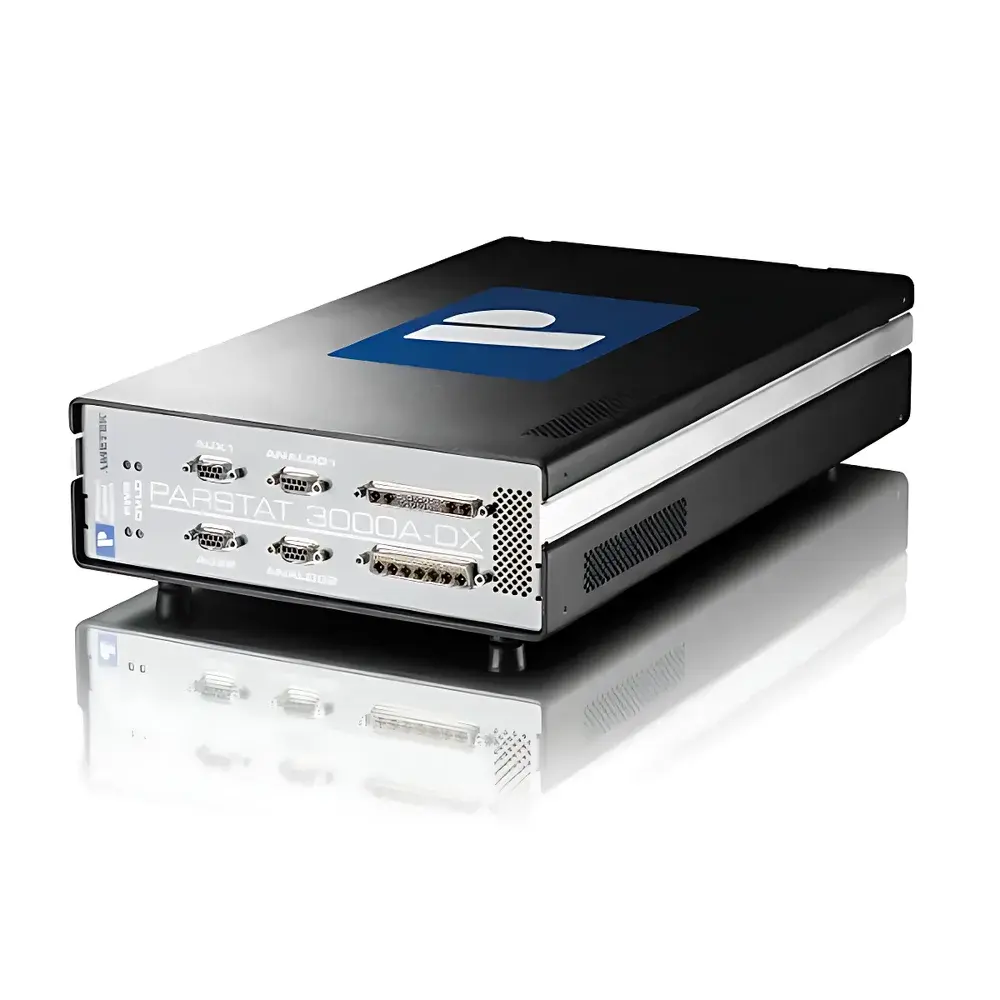
Princeton Applied Research PARSTAT 3000A Electrochemical Workstation
| Brand | Princeton Applied Research |
|---|---|
| Origin | USA |
| Model | PARSTAT 3000A |
| Instrument Type | Single-Channel Electrochemical Workstation |
| Current Range | ±1 A |
| Current Accuracy | ±0.2% |
| Potential Accuracy | 0.2% ± 2 mV |
| Potentiostatic Range | ±30 V |
| EIS Frequency Range | 10 µHz – 7 MHz |
Overview
The Princeton Applied Research PARSTAT 3000A is a high-performance, single-channel electrochemical workstation engineered for precision potentiostatic, galvanostatic, and electrochemical impedance spectroscopy (EIS) measurements. Built upon over five decades of electrochemical instrumentation expertise, the PARSTAT 3000A implements a robust analog front-end architecture with low-noise signal conditioning and high-fidelity digital control to support demanding applications in energy storage, corrosion science, physical electrochemistry, and materials development. Its core measurement principle relies on real-time, closed-loop feedback control of electrode potential or current, combined with fast Fourier transform (FFT)-based frequency-domain analysis for broadband EIS characterization. The system supports true 6-wire auxiliary voltage sensing—enabling simultaneous, independent DC and AC impedance monitoring of individual electrodes within multi-electrode configurations such as battery cells, fuel cell stacks, or coated metal interfaces—without shared reference path errors.
Key Features
- 6-wire auxiliary voltage measurement capability for decoupled cathodic/anodic or cell-level DC and AC impedance analysis
- Broad EIS frequency coverage from 10 µHz to 7 MHz—critical for resolving interfacial processes in solid-state electrolytes, SOFCs, and low-conductivity media (e.g., organic solvents, concrete pore solutions)
- High-speed data acquisition at up to 1 MS/s (1,000 kS/s), supporting transient analysis of supercapacitor charge/discharge, battery pulse testing, and rapid-scan cyclic voltammetry
- ±30 V compliance voltage range—suitable for high-voltage electrochemical systems including Li-ion battery packs (up to 6 cells), Ni-MH stacks (up to 20 cells), anodization of Ti, and electrophoretic deposition
- Potential accuracy of 0.2% ± 2 mV and current accuracy of ±0.2%, traceable to NIST-calibrated standards
- Compact benchtop form factor (29.5 × 24.1 × 12.7 cm) enabling integration into inert-atmosphere gloveboxes and confined lab environments
- Support for low-current measurements in low-conductivity systems using high-impedance reference electrodes, sintered glass frits, and non-aqueous electrolytes
Sample Compatibility & Compliance
The PARSTAT 3000A accommodates diverse electrochemical configurations—including three-electrode cells, two-electrode batteries, symmetric half-cells, and multi-electrode arrays—with flexible cabling and grounding options. It is routinely deployed in ASTM G59, G102, and G106-compliant corrosion testing; ISO 16773-2 and IEC 62660-2 protocols for battery impedance validation; and USP and guidelines for electrochemical sensor qualification. The hardware and firmware architecture support GLP/GMP-aligned operation, including audit-trail-enabled software logging, user-access controls, and electronic signature readiness per FDA 21 CFR Part 11 when used with compliant data management modules.
Software & Data Management
Controlled via the fully integrated PowerCV™ and PowerSuite™ software suite, the PARSTAT 3000A provides intuitive experiment sequencing, real-time visualization, and post-acquisition modeling (e.g., equivalent circuit fitting using ZView®-compatible formats). All raw data are stored in vendor-neutral binary files with embedded metadata (timestamp, instrument ID, calibration history, parameter set), ensuring long-term reproducibility and third-party analysis compatibility. Software features include oversampling with moving-average noise reduction, iR-compensation algorithms (including current-interrupt and positive-feedback methods), and synchronized auxiliary channel logging (e.g., pH, bath temperature, or external potentiostat output).
Applications
- Characterization of solid-state electrolytes and oxide ion conductors via high-frequency EIS (>1 MHz) to resolve grain-boundary vs. bulk contributions
- In situ and operando impedance monitoring of Li-metal anodes and sulfur cathodes under realistic cycling conditions
- Corrosion mechanism studies in reinforced concrete, marine coatings, and high-temperature aqueous systems
- Kinetic analysis of redox mediators and enzymatic electron transfer using fast-scan CV (≥10 V/s) and Tafel extrapolation
- Electrodeposition process optimization—including pulse-reverse plating and electrophoretic deposition—under high-voltage bias (±30 V)
- Multi-electrode impedance mapping for fuel cell membrane degradation and battery cell imbalance detection
FAQ
What is the maximum recommended cell impedance for accurate 7 MHz EIS measurements?
For optimal signal-to-noise ratio above 1 MHz, cell impedances should generally remain below 100 kΩ; lower impedances (<10 kΩ) are preferred for full-bandwidth fidelity.
Can the PARSTAT 3000A perform true galvanostatic EIS (GEIS)?
Yes—it supports both potentiostatic and galvanostatic EIS modes with automatic amplitude scaling and harmonic distortion monitoring.
Is 6-wire measurement compatible with standard three-electrode cells?
Yes—the auxiliary inputs can be configured for remote sense connections without modifying conventional cell setups, improving accuracy in high-resistance electrolytes.
Does the system support external trigger synchronization with other instruments (e.g., XRD, Raman)?
Yes—via TTL-compatible trigger I/O ports, enabling time-correlated multimodal electrochemical experiments.
How is IR drop compensation implemented during dynamic EIS acquisition?
The system applies real-time current-interrupt correction synchronized with each EIS frequency point, preserving phase integrity across the full spectrum.






