
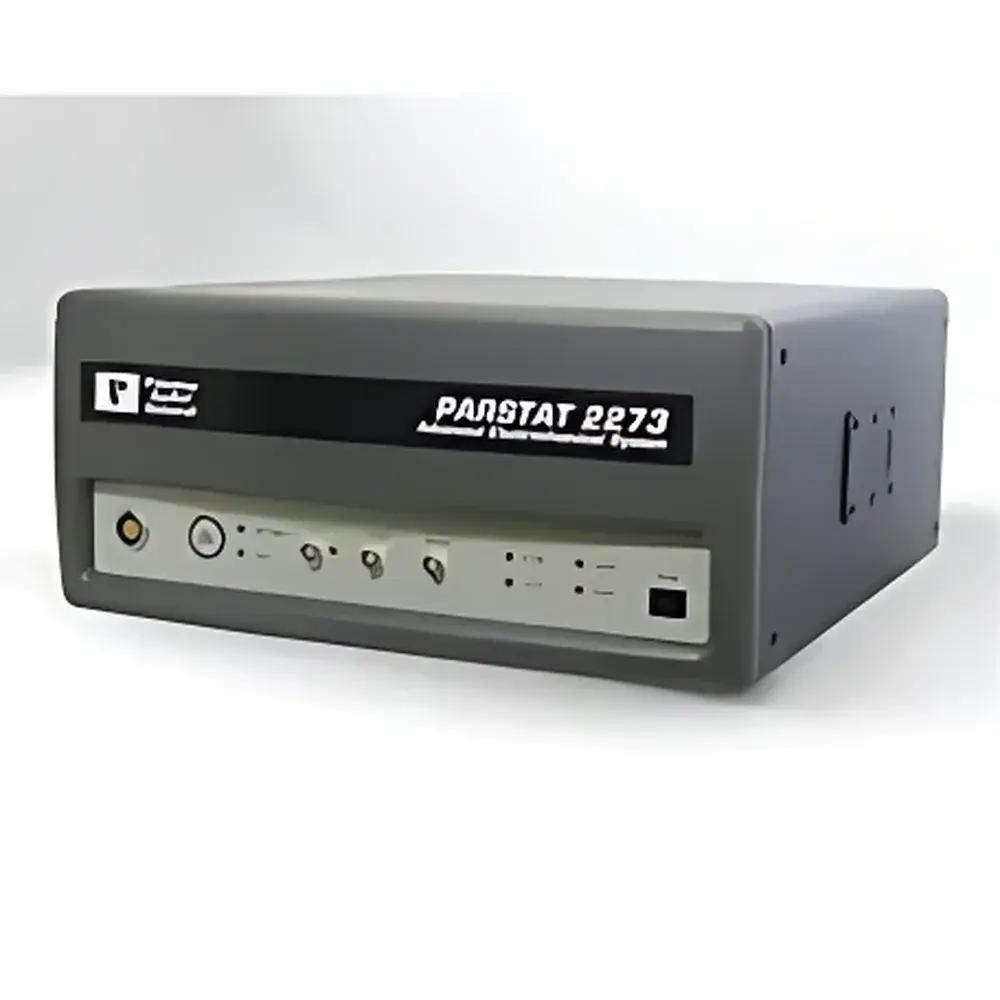
Princeton Applied Research PARSTAT 2273 Electrochemical Workstation
| Brand | Princeton Applied Research |
|---|---|
| Origin | USA |
| Model | PARSTAT 2273 |
| Instrument Type | Electrochemical Workstation |
| Current Range | ±40 pA to ±2 A (optional ±20 A) |
| Current Resolution | 1.2 fA |
| Current Accuracy | <0.4% of reading (for 20 µA–2 A range) |
| Potential Accuracy | ±0.2% of value ± 2 mV |
| Potentiostatic Range | ±10 V |
| Galvanostatic Range | ±2 A (extendable) |
| Cell Voltage Compliance | ±100 V |
| EIS Frequency Range | 10 µHz to 1 MHz |
| Input Impedance | >10¹³ Ω |
| Electrometer Bandwidth | >15 MHz (–3 dB) |
| Minimum Time Base | 20 µs |
| Minimum Potential Step | 2.5 µV |
| iR Compensation | Positive feedback (2 Ω to 2000 MΩ) |
| Interface | USB |
| Weight | 31 kg |
| Dimensions | 50.8 cm W × 47.6 cm H × 22.9 cm D |
| Power Supply | 90–260 V AC, 50–60 Hz, max. 600 W |
Overview
The Princeton Applied Research PARSTAT 2273 Electrochemical Workstation is a high-performance, modular potentiostat/galvanostat/frequency response analyzer engineered for precision electrochemical characterization across academic, industrial, and regulatory environments. Built upon the legacy of the PARSTAT 273A, the 2273 integrates advanced analog architecture with digital control to deliver exceptional stability, wide dynamic range, and metrologically traceable performance. Its core measurement principle relies on four-quadrant bipolar operation with true analog feedback control, enabling accurate current and potential regulation under both steady-state and transient conditions. The system supports potentiodynamic, potentiostatic, galvanostatic, and hybrid techniques—including cyclic voltammetry, chronoamperometry, chronopotentiometry, pulse methods, and controlled-potential or controlled-current electrochemical impedance spectroscopy (EIS). With ±100 V cell compliance voltage, ±2 A standard current output (expandable to ±20 A), and sub-femtoampere current resolution (1.2 fA), the PARSTAT 2273 is uniquely suited for low-conductivity media, high-impedance interfaces (e.g., coated metals, biological membranes), and ultra-trace electroanalytical applications.
Key Features
- True four-quadrant bipolar operation with ±100 V cell compliance and ±2 A standard current output (optional ±20 A high-current module)
- Ultra-low current resolution of 1.2 fA and input impedance >10¹³ Ω in parallel with <5 pF—enabling reliable measurements in insulating or passivated systems
- Integrated frequency response analysis engine supporting EIS from 10 µHz to 1 MHz, with single-sine, multi-sine (FAST EIS), and Mott-Schottky capability
- Dual 16-bit DACs for independent, high-fidelity control of potential bias (±10 V range) and current modulation
- Sub-microsecond signal settling (15 MHz electrometer bandwidth ensure fidelity in fast transient experiments
- Real-time iR compensation via positive feedback (adjustable from 2 Ω to 2000 MΩ) and digital voltage error correction
- USB 2.0 interface with deterministic timing and hardware-triggered synchronization for integration with auxiliary equipment (e.g., temperature controllers, spectrometers, microbalances)
Sample Compatibility & Compliance
The PARSTAT 2273 accommodates diverse electrochemical configurations—including two-, three-, and four-electrode cells; rotating disk, ring-disk, and ultramicroelectrode assemblies; and custom-built corrosion, battery, or fuel cell test fixtures. Its high input impedance and low input capacitance minimize stray coupling in high-impedance measurements (e.g., polymer electrolytes, oxide films, biomolecular layers), while the ±100 V compliance enables studies of aggressive redox couples, aqueous/non-aqueous electrolyte breakdown, and anodization processes. From a regulatory standpoint, the instrument’s architecture supports audit-ready operation: PowerSuite software logs all parameter changes, sequence execution, and raw data acquisition with timestamped metadata. When configured with optional electronic signature and audit trail modules, it meets requirements for GLP, GMP, and FDA 21 CFR Part 11 compliance in pharmaceutical and medical device development labs. It is routinely applied in ASTM G5, G59, G102, G106, and ISO 16773-1 testing protocols for corrosion evaluation, as well as IEC 62660-1 and USP related battery and electrochemical sensor validation workflows.
Software & Data Management
The PARSTAT 2273 operates exclusively with PowerSuite™—a modular, Windows-based application suite offering method-driven experiment design, real-time visualization, and post-acquisition analysis. PowerSuite includes pre-validated technique templates (e.g., linear sweep voltammetry per ASTM E1941, EIS per ASTM E1492), customizable scripting (via Python-compatible API), and integrated equivalent circuit modeling (ZView®-compatible). All data are stored in vendor-neutral binary format (.PAR) with embedded metadata (instrument ID, calibration date, operator, environmental conditions), ensuring long-term readability and interoperability. Export options include CSV, TXT, and MATLAB-compatible MAT files. For enterprise deployment, PowerSuite supports network licensing, centralized configuration management, and secure user role assignment (administrator, technician, reviewer) aligned with ALCOA+ data integrity principles.
Applications
- Battery and fuel cell R&D: SEI formation kinetics, Li-ion interfacial impedance mapping, PEMFC catalyst degradation, solid-state electrolyte conductivity profiling
- Corrosion science: Polarization resistance, electrochemical noise analysis, localized corrosion detection, coating delamination monitoring
- Electrodeposition & electroplating: Nucleation overpotential quantification, mass transport-limited deposition, additive inhibition studies
- Biosensors & bioelectrochemistry: Enzyme kinetics, DNA hybridization detection, redox protein electron transfer rates
- Materials science: Conducting polymer doping/dedoping, metal oxide semiconductor band-edge characterization, graphene/electrolyte interface dynamics
- Environmental electroanalysis: Heavy metal speciation (anodic stripping voltammetry), nitrate/nitrite reduction pathways, microbial electrochemical systems (MES)
FAQ
Is the PARSTAT 2273 compatible with third-party electrochemical cells and accessories?
Yes—the system features standard BNC and triaxial connectors, fully programmable analog I/O, and TTL trigger lines, enabling seamless integration with commercial and custom-built cells, Faraday cages, temperature stages, and in situ spectroelectrochemical platforms.
What level of EIS accuracy can be expected at ultra-low frequencies (e.g., below 1 mHz)?
With proper grounding, shielding, and experimental duration (>10× the lowest period), the 2273 achieves stable, repeatable spectra down to 10 µHz. Low-frequency accuracy is enhanced by its 20 µs minimum time base and drift-compensated signal processing.
Can PowerSuite generate reports compliant with ISO/IEC 17025 or GLP requirements?
Yes—when used with optional validation packages, PowerSuite provides full electronic records including instrument calibration certificates, user access logs, method version history, and digitally signed final reports.
Does the system support simultaneous multi-channel EIS (e.g., for array electrodes)?
The base PARSTAT 2273 is a single-channel workstation. Multi-electrode array studies require external multiplexing hardware or parallel deployment of multiple units synchronized via external clock triggers.
How often does the system require recalibration?
Princeton Applied Research recommends annual factory calibration. In-house verification using certified reference resistors and voltage standards is supported via built-in diagnostic routines and the PowerSuite Calibration Assistant module.



