
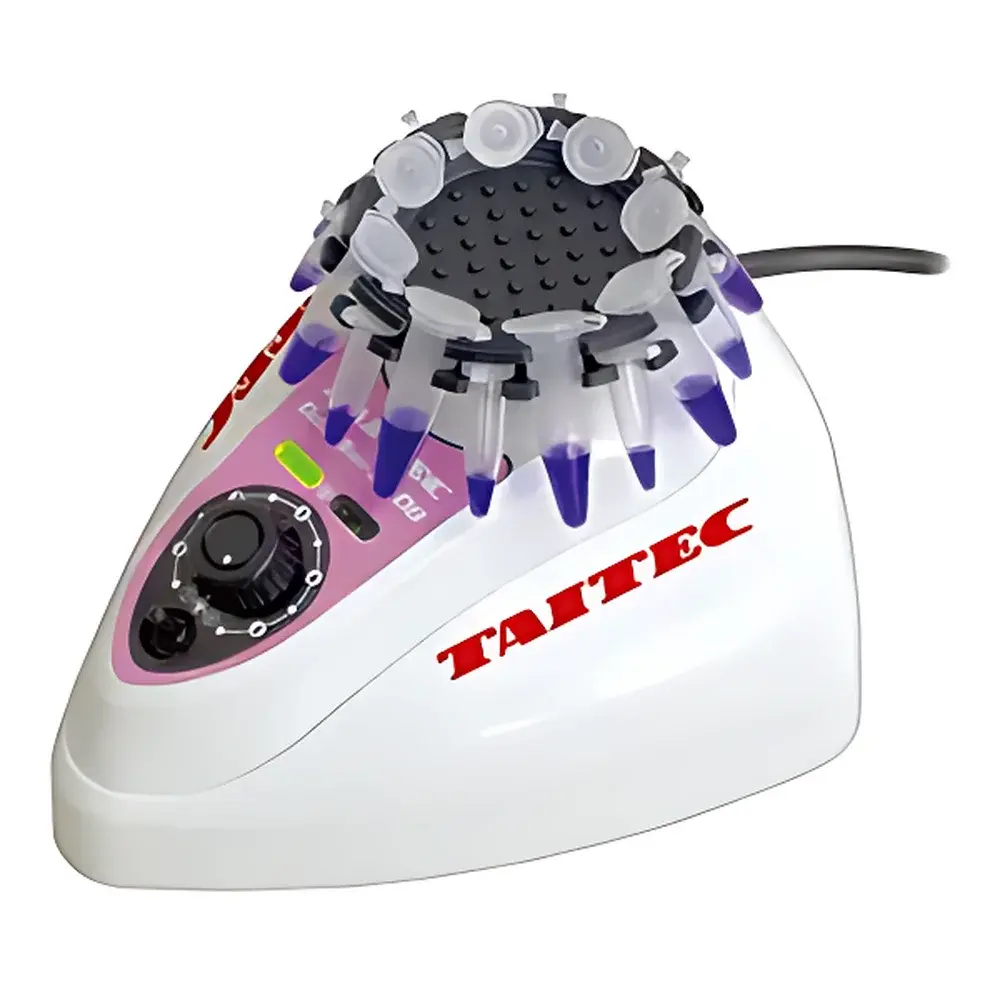
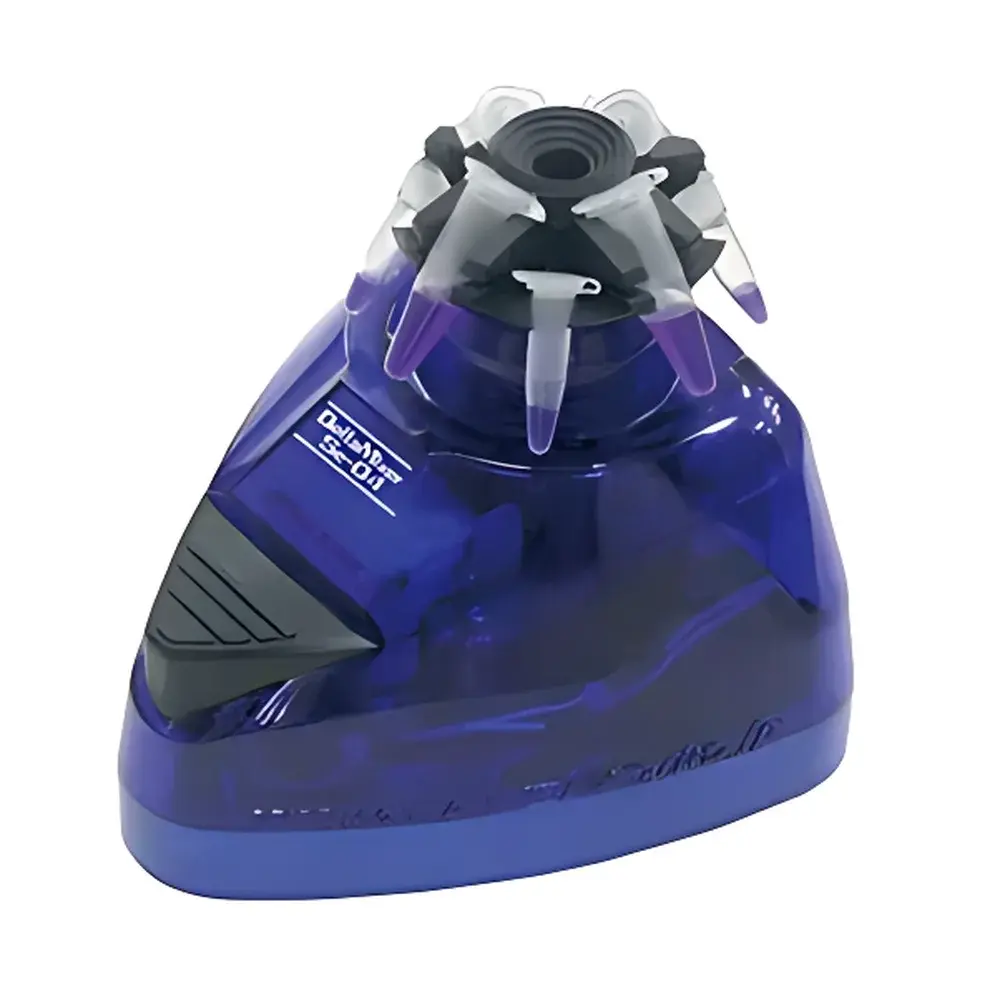
TAITEC DELTA MIXER Se-08 Vortex Mixer
| Brand | TAITEC |
|---|---|
| Origin | Japan |
| Model | DELTA MIXER Se-08 |
| Speed Range | 0–3000 rpm (adjustable) |
| Operating Mode | Touch-activated or continuous |
| Oscillation Type | Horizontal eccentric oscillation |
| Amplitude | 4.5 mm |
| Display | Analog speed indicator |
| Housing Material | Die-cast aluminum alloy |
| Dimensions (W×D×H) | 140 × 160 × 135 mm |
| Weight | ~3 kg (including rubber head) |
| Power Supply | AC 220 V, 0.5 A |
| Ambient Operating Temperature | +5 °C to +35 °C |
| Sample Compatibility | Microcentrifuge tubes (0.5 / 1.5 / 2.0 mL), standard centrifuge tubes up to 50 mL, microplates (with optional MD02 kit) |
Overview
The TAITEC DELTA MIXER Se-08 is a precision-engineered vortex mixer designed for reproducible, low-vibration sample homogenization in life science and analytical laboratories. Utilizing horizontal eccentric oscillation—distinct from vertical orbital or conical motion—the Se-08 generates consistent, controlled turbulence across a wide range of tube formats without inducing excessive foaming or aerosol generation. Its core mechanical architecture features a three-point triangular base with optimized mass distribution and die-cast aluminum construction, delivering exceptional stability during both touch-activated and continuous operation. This design satisfies ISO/IEC 17025-aligned requirements for instrument stability under routine benchtop use, particularly where vibration-sensitive instrumentation (e.g., spectrophotometers, balances, or microscopes) is located nearby.
Key Features
- Delta-Balance Triangular Base: Patented three-foot geometry validated on lubricated surfaces and inclined planes (up to 5°), ensuring zero lateral displacement even at maximum 3000 rpm—critical for unattended overnight mixing and GLP-compliant workflows.
- Dual-Mode Operation: Seamless transition between momentary touch activation (for brief mixing pulses) and continuous mode via a pressure-sensitive analog switch; variable pressure modulation allows fine control over mixing intensity without digital interface dependency.
- Universal Rubber Head (04 & 08 variants): Proprietary elastomeric coupling accommodates eight 0.5–2.0 mL microtubes simultaneously—or enables direct handheld mixing of tubes up to 50 mL by centering the tube tip within the head’s conical cavity.
- Analog Speed Control & Feedback: Smooth, gear-driven rheostat adjustment with calibrated analog dial provides intuitive, drift-free speed selection across the full 0–3000 rpm range (50/60 Hz compatible); eliminates reliance on firmware or software calibration.
- Robust Mechanical Architecture: All-metal drive train, sealed bearing assembly, and corrosion-resistant anodized aluminum housing ensure long-term reliability under high-cycle laboratory use (>50,000 actuations typical).
Sample Compatibility & Compliance
The Se-08 supports standardized consumables per ISO 8573-1 (compressed air purity) and ASTM D4789 (microtube dimensional tolerances). It accommodates common tube formats—including Eppendorf-style microcentrifuge tubes (0.5/1.5/2.0 mL), conical-bottom 15 mL and 50 mL centrifuge tubes (up to 30 mL liquid volume), and 96-well microplates when used with the optional MD02 accessory kit (comprising 30-position microtube clamp and single-plate holder). The device complies with IEC 61010-1:2010 safety standards for electrical equipment for measurement, control, and laboratory use. Its stable oscillation profile meets internal QC criteria for reproducibility in nucleic acid extraction, ELISA plate preparation, and cell suspension protocols per CLSI EP15-A3 guidelines.
Software & Data Management
As a standalone electromechanical instrument, the Se-08 operates without embedded firmware or network connectivity—eliminating cybersecurity risks and validation overhead associated with digital controllers. Speed settings are manually recorded in lab notebooks or electronic lab notebooks (ELNs) as part of standard operating procedures (SOPs). For regulated environments (e.g., FDA-regulated biomanufacturing or ISO 13485 medical device testing), its analog operation supports straightforward IQ/OQ documentation and satisfies 21 CFR Part 11 audit trail requirements when paired with paper-based or validated ELN logging practices. No software updates, drivers, or cloud dependencies are required.
Applications
- Routine resuspension of lyophilized reagents and bacterial pellets in molecular biology workflows
- Homogenization of viscous samples (e.g., glycerol stocks, agarose gels, or protein solutions) prior to electrophoresis or chromatography injection
- Pre-analytical mixing in clinical chemistry—particularly for serum separation tubes requiring gentle inversion alternatives
- Cell dissociation support in primary culture setup, including gentle agitation of trypsinized monolayers
- Quality control mixing steps in pharmaceutical stability studies (ICH Q5C), where mechanical consistency across batches is essential
- Supporting AOAC 990.11 and ISO 11290-1 protocols for microbial enrichment broth homogenization
FAQ
Does the Se-08 require calibration or periodic verification?
No formal calibration is mandated; however, users should verify speed accuracy annually using a certified optical tachometer per ISO/IEC 17025 clause 6.5.2, especially in accredited testing labs.
Can the Se-08 be used with PCR plates or deep-well plates?
Yes—when equipped with the MD02 microplate adapter, it accommodates standard 96-well PCR plates and shallow/deep-well formats (1–2 mL well capacity) with uniform mixing across all wells.
Is the rubber head autoclavable?
The proprietary rubber head is not autoclavable; it is cleaned with 70% ethanol or isopropanol and air-dried. Replacement heads (part no. RH-04, RH-08) are available separately.
What maintenance is recommended?
Biannual inspection of drive belt tension and bearing smoothness; wipe exterior with non-abrasive damp cloth; avoid solvent exposure to rubber components.
How does horizontal eccentric oscillation differ from conventional vortexing?
Unlike vertical vortex mixers that induce high-shear conical motion, horizontal eccentric oscillation generates laminar, side-to-side fluid displacement—reducing bubble formation and shear-induced denaturation of sensitive biomolecules.



