
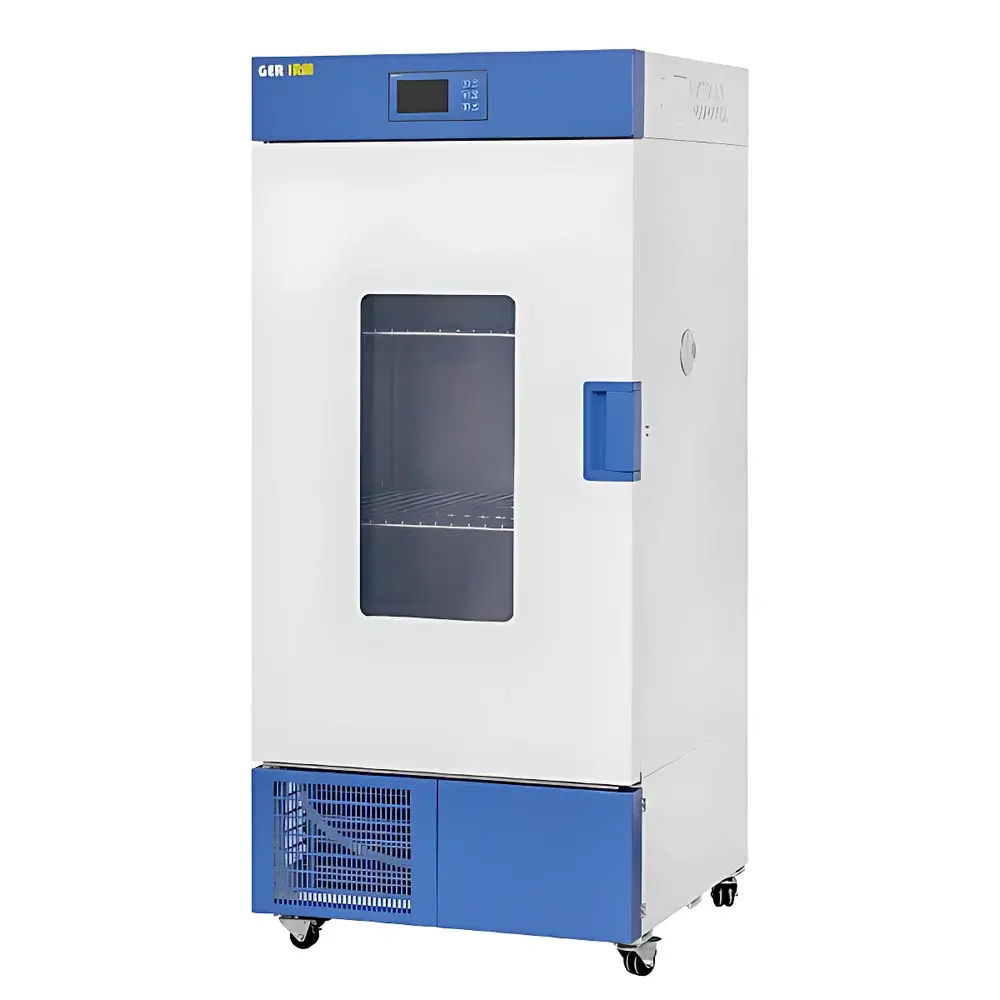

IRM NIB260 Biochemical Incubator
| Brand | IRM |
|---|---|
| Origin | Beijing, China |
| Manufacturer Type | Direct Manufacturer |
| Heating Method | Air-jacketed |
| Cooling Method | Compressor-based |
| Air Circulation | Forced convection |
| Temperature Range | −10 °C to +90 °C |
| Temperature Accuracy | ±0.1 °C |
| Temperature Fluctuation | ±0.2 °C |
| Temperature Uniformity | ±0.5 °C (at 20 °C) |
| Capacity | 305 L |
| External Dimensions | 780 × 790 × 1600 mm (W × D × H) |
Overview
The IRM NIB260 Biochemical Incubator is an air-jacketed, forced-convection incubation system engineered for precise, stable, and reproducible temperature control in life science laboratories, quality control environments, and regulated biopharmaceutical settings. Designed around a dual-mode thermal architecture—combining independent air-jacket heating with a high-efficiency hermetic compressor cooling circuit—the NIB260 maintains tight thermal stability across its full operational range of −10 °C to +90 °C. Its core control algorithm implements intelligent PID regulation with adaptive gain tuning, enabling sustained thermal uniformity of ±0.5 °C at 20 °C (measured per ISO 15378 Annex B and ASTM E2842-21 test protocols under no-load conditions). Unlike natural-convection units, the NIB260’s tangential blower system ensures rapid equilibration and minimal spatial gradient—critical for long-term microbial culture, enzyme kinetics studies, and stability testing per ICH Q1A(R3). The unit operates frost-free above 20 °C, eliminating manual defrost cycles and associated temperature excursions.
Key Features
- Air-jacketed heating system with distributed heater arrays and independent overtemperature cutoff—ensures fail-safe thermal containment without hot-spot formation.
- High-reliability hermetic compressor (imported brand), R134a refrigerant, and integrated pressure/thermal protection circuits (compressor overpressure, motor overheating, condenser fan failure).
- Forced convection airflow optimized via aerodynamic duct design and low-turbulence impeller—validated to achieve ≤0.5 °C spatial deviation at 20 °C per ISO 15378 Annex B mapping protocol.
- Comprehensive safety architecture: residual-current device (RCD), independent mechanical overtemperature limiter (non-resettable at >95 °C), door-open alarm, power-fail recovery with memory retention, and real-time sensor fault detection.
- Ergonomic mobility: heavy-duty locking casters (load rating ≥150 kg), front-access service panel, and dual 50 mm diameter pass-through ports (left/right) for external probe routing or gas line integration.
- Robust enclosure: 1.2 mm cold-rolled steel cabinet with epoxy-powder coating; stainless-steel interior chamber (304 grade); double-layer insulated door with magnetic seal and anti-condensation heater.
Sample Compatibility & Compliance
The NIB260 accommodates standard microbiological vessels—including Petri dishes, flasks (up to 2 L), multi-well plates, and serum bottles—on up to 20 adjustable stainless-steel shelves (standard configuration: 2 shelves, max 15). Its internal geometry (640 × 450 × 1060 mm W × D × H) supports stacked shelving layouts without compromising airflow integrity. The unit complies with essential regulatory frameworks for GxP environments: it supports ALCOA+ data integrity principles through event logging, audit-trail-capable operation history, and user-level access control (when equipped with optional IB-series touchscreen). While the NIB260 itself is not FDA-cleared, its design aligns with key elements of 21 CFR Part 11 (electronic records/signatures) when deployed with validated software configurations and procedural controls. It meets IEC 61010-1:2010 safety requirements for laboratory equipment and conforms to EMC directive 2014/30/EU.
Software & Data Management
The NIB260 series offers two control interfaces: the entry-level NIB variant features membrane-keypad input with alphanumeric LCD display supporting fixed-setpoint, timer-based, and multi-segment programmable operation (1–30 steps). For advanced traceability, the IB-series touchscreen upgrade (7″ capacitive LCD) provides role-based authentication (three-tier permission system: Operator, Supervisor, Administrator), time-stamped event logs (door opens, alarms, setpoint changes), real-time trend visualization (temperature vs. time), and USB export of CSV-formatted datasets—including raw sensor values, timestamps, and status flags. All logged events include immutable metadata (user ID, timestamp, action type), satisfying basic GLP documentation requirements. Optional thermal printer interface enables hard-copy record generation compliant with internal SOPs.
Applications
- Microbial growth studies (E. coli, yeast, molds) under controlled sub-zero to hyperthermic conditions.
- Long-term stability testing of biologics, vaccines, and diagnostic reagents per ICH Q5C and USP <1043>.
- Biochemical assay development requiring stable thermal baselines for kinetic profiling (e.g., LDH, amylase, protease activity).
- Cell culture pre-incubation and environmental stress simulation (cold shock, heat shock, diurnal cycling).
- QC/QA release testing in pharmaceutical manufacturing where temperature consistency directly impacts endotoxin assay validity (USP <85>) or sterility test incubation (USP <71>).
- Environmental simulation for material degradation studies (polymer aging, packaging permeability).
FAQ
What is the difference between the NIB and IB control systems?
The NIB model uses a membrane keypad and monochrome LCD for basic setpoint, timer, and 30-step program control. The IB variant adds a 7″ touchscreen, three-level user permissions, electronic audit trail, real-time graphing, and USB data export.
Does the NIB260 support humidity control?
No—this is a temperature-only incubator. Humidity management requires the separate IRM H-series humidified incubators.
Can the NIB260 be validated for GMP use?
Yes—its documented design, deterministic control logic, alarm logging, and configurable user access make it suitable for IQ/OQ/PQ validation when supported by site-specific SOPs and qualified calibration procedures.
What maintenance is required for the compressor system?
Annual inspection of condenser coil cleanliness, refrigerant pressure verification, and fan motor lubrication per manufacturer’s service manual. No routine oil changes are needed for sealed compressors.
Is the temperature uniformity specification guaranteed across the entire volume?
The ±0.5 °C uniformity is verified at 20 °C under no-load ISO 15378 Annex B mapping. Loaded uniformity depends on load mass, vessel density, and shelf placement—users should perform periodic in-situ mapping per their internal validation protocol.






