
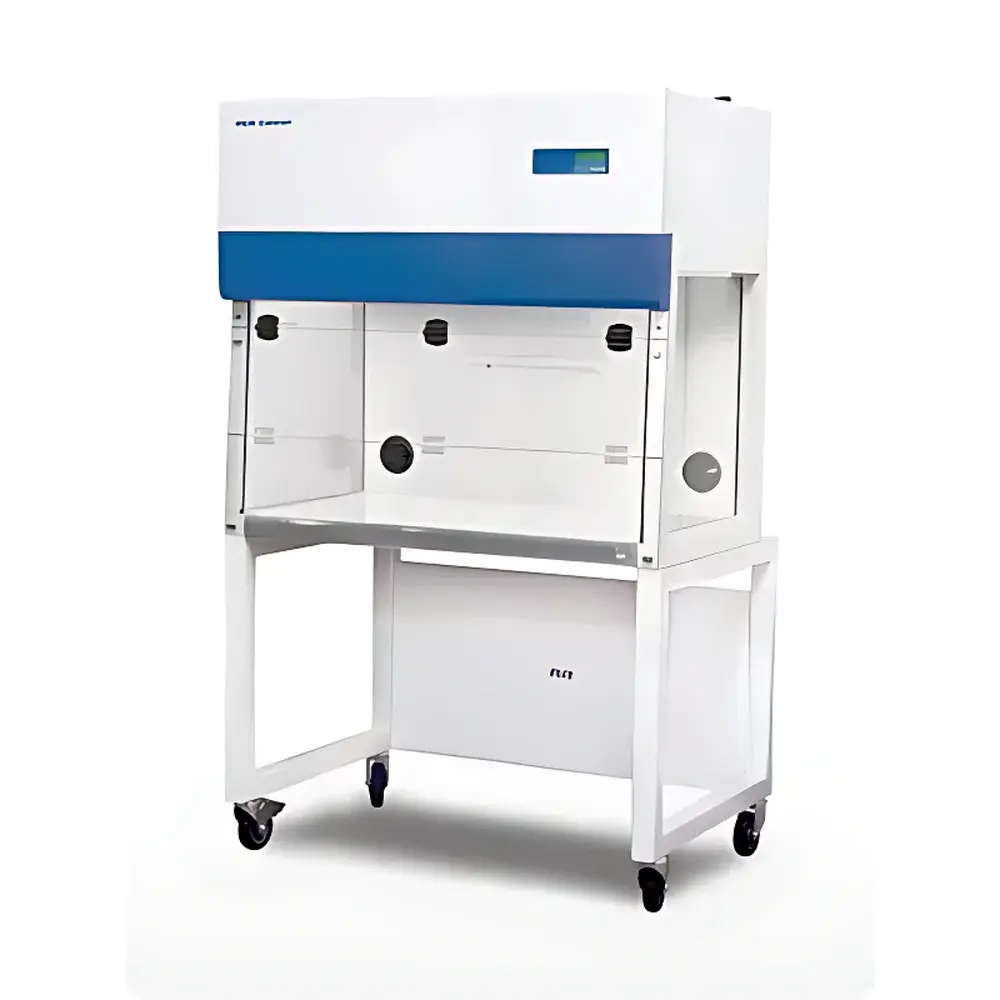
Esco PCR-Specific Vertical Laminar Flow Clean Bench
| Brand | Esco |
|---|---|
| Model | PCR-A |
| Origin | Singapore |
| Filter Efficiency | 99.99% @ 0.3 µm (HEPA) |
| Cleanliness Class | ISO 4 (Work Area), < ISO 5 (Operator Zone) |
| Airflow Velocity | 0.30 m/s (60 fpm) |
| Noise Level | ≤64 dBA (2-ft), ≤53 dBA (3-ft), ≤62 dBA (4-ft) |
| UV Lamp Options | 15 W / 30 W @ 254 nm |
| Control System | Sentinel Microprocessor-Based Controller with Real-Time Airflow Monitoring, Audible/Visual Alarms, and Programmable UV Cycle |
| Safety Interlock | Dual-Fold Front Sash Linked to UV Lamp |
| Surface Coating | Esco Isoceide Antimicrobial Coating |
| Work Surface | Seamless Stainless Steel |
| Side Panels | Tempered Glass for Enhanced Illumination |
| Compliance | AS 1386.5 (Australia), ISO 14644-1 Class 4, NSF/ANSI 49 (Referenced Design Principles) |
Overview
The Esco PCR-A is a vertically oriented laminar flow clean bench specifically engineered for polymerase chain reaction (PCR) workflows where stringent contamination control is non-negotiable. Unlike general-purpose horizontal or vertical laminar flow hoods, the PCR-A integrates design and operational parameters optimized for molecular biology applications—particularly those involving low-copy-number DNA templates, amplicon-sensitive assays, and pre-PCR sample preparation. Its airflow architecture follows the principles of unidirectional vertical laminar flow: air is drawn through a pre-filter, conditioned, then passed through a certified HEPA filter (99.99% efficiency at 0.3 µm) before descending uniformly over the work surface at a controlled velocity of 0.30 m/s. This ensures consistent particle removal and prevents turbulent mixing that could reintroduce aerosolized nucleic acid contaminants. The interior achieves an ISO 4 (Class 10) cleanroom environment—verified per ISO 14644-1—and maintains operator-zone cleanliness exceeding ISO 5 standards under dynamic operating conditions.
Key Features
- Vertical laminar airflow system with ISO 4-certified clean working area, validated per AS 1386.5 and aligned with ISO 14644-1 requirements for critical molecular biology environments.
- True dual-fold front sash mechanism interlocked with UV irradiation: UV lamps deactivate only when the sash is fully closed, preventing accidental exposure and ensuring compliance with occupational safety protocols (AS/NZS 2211.1).
- Sentinel microprocessor-based controller providing real-time digital display of inflow velocity, programmable UV sterilization cycles (duration, delay, auto-shutdown), and configurable audible/visual alarms for airflow deviation (>±10%), filter saturation, or door position faults.
- Esco Isoceide antimicrobial coating applied to all external cabinet surfaces—validated against ISO 22196—to inhibit proliferation of bacteria, fungi, and mold on painted metal surfaces, reducing bioburden accumulation between routine disinfection cycles.
- Monolithic 304 stainless steel work surface with zero seams or crevices; resistant to corrosion from ethanol, bleach, and common enzymatic decontaminants used in PCR labs.
- Tempered glass side panels enhance ambient light transmission without compromising structural integrity or UV shielding performance during sterilization.
Sample Compatibility & Compliance
The PCR-A accommodates standard PCR consumables—including 96-well plates, tube racks, pipette tip boxes, thermal cyclers (benchtop models), and microcentrifuges—within its defined internal dimensions (630 × 538 × 550 mm for 2-ft variant). Its ISO 4 classification satisfies the environmental requirements specified in ISO/IEC 17025:2017 Annex A.3 for molecular testing laboratories and aligns with CLSI MM19-A guidelines for nucleic acid amplification contamination prevention. While not a biosafety cabinet (BSC), it complies with key elements of NSF/ANSI 49 for airflow containment integrity and user protection during non-hazardous procedures. Documentation packages include factory-issued filter certification reports, airflow uniformity test data, and AS 1386.5 conformance statements—all traceable to NATA-accredited calibration laboratories.
Software & Data Management
The Sentinel controller logs operational events—including UV cycle timestamps, airflow excursions, sash position changes, and alarm triggers—with timestamped entries stored internally for ≥30 days. Audit trail functionality supports GLP and GMP-aligned quality systems: logged data cannot be edited or deleted without administrator-level authentication. Optional RS-232 or USB-C interface enables export of CSV-formatted logs for integration into LIMS or electronic lab notebook (ELN) platforms. Firmware updates are performed via secure authenticated firmware image upload, maintaining data integrity and version control per FDA 21 CFR Part 11 requirements for electronic records.
Applications
- Pre-PCR reagent preparation and master mix assembly in clinical diagnostics, research, and forensic laboratories.
- Template DNA/RNA handling prior to reverse transcription or library preparation for NGS workflows.
- Cloning, restriction digestion, and ligase reactions requiring ultra-low background contamination.
- Quality control of oligonucleotide stocks and enzyme preparations susceptible to nuclease carryover.
- Environmental monitoring sampling prep where airborne amplicon cross-contamination must be eliminated.
FAQ
Is the PCR-A certified as a biosafety cabinet?
No. It is a laminar flow clean bench designed exclusively for product protection—not personnel or environmental protection. It does not meet NSF/ANSI 49 Class II criteria and must not be used for handling viable pathogens or toxic compounds.
Can the UV lamp operate while the sash is open?
No. The dual-fold sash is mechanically and electronically interlocked with the UV system; irradiation is disabled unless the sash is fully lowered and latched.
What maintenance intervals are recommended for the HEPA filter?
Filter replacement is triggered by pressure differential monitoring and scheduled every 12–24 months depending on usage frequency and ambient particulate load. The Sentinel system issues a visual alert when ΔP exceeds threshold limits.
Does the unit support IQ/OQ documentation for regulated environments?
Yes. Esco provides IQ/OQ protocol templates compliant with ISO/IEC 17025 and ASTM E2500-07, including test methods for airflow velocity mapping, filter leak testing (using PAO/DOP aerosol), and alarm verification.
Is the Isoceide coating effective against SARS-CoV-2 or other RNA viruses?
Isoceide is tested per ISO 22196 for bacterial and fungal inhibition. While not specifically validated against enveloped viruses, its copper-based formulation exhibits broad-spectrum antimicrobial activity consistent with literature on contact-killing mechanisms for lipid-enveloped pathogens.



