
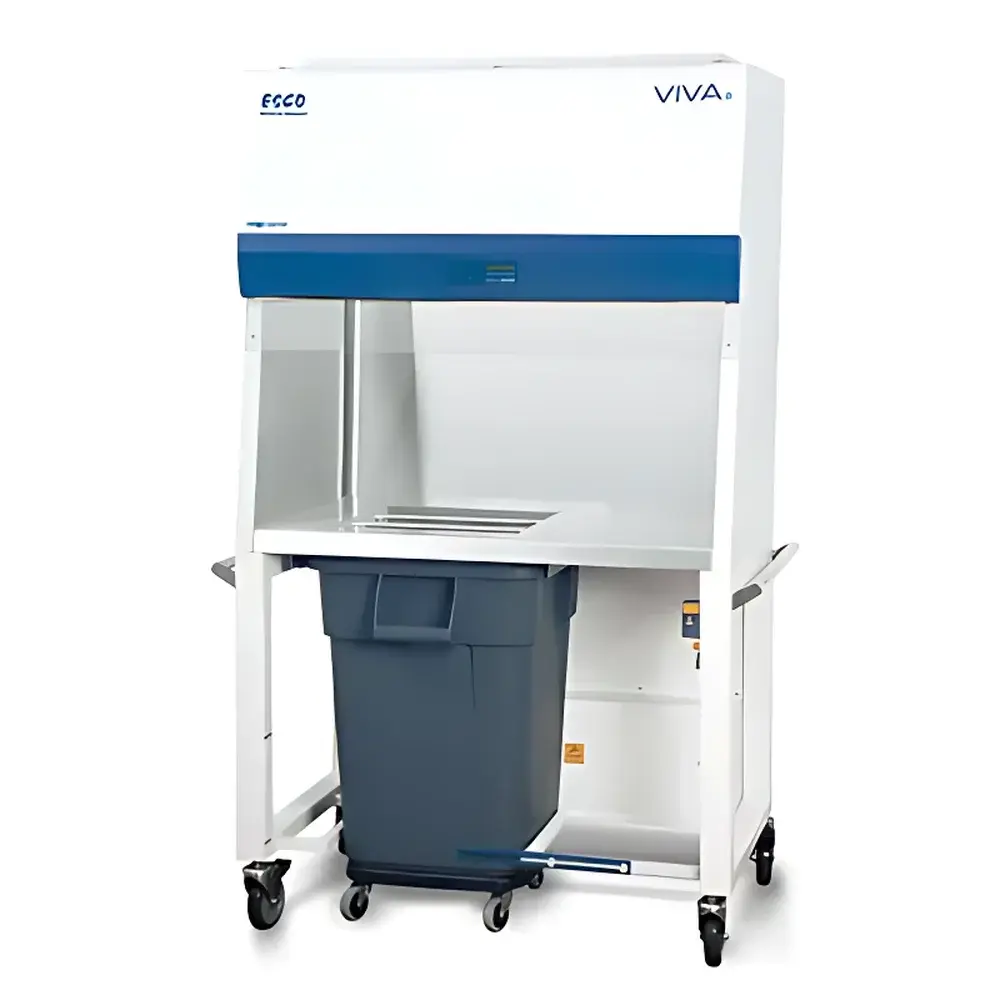
Esco VIVA Animal Bedding Processing Workstation
| Brand | Esco |
|---|---|
| Origin | Singapore |
| Manufacturer Type | Original Equipment Manufacturer (OEM) |
| Product Category | Imported |
| Model | VBD-4A1 |
| Safety Class | Class II Biological Safety Cabinet |
| External Dimensions (L×W×H) | 1247 × 760 × 1966 mm (adjustable height up to 2271 mm) |
| Internal Dimensions (L×W×H) | 1040 × 680 × 594 mm |
| Inflow Air Velocity | 0.35 m/s (70 fpm) |
| ULPA Filter Efficiency | ≥99.999% at 0.12 µm |
| Power Supply | 220–240 VAC, 50 Hz |
| NSF-Certified Waste Container Capacity | 40 US gallons (151 L) |
| Pre-filter | Polyester media, cardboard frame, 870 × 500 mm, 6 units per box |
Overview
The Esco VIVA Animal Bedding Processing Workstation (Model VBD-4A1) is a purpose-engineered Class II biological safety cabinet designed specifically for the safe, ergonomic, and contamination-controlled handling of animal bedding, cage washing effluents, and allergenic particulates in preclinical research, vivarium support, and comparative medicine laboratories. Unlike standard biosafety cabinets, the VIVA integrates dual-layer protection—ULPA filtration for airborne particulate containment and Nanocarb™ activated carbon filtration for volatile organic compound (VOC) and malodorous gas abatement—making it uniquely suited for high-exposure tasks such as soiled bedding disposal, cage rinsing, and allergen-laden waste consolidation. Its operational principle follows the Class II A2 airflow pattern: inward inflow (0.35 m/s) protects the operator; downward laminar downflow (≥0.25 m/s) safeguards the work surface; and recirculated air passes through both ULPA and carbon filters before reintroduction into the workspace. All airflow dynamics are continuously monitored and validated per NSF/ANSI 49 and EN 12469 standards.
Key Features
- Sentinel™ microprocessor-based control system with real-time monitoring of inflow velocity, downflow velocity, filter differential pressure, UV lamp status, and alarm logging—supporting audit-ready GLP/GMP compliance.
- Hydraulic height-adjustable work surface (1966–2271 mm total height), enabling precise ergonomic alignment for users of varying stature and reducing repetitive strain injury (RSI) risk during prolonged operation.
- Integrated 40-gallon (151 L) NSF-certified waste container mounted directly within the work area—eliminating secondary transfer steps and minimizing cross-contamination potential.
- ULPA filter certified to retain ≥99.999% of particles ≥0.12 µm, validated via DOP/PAO testing and compliant with ISO 29463-3:2017 and IEST-RP-CC001.7.
- Nanocarb™ granular activated carbon filter with ≥90% adsorption efficiency for common animal facility VOCs including ammonia, hydrogen sulfide, and short-chain fatty acids (e.g., butyric acid).
- Replaceable pre-filter (polyester media, cardboard frame, 870 × 500 mm) extends ULPA service life and allows safe in-situ replacement under active airflow—no system shutdown required.
- Stainless steel monobloc work surface with fully radiused corners (R10 mm), ISOCIDE® antimicrobial coating (ASTM E2149-22 tested), and dedicated sloped spill containment zone for rapid, drip-free disposal of wet bedding or rinse water.
- Energy-optimized EC motor-driven风机 system delivering stable airflow across variable filter loading conditions, with ≤15% power consumption variance over full filter lifecycle.
- Uniform LED task lighting (≥500 lux at work surface, color rendering index CRI >85) calibrated to minimize shadowing during fine manual operations.
Sample Compatibility & Compliance
The VBD-4A1 accommodates standard rodent and lagomorph housing systems—including static and ventilated caging (IVC), automated wash racks, and disposable bedding containers—within its 1040 × 680 × 594 mm interior chamber. It supports routine processing of cellulose-, corn cob-, and wood-based bedding materials, as well as enzymatic or chemical decontamination agents used in cage-wash cycles. The workstation has undergone independent ELISA-based allergen challenge testing (per ASTM D6328-20), demonstrating ≤0.02 ng/m³ residual murine urinary protein (MUP) concentration under continuous operation. Regulatory compliance includes NSF/ANSI 49 (2023 edition), EN 12469:2020, ISO 14644-1 Class 5 (at work surface), and FDA 21 CFR Part 11–ready data logging when paired with Esco’s optional Sentinel Connect software module.
Software & Data Management
The Sentinel™ controller stores 30 days of continuous operational logs—including airflow setpoints, actual velocities, filter delta-P trends, UV exposure time, and alarm events—with timestamped entries and user ID tagging. Optional Sentinel Connect software enables remote monitoring via secure HTTPS web interface, configurable email/SMS alerts, and export of CSV/Excel reports compatible with laboratory information management systems (LIMS). Audit trails comply with ALCOA+ principles (Attributable, Legible, Contemporaneous, Original, Accurate, Complete, Consistent, Enduring, Available) and support FDA 21 CFR Part 11 electronic signature requirements when deployed with validated authentication protocols.
Applications
- Primary containment during manual or semi-automated disposal of soiled animal bedding in AAALAC-accredited facilities.
- Safe handling of allergen-rich cage wash effluents prior to wastewater discharge or on-site treatment.
- Preparation and packaging of irradiated or autoclaved bedding under particle-controlled conditions.
- Integration into centralized vivarium utility corridors for decentralized waste consolidation without compromising HVAC integrity.
- Support of immunocompromised animal studies requiring strict environmental particulate control beyond standard BSC performance.
FAQ
Is the VBD-4A1 certified as a Class II, Type A2 biosafety cabinet?
Yes—the VBD-4A1 is independently certified to NSF/ANSI 49:2023 and EN 12469:2020 as a Class II, Type A2 cabinet with verified inflow and downflow velocities, filter integrity, and containment performance.
Can the ULPA and carbon filters be replaced without shutting down the unit?
The pre-filter may be replaced under active airflow; however, ULPA and Nanocarb™ filter replacements require full system shutdown and recommissioning per ISO 14644-3 protocols.
Does the workstation meet requirements for GLP or GMP-regulated animal studies?
Yes—its Sentinel™ controller provides traceable, time-stamped operational records, and optional Sentinel Connect supports 21 CFR Part 11 compliance for regulated environments.
What maintenance intervals are recommended for optimal performance?
Pre-filters: every 3–6 months depending on particulate load; ULPA/carbon filters: every 24–36 months or upon reaching 80% rated delta-P; annual third-party certification per ISO 14644-3 is strongly advised.
Is the stainless steel work surface resistant to common disinfectants used in animal facilities?
Yes—the AISI 304 stainless steel surface with ISOCIDE® coating is validated for repeated exposure to 70% ethanol, 10% sodium hypochlorite, and quaternary ammonium compounds per ASTM E2180-22.




