
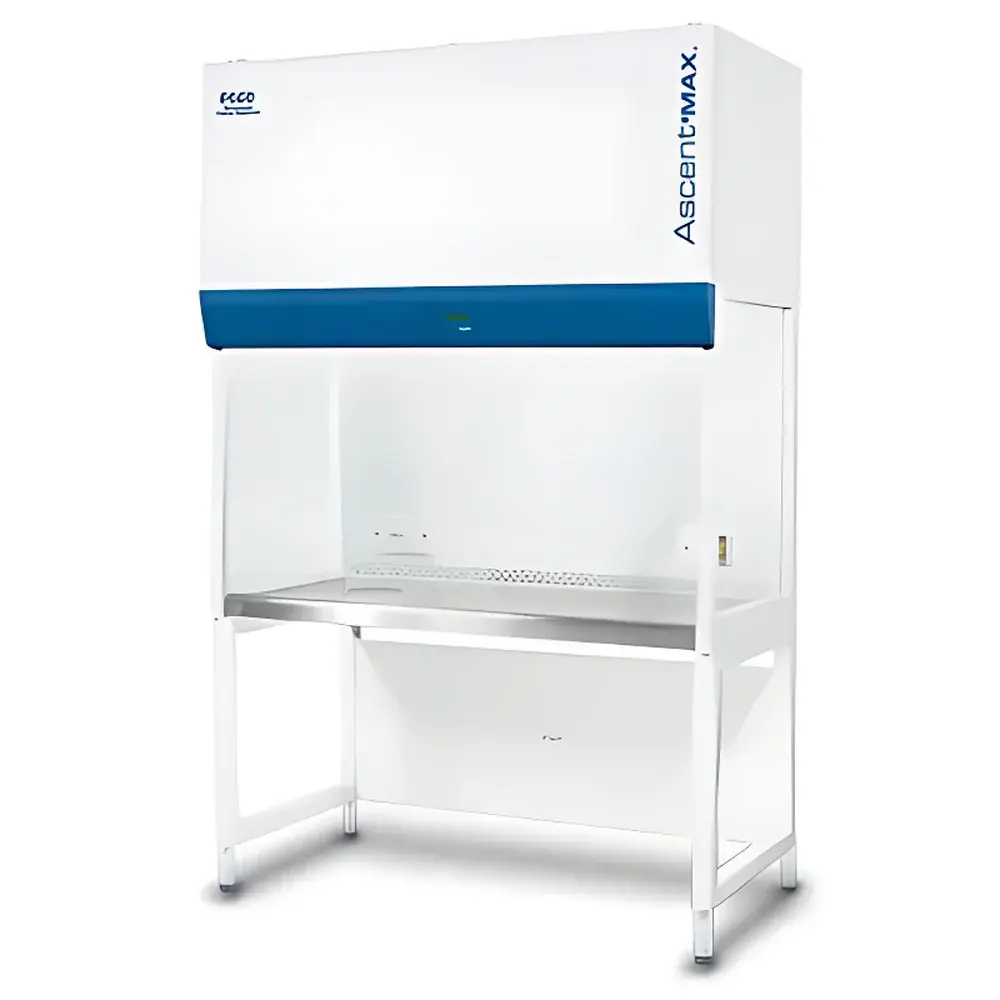
Esco Ascent MAX ADC-C Ductless Fume Hood
| Brand | Esco |
|---|---|
| Origin | Singapore |
| Manufacturer Type | Manufacturer |
| Origin Category | Imported |
| Model | ADC-C |
| Construction | Single-Face, All-Steel Ductless Fume Hood |
| Cabinet Material | 304 Stainless Steel Work Surface, Galvanized Steel Side Walls |
| Filter System | Dual-Stage Nanocarb™ Activated Carbon with Optional Auxiliary Carbon Module |
| Airflow Inflow Velocity | 0.4 m/s |
| Compliance | ASHRAE 110, EN 14175-3, AFNOR NF X 15-203, BS 7989, BS 7258 |
| Control System | Sentinel™ Microprocessor-Based Monitoring & Alarm Interface |
| Optional Accessories | VOC Sensor, PP Sink + Gooseneck Faucet (PP), Adjustable Height Stand (SAL), Mobile Base with Braking Casters (SPC), International Power Outlets, DIN/BS-Compliant Utility Services |
Overview
The Esco Ascent MAX ADC-C is a high-performance, single-face ductless fume hood engineered for safe containment and recirculation of hazardous chemical vapors in laboratories where external ducting is impractical or cost-prohibitive. Unlike traditional ducted hoods that exhaust air to the exterior environment, the ADC-C employs a closed-loop airflow system with dual-stage filtration—comprising primary and auxiliary Nanocarb™ activated carbon media—to adsorb volatile organic compounds (VOCs), acids, mercury, aldehydes, ammonia, halogens, and other airborne contaminants. Its design adheres strictly to internationally recognized performance validation protocols, including ASHRAE 110 tracer gas testing, EN 14175-3 face velocity and containment criteria, and AFNOR NF X 15-203 operational safety thresholds. The hood’s structural integrity derives from a fully welded 304 stainless steel work surface and galvanized steel side panels, ensuring long-term resistance to corrosion, particulate generation, and mechanical wear under routine laboratory use.
Key Features
- Robust all-steel construction with seamless 304 stainless steel work surface meeting ISO 8501-1 Sa 2½ surface preparation standards for corrosion resistance.
- Front-edge upstand design (15 mm vertical lip) retains spilled liquids within the work area, supporting compliance with GLP spill containment requirements.
- Sentinel™ microprocessor-based control system continuously monitors airflow, filter saturation status, and door position; triggers audible and visual alarms upon deviation from preset safety thresholds (e.g., 85% filter loading).
- Ergonomic sliding sash with smooth counterbalanced mechanism and soft-stop braking, tested to >100,000 operational cycles per ASTM F2656.
- ISOCIDE® antimicrobial coating applied to all exposed polymer surfaces—including sash frame and control panel—reducing microbial colonization per ISO 22196:2011.
- Front-access maintenance architecture: all filters, sensors, and internal components are serviceable via removable front service panel, enabling wall-mounted installation without rear clearance.
- Modular Nanocarb™ filter portfolio: eight chemically selective configurations available—including acid gas, mercury-specific, aldehyde-scavenging, and mixed-halogen formulations—each validated per ASTM D5212 for adsorption capacity and breakthrough time.
Sample Compatibility & Compliance
The ADC-C is certified for use with low-to-moderate volatility chemicals commonly handled in analytical chemistry, pharmaceutical QC, and academic research labs—including acetone, methanol, chloroform, formaldehyde, hydrochloric acid vapor, and elemental mercury vapor. It is not intended for perchloric acid, hydrogen fluoride, or radioactive aerosols. All units undergo factory calibration and third-party verification per EN 14175-3 Type I classification for ductless hoods. Documentation includes full ASHRAE 110 smoke visualization reports, filter efficiency test certificates (per ISO 10121-1), and CE marking under EU Machinery Directive 2006/42/EC and EMC Directive 2014/30/EU. Optional VOC sensor integration supports real-time concentration monitoring aligned with OSHA PEL and ACGIH TLV® reference values.
Software & Data Management
The Sentinel™ controller logs timestamped operational data—including sash height, average inflow velocity, cumulative runtime, and filter usage metrics—for up to 12 months onboard. Data export is supported via USB 2.0 interface in CSV format, compatible with LIMS and electronic lab notebook (ELN) platforms. Audit trail functionality complies with FDA 21 CFR Part 11 requirements when paired with Esco’s optional Sentinel Connect cloud gateway (sold separately), enabling remote monitoring, user access logging, and electronic signature-enabled maintenance records. Firmware updates are delivered via secure HTTPS protocol with SHA-256 signature validation.
Applications
The ADC-C serves as a primary containment solution for routine bench-scale chemical handling in environments constrained by infrastructure limitations: university teaching labs lacking dedicated exhaust shafts; QA/QC laboratories in GMP-compliant facilities requiring segregated VOC handling zones; environmental testing labs performing solvent-based extractions; and biotech incubators where thermal load minimization is critical. Its compact footprint and wall-mount capability make it suitable for satellite workstations, mobile labs, and cleanroom-adjacent support areas. When configured with acid-resistant Nanocarb™ filters and PP sink accessories, it meets DIN 12919 specifications for corrosive reagent dispensing stations.
FAQ
What filter replacement interval is recommended for the ADC-C?
Filter service life depends on chemical type, concentration, and daily usage duration. Esco recommends quarterly verification using the Sentinel™ system’s filter saturation indicator; typical replacement occurs every 6–12 months under moderate use (≤4 hrs/day, <50 ppm avg. VOC exposure).
Can the ADC-C be installed in a cleanroom environment?
Yes—the unit generates no external exhaust and maintains Class 10,000-compatible particle shedding rates (<1 particle/ft³ ≥0.5 µm) when operated with HEPA-equipped variants (e.g., ADC-E model); standard ADC-C models meet ISO 14644-1 Class 8 background requirements.
Is the VOC sensor calibrated traceably to NIST standards?
Yes—optional VOC sensors ship with NIST-traceable calibration certificate (per ISO/IEC 17025) and support field recalibration using certified isobutylene challenge gas.
Does the ADC-C comply with local fire code requirements for ductless hoods?
Compliance varies by jurisdiction; Esco provides technical documentation packages—including UL 61010-1 certification, flame-spread index (ASTM E84 Class A rating for cabinet materials), and suppression-ready electrical schematics—to support AHJ review.
What power supply options are available beyond the standard 110–240 VAC input?
Custom configurations include 208 VAC three-phase input, 24 VDC emergency backup operation (for alarm continuity during mains failure), and integrated UPS interface—subject to engineering review and lead-time extension.



