
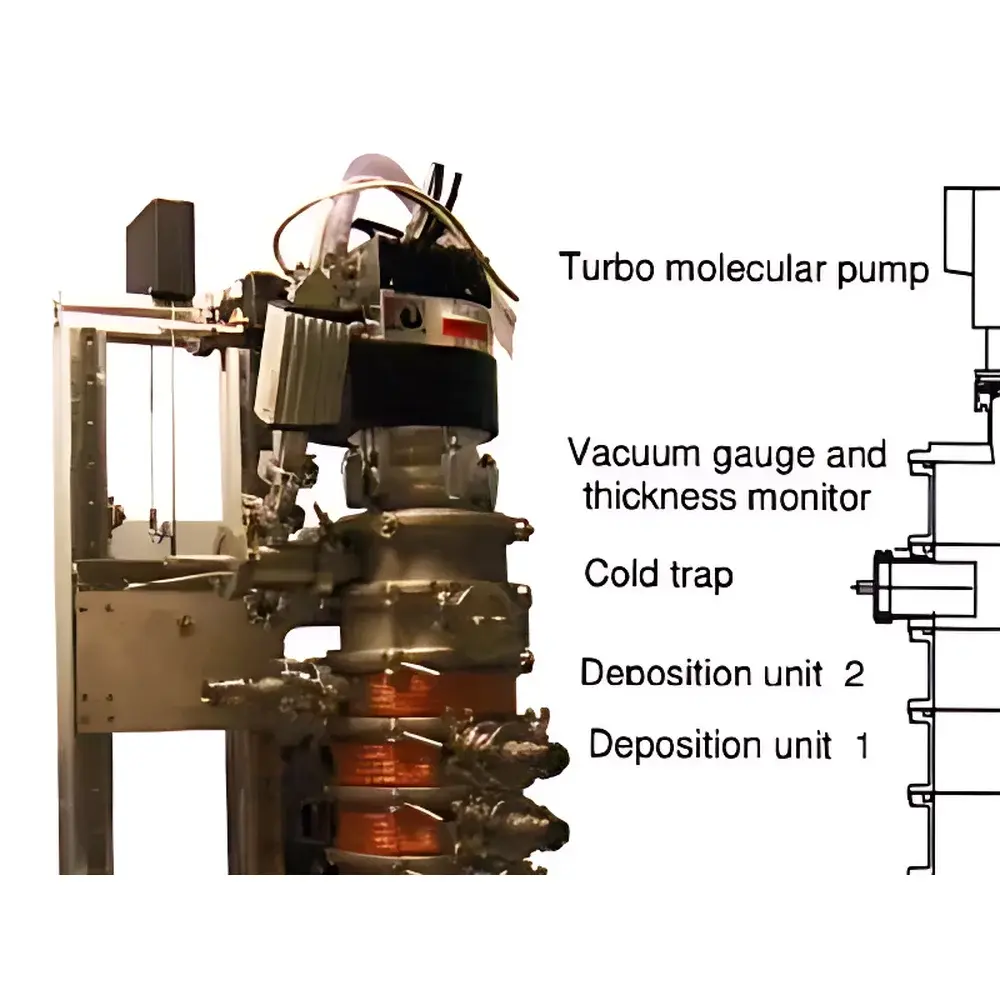
CreaPhys DSU200 Pilot-Scale Vacuum Sublimation System
| Brand | CreaPhys |
|---|---|
| Origin | Germany |
| Model | DSU200 |
| Maximum Batch Capacity | 200 g |
| Base Vacuum | < 10⁻⁶ mbar (clean & dry system) |
| Evaporation Zone Temp Range | 100–500 °C |
| Deposition Zone Temp Range | 100–450 °C |
| Deposition Zone Temperature Uniformity | < ±10 °C |
| Footprint Diameter | 190 mm |
| Height | ~800 mm |
| Optional Accessories | Liquid Nitrogen Cold Trap, Glovebox Integration Kit |
Overview
The CreaPhys DSU200 Pilot-Scale Vacuum Sublimation System is an engineered solution for high-purity purification of thermally stable organic and organometallic compounds via physical vapor transport under ultra-high vacuum (UHV) conditions. Based on the principle of fractional sublimation—where solid-phase material transitions directly to vapor without passing through a liquid phase, followed by controlled condensation onto a cooler surface—the DSU200 enables selective separation of target compounds from impurities with differing vapor pressures and thermal stabilities. Designed specifically for laboratory-to-pilot transition, it bridges the gap between bench-scale feasibility studies and pre-production material qualification. Its modular architecture supports reproducible single-batch processing of up to 200 g of feedstock, making it suitable for R&D labs developing emissive layers for OLEDs, charge-transport materials for perovskite photovoltaics, molecular dopants for organic transistors, and precursors for vapor-deposited nanomaterials.
Key Features
- Independent Dual-Zone Thermal Control: Precisely regulated heating of evaporation and deposition zones via separate PID-controlled cartridge heaters and calibrated Pt100 sensors—ensuring ΔT ≥ 150 °C at operational setpoints and uniform deposition surface temperature within ±10 °C.
- Ultra-High Vacuum Performance: Integrated turbomolecular pumping station achieves and maintains base pressure < 10⁻⁶ mbar in clean, dry conditions—critical for minimizing oxidative degradation and residual gas-phase contamination during sublimation.
- Modular UHV-Compatible Construction: All wetted surfaces fabricated from electropolished stainless steel (AISI 316L) with metal-sealed CF flanges; no elastomer seals in vacuum path to ensure bake-out compatibility and long-term vacuum integrity.
- Glovebox-Ready Integration: Compact cylindrical footprint (Ø190 mm × H800 mm) allows direct mounting into standard inert-atmosphere gloveboxes (Ar/N₂); optional feedthroughs support real-time pressure, temperature, and power monitoring under glovebox operation.
- Thermal Decomposition Mitigation: Patented gradient-heating profile logic prevents localized overheating; evaporation zone ramp rates and dwell times are programmable to accommodate low-melting or polymorphic substrates without melt-back or charring.
Sample Compatibility & Compliance
The DSU200 processes solids and low-volatility liquids—including small-molecule organics (e.g., Alq₃, NPB, TPD), metal chelates (e.g., Ir(ppy)₃, CuPc), and select inorganic halides—provided they exhibit measurable vapor pressure above 100 °C and remain chemically intact below 500 °C. It complies with ISO 27427:2012 (vacuum equipment safety), EN 61000-6-3 (EMC emission limits), and meets mechanical design requirements per PED 2014/68/EU for pressure equipment. While not intrinsically certified for hazardous area use, its all-electric, spark-free architecture supports integration into Class 1000 cleanrooms and GMP-aligned development environments where traceability and process repeatability are mandated.
Software & Data Management
Control and monitoring are executed via CreaPhys SubliSoft™ v3.2—a Windows-based application with deterministic real-time loop execution (100 ms cycle time). The software provides full parameter logging (temperature, pressure, heater power, valve status) with timestamped CSV export and optional SQL database archiving. Audit trails meet FDA 21 CFR Part 11 requirements when deployed with Windows domain authentication and electronic signature modules. Process recipes—including multi-step ramps, hold sequences, and interlocked pump-down protocols—are password-protected and version-controlled. Remote diagnostics via encrypted TLS-enabled VNC is available for technical support under service contract.
Applications
- Purification of emissive and host materials for high-efficiency OLED displays and lighting panels
- Refinement of hole/electron transport layers (HTL/ETL) used in tandem organic photovoltaic cells
- Isolation of enantiomerically pure chiral dopants for circularly polarized electroluminescence
- Removal of metal catalyst residues (e.g., Pd, Ni) from cross-coupled synthetic intermediates
- Preparation of ultra-high-purity precursors for molecular beam epitaxy (MBE) and thermal evaporation of thin-film optoelectronic stacks
FAQ
What is the maximum recommended batch size for the DSU200 model?
The DSU200 is validated for consistent thermal and mass-transfer performance with up to 200 g of solid organic feedstock per cycle. Exceeding this load may compromise temperature uniformity and sublimation kinetics.
Can the system operate continuously across multiple cycles without venting?
Yes—under automated recipe control, the DSU200 supports sequential unattended runs using integrated cryo-trap regeneration and pressure recovery logic, provided the cold trap (standard or LN₂-cooled) is sized appropriately for total expected condensate volume.
Is validation documentation (IQ/OQ/PQ) available?
CreaPhys provides customizable IQ/OQ protocols aligned with ISO/IEC 17025 and ASTM E2500-13. PQ execution requires user-defined acceptance criteria and reference standards; on-site commissioning support is offered as an optional service.
How does the DSU200 handle materials prone to decomposition at elevated temperatures?
The system’s programmable low-ramp-rate mode (< 0.1 °C/min), combined with real-time pressure feedback to modulate heater output, minimizes residence time in critical thermal windows—enabling sublimation of labile compounds such as certain diketopyrrolopyrroles (DPPs) and boron-dipyrromethene (BODIPY) derivatives.
Are replacement parts and calibration services supported outside Germany?
Global technical support includes remote troubleshooting, certified spare parts distribution via authorized partners, and biannual on-site calibration by CreaPhys-trained engineers—traceable to PTB (Physikalisch-Technische Bundesanstalt) standards.



