
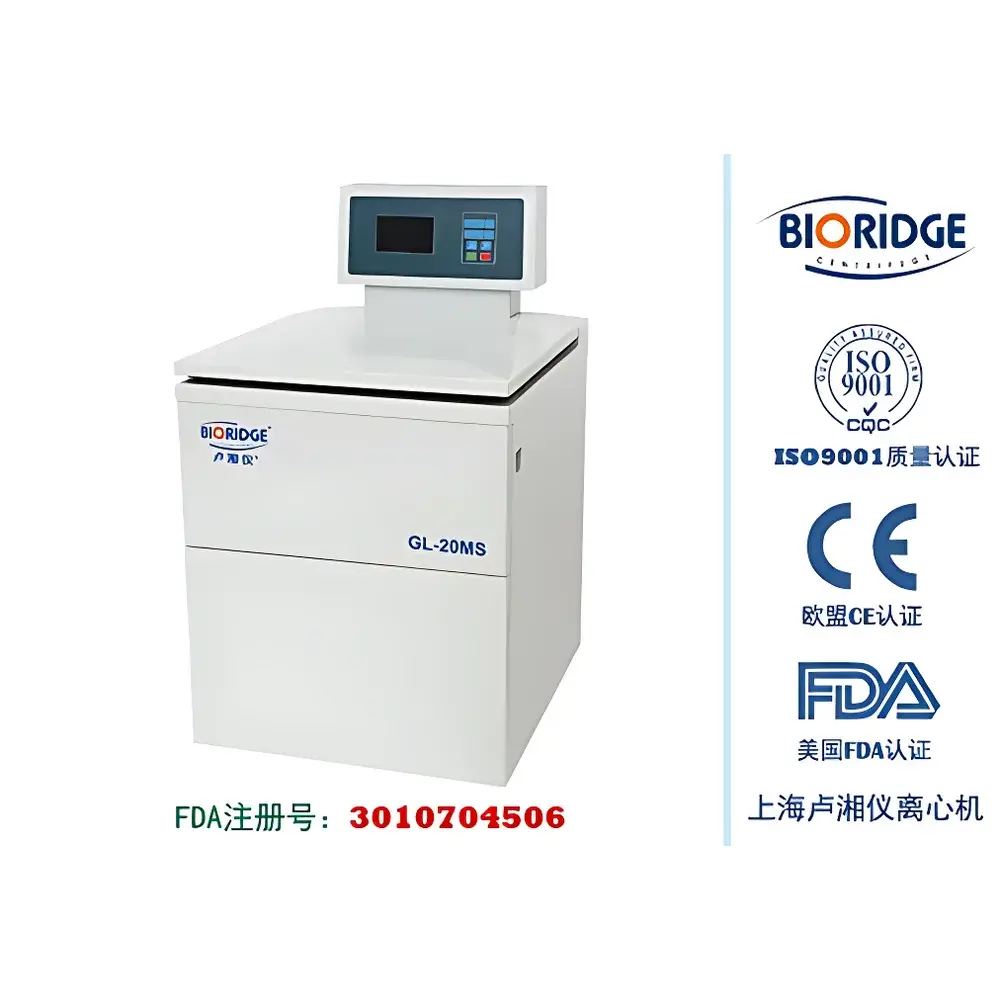
LUXIANGYI GL-20M Floor-standing High-Speed Refrigerated Centrifuge
| Brand | LUXIANGYI / BIORIDGE |
|---|---|
| Origin | Shanghai, China |
| Model | GL-20M |
| Type | Floor-standing refrigerated centrifuge |
| Speed Range | 10,000–20,000 rpm |
| Max RCF | 27,800 × g |
| Max Capacity | 4 × 250 mL |
| Temperature Range | −20 °C to +40 °C |
| Temp. Accuracy | ±1 °C |
| Noise Level | <65 dB(A) |
| Dimensions (L×W×H) | 650 × 710 × 1100 mm |
| Net Weight | 170 kg |
| Power Supply | AC 220 V, 50 Hz, 20 A |
| Refrigerant | R404a (non-ozone-depleting) |
| Control | Microprocessor-based with touch panel interface |
| Rotor Compatibility | Horizontal, fixed-angle, and swing-out configurations (including 96-well plate, microtube, and large-volume buckets) |
| Safety Features | Electronic door lock, overspeed/overtemperature/unbalance detection, automatic fault alarm, programmable acceleration/deceleration profiles (10 curves) |
Overview
The LUXIANGYI GL-20M Floor-standing High-Speed Refrigerated Centrifuge is an engineered solution for laboratories requiring high-throughput, temperature-controlled separation of biological macromolecules—including proteins, nucleic acids, organelles, and viral particles—under reproducible and GxP-aligned conditions. Built on a robust floor-standing architecture, the GL-20M employs a high-torque AC brushless inverter motor coupled with precision-machined rotor assemblies to deliver stable rotational dynamics at speeds up to 20,000 rpm and relative centrifugal forces (RCF) reaching 27,800 × g. Its active refrigeration system utilizes an imported high-efficiency compressor and environmentally compliant R404a refrigerant, enabling precise thermal control from −20 °C to +40 °C—critical for preserving labile biomolecular integrity during prolonged runs. Designed for integration into clinical diagnostics, biopharmaceutical process development, and academic research workflows, the GL-20M meets foundational mechanical and thermal stability requirements aligned with ISO 21501-4 (particle size analysis instrumentation), IEC 61010-2-020 (safety for laboratory centrifuges), and supports audit-ready operation under GLP and GMP environments when paired with validated protocols.
Key Features
- Microprocessor-controlled operation with intuitive touch-panel interface and dual-display options (digital display on GL-20M; large LCD on GL-20MS variant)
- Real-time interconversion between rpm and RCF values during parameter setup and runtime monitoring
- Programmable acceleration and deceleration profiles—10 user-defined ramp curves for optimized sample integrity and rotor longevity
- Comprehensive safety architecture: electronic lid lock, automatic imbalance detection, overspeed cutoff, overtemperature shutdown, and self-diagnostic fault alerts
- Low-noise design (<65 dB[A]) achieved via vibration-dampened chassis, balanced rotor housing, and acoustic insulation
- Energy-efficient refrigeration with rapid cool-down capability and ±1 °C temperature uniformity across chamber volume
- Non-volatile memory for storing up to 10 user-defined protocols—including time, speed, temperature, and ramp settings
Sample Compatibility & Compliance
The GL-20M accommodates a broad spectrum of sample formats through interchangeable rotor systems: horizontal swing-bucket rotors (e.g., 4 × 250 mL), fixed-angle rotors for microtubes (1.5/2.2 mL × 12 or × 24), conical tube carriers (5 mL, 10 mL, 50 mL, 100 mL), and specialized 96-well plate carriers. All rotors are certified for maximum rated speeds and RCF values per ISO 15197 and ASTM F2308 standards. The instrument’s refrigeration performance complies with EN 61000-6-3 (EMC emission limits) and adheres to RoHS and REACH directives. While not pre-certified for FDA 21 CFR Part 11, its parameter logging, user-access controls, and protocol retention support validation pathways required for regulated QC/QA labs performing USP , EP 2.2.37, or ISO/IEC 17025-compliant testing.
Software & Data Management
The GL-20M operates autonomously without external PC dependency but supports optional USB data export for run logs—including start/stop timestamps, actual vs. setpoint temperature and speed, error codes, and rotor usage history. Each run record includes operator ID (via manual entry), protocol name, and cycle completion status. For facilities implementing electronic lab notebooks (ELN) or LIMS integration, ASCII-formatted output files can be parsed for metadata ingestion. Audit trail functionality—while not embedded as a full 21 CFR Part 11 module—is achievable via procedural controls: defined user roles, printed log reports signed by operators, and periodic backup of internal flash memory.
Applications
- Purification of plasmid DNA and mRNA intermediates in vaccine development workflows
- Isolation of exosomes and extracellular vesicles from serum, plasma, and cell culture supernatants
- Subcellular fractionation (mitochondria, lysosomes, nuclei) in mechanistic cell biology studies
- Clarification of monoclonal antibody harvest streams prior to chromatography
- Routine hematological separations (PBMC isolation, platelet-rich plasma preparation) in clinical labs
- High-volume buffer exchange and concentration steps in protein formulation development
FAQ
What is the maximum allowable imbalance tolerance for safe operation?
The GL-20M detects mass imbalances exceeding 5 g per rotor position and halts acceleration before reaching operational speed.
Can this centrifuge be used for radioactive samples?
Yes—when equipped with sealed, gamma-compatible rotors and operated within designated containment hoods; consult local radiation safety office for shielding verification.
Is rotor calibration traceable to national standards?
Rotor certification documents include speed and RCF validation data referenced to NIST-traceable tachometry and torque measurement equipment.
Does the unit support remote monitoring via Ethernet or Wi-Fi?
No native network interface is provided; however, third-party IoT gateways may interface via RS-232 serial port (optional accessory).
What maintenance intervals are recommended for the refrigeration system?
Compressor oil and filter replacement every 24 months; annual inspection of condenser coil cleanliness and refrigerant pressure levels by authorized service technicians.



