
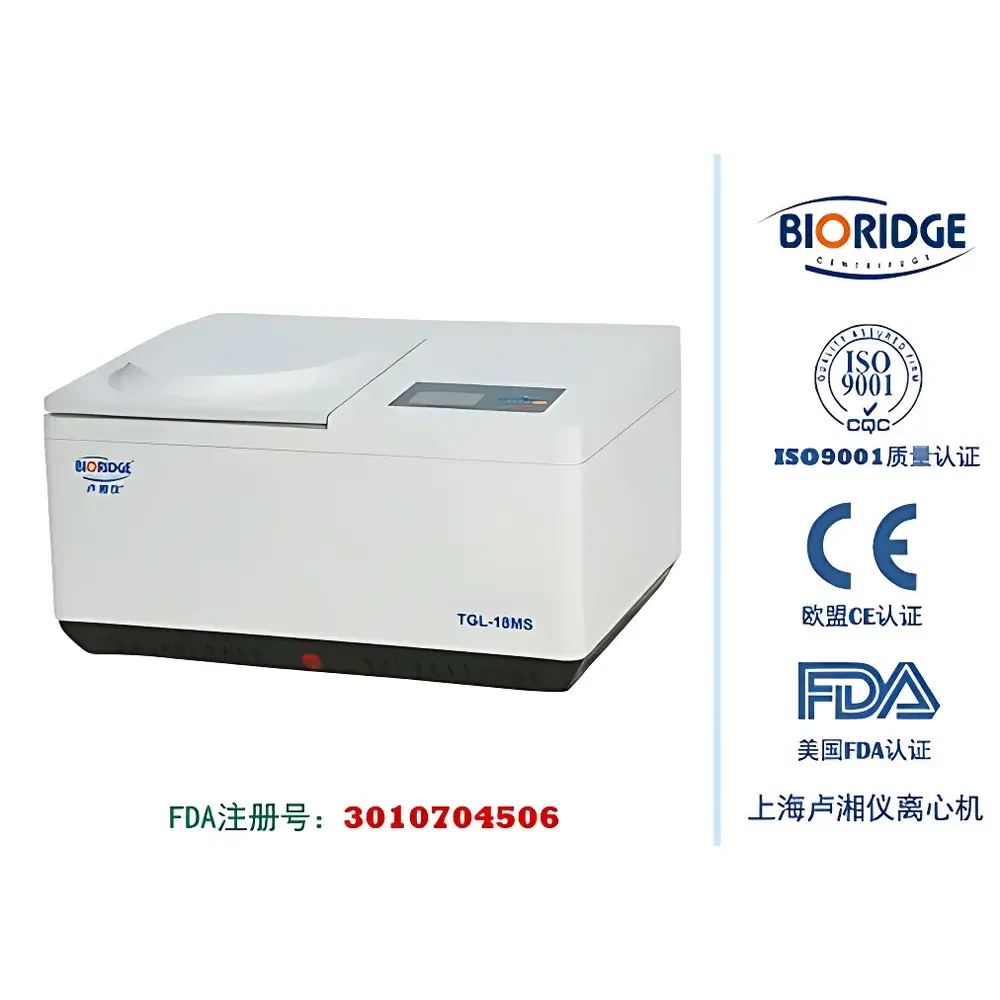
LuXiangYi TGL-18MS Benchtop High-Speed Refrigerated Centrifuge
| Brand | LuXiangYi / BIORIDGE |
|---|---|
| Origin | Shanghai, China |
| Model | TGL-18MS |
| Instrument Type | Benchtop Centrifuge |
| Category | High-Speed Refrigerated Centrifuge (10,000–30,000 rpm) |
| Max Speed | 18,000 rpm |
| Max RCF | 23,755 × g |
| Max Capacity | 4 × 100 mL |
| Temperature Range | −20 °C to +40 °C |
| Temp. Accuracy | ±1 °C |
| Noise Level | <65 dB(A) |
| Dimensions (L×W×H) | 600 × 470 × 330 mm |
| Net Weight | 50 kg |
| Power Supply | AC 220 V, 50 Hz, 15 A |
| Refrigerant | R134a |
| Rotor Types | Horizontal (swing-out), with multiple interchangeable rotor configurations including microtube, conical tube, and microplate carriers |
Overview
The LuXiangYi TGL-18MS Benchtop High-Speed Refrigerated Centrifuge is engineered for precision separation of biological macromolecules—including nucleic acids, proteins, organelles, and viral particles—under controlled thermal conditions. Utilizing a high-torque AC frequency-controlled motor and advanced microprocessor-based control architecture, the system delivers stable rotational dynamics across its operational range (1,000–18,000 rpm), with real-time conversion between rotational speed (rpm) and relative centrifugal force (RCF) displayed on a large LCD interface. Its refrigeration system employs an imported high-efficiency compressor and environmentally compliant R134a refrigerant, maintaining chamber temperature within ±1 °C across the full −20 °C to +40 °C setpoint range—critical for preserving thermolabile samples during extended high-speed runs.
Key Features
- Microprocessor-controlled operation with programmable run profiles: up to 9 customizable acceleration/deceleration ramps, enabling gentle pelleting of sensitive cellular components or rapid sedimentation of dense particulates.
- Touch-sensitive user interface with intuitive navigation; all parameters—including speed, time, temperature, and brake profile—are stored automatically upon power-down for repeatable protocol execution.
- Integrated safety architecture: electronic lid lock with automatic interlock, overspeed detection, overtemperature cutoff, rotor imbalance sensing, and real-time fault diagnostics with audible/visual alerts.
- Low-noise design (<65 dB[A] at maximum speed) achieved through precision-balanced rotor assembly, vibration-dampening chassis, and optimized airflow management—suitable for shared laboratory environments.
- High reproducibility: speed accuracy of ±30 rpm ensures consistent sedimentation kinetics across sequential runs, supporting GLP-compliant workflows in regulated research settings.
Sample Compatibility & Compliance
The TGL-18MS accommodates a broad spectrum of sample formats via seven standard rotor configurations: 12–48 position microtube carriers (0.2–2.2 mL), conical tube rotors (5–100 mL), dual 48-well microplate carriers, and low-speed horizontal carriers for 10 mL tubes. All rotors are certified for use at rated speeds and RCF values per ISO 15195:2020 (clinical laboratory centrifuge performance standards). The unit meets IEC 61010-1:2010 safety requirements for electrical equipment and complies with RoHS directives. While not FDA 21 CFR Part 11–validated out-of-the-box, its audit-trail-capable parameter logging supports integration into GMP/GLP documentation systems when paired with external LIMS or ELN platforms.
Software & Data Management
The embedded firmware enables full parameter logging—including start/stop timestamps, actual vs. set temperature and speed traces, and error codes—for each run. Data export is supported via USB port (CSV format) for post-acquisition analysis in Excel or statistical software. Though no proprietary PC software is bundled, the device’s standardized serial communication protocol allows third-party integration with laboratory automation middleware (e.g., LabVantage, STARLIMS) using Modbus RTU or ASCII command sets. All user-defined programs persist through power cycles without battery backup dependency.
Applications
This centrifuge serves as a core platform in molecular biology labs for plasmid DNA purification, RNA isolation, and protein precipitation; in clinical diagnostics for serum/plasma separation prior to immunoassay or PCR; in immunology for lymphocyte enrichment via density gradient centrifugation; and in bioprocessing R&D for harvest and clarification of mammalian cell culture supernatants. Its −20 °C capability enables cryo-centrifugation protocols essential for membrane protein stabilization and lipid raft isolation. The 23,755 × g maximum RCF supports subcellular fractionation—including mitochondrial and nuclear pellet recovery—when used with appropriate swing-out rotors and density media.
FAQ
What is the minimum and maximum operating temperature?
The chamber temperature is adjustable from −20 °C to +40 °C in 1 °C increments, with stability maintained within ±1 °C under load.
Can the TGL-18MS be used for continuous operation at maximum speed?
Yes—thermal management and motor duty cycle are designed for uninterrupted runs up to 9 hours 59 minutes at any speed within specification.
Are rotors autoclavable?
Aluminum rotors are not autoclavable; they must be cleaned with non-corrosive disinfectants and dried thoroughly. Stainless steel adapters may tolerate low-pressure steam sterilization per manufacturer guidelines.
Does the system support remote monitoring or network connectivity?
No native Ethernet or Wi-Fi interface is provided; however, USB data export and RS-232 serial output enable integration with local lab networks via gateway devices.
What regulatory certifications does the TGL-18MS hold?
It carries CE marking (EMC & LVD directives), conforms to IEC 61010-1:2010, and complies with ISO 15195:2020 for clinical centrifuge performance verification. Factory calibration reports are available upon request.



