
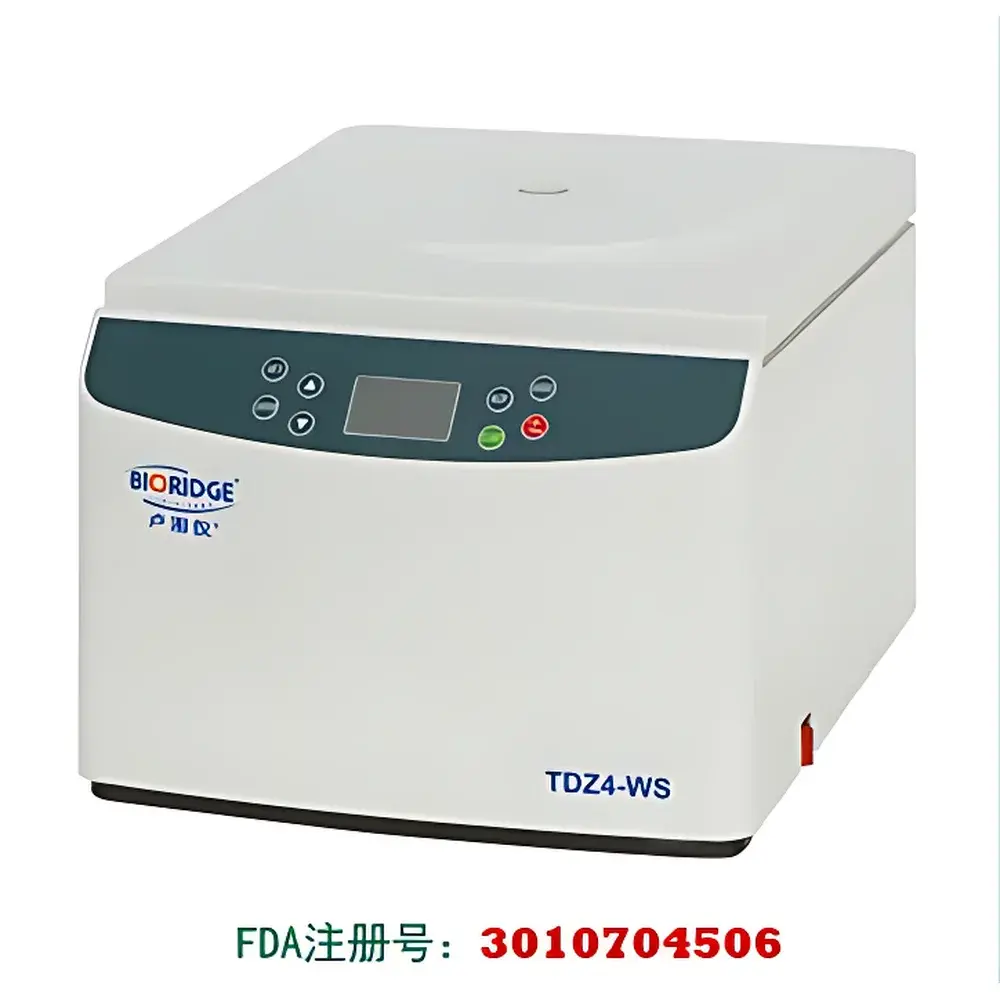
LUXIANGYI TDZ4-WS Benchtop Low-Speed Centrifuge
| Brand | LUXIANGYI / BIORIDGE |
|---|---|
| Origin | Shanghai, China |
| Model | TDZ4-WS |
| Type | Benchtop Centrifuge |
| Max Speed | 4000 rpm |
| Max RCF | 2200 × g |
| Max Capacity | 20 mL × 12 |
| Dimensions (L×W×H) | 410 mm × 490 mm × 310 mm |
| Noise Level | <60 dB(A) |
| Power Supply | AC 220 V, 50 Hz, 5 A |
| Weight | 14 kg |
| Speed Accuracy | ±50 rpm |
| Timer Range | 1–99 min |
| Rotor Type | Horizontal Swing-Out Rotor |
| Compliance | Designed for general laboratory separation of biological macromolecules and routine clinical samples |
Overview
The LUXIANGYI TDZ4-WS Benchtop Low-Speed Centrifuge is an engineered solution for routine sedimentation and phase separation tasks in clinical diagnostics, cell culture laboratories, and basic life science research. Operating on the principle of centrifugal force generation via horizontal swing-out rotor dynamics, it delivers consistent gravitational acceleration up to 2200 × g at a maximum rotational speed of 4000 rpm—optimized for gentle yet effective pelleting of whole blood, mammalian cells, yeast, and larger subcellular components such as nuclei and mitochondria. Its design prioritizes operational reliability under continuous daily use, with a brushless DC motor ensuring stable torque delivery, minimal thermal drift, and extended service life. The unit complies with IEC 61010-1 safety standards for laboratory electrical equipment and incorporates mechanical and electronic safeguards aligned with ISO 13485-informed quality system expectations for in vitro diagnostic support instrumentation.
Key Features
- Microprocessor-controlled operation with real-time RPM/RCF interconversion displayed on a high-contrast LCD interface
- Programmable parameter storage: up to 10 user-defined protocols retained after power cycling
- Brushless DC motor drive—no carbon brushes to replace, low maintenance, and <60 dB(A) acoustic emission during operation
- Electronic lid lock with automatic engagement and dual-safety interlock circuitry preventing rotor rotation unless fully closed and secured
- Comprehensive protection suite: overspeed detection, imbalance sensing, door-open emergency stop, and fault-code-based diagnostics
- Intuitive touch-sensitive control panel with tactile feedback and logical menu navigation for rapid protocol execution
Sample Compatibility & Compliance
The TDZ4-WS accommodates a broad range of standard laboratory vessels through interchangeable adapter configurations, supporting tubes from 1.5 mL microcentrifuge tubes up to 50 mL conical centrifuge tubes. Certified compatibility includes polypropylene and polycarbonate tubes rated for ≥2200 × g exposure. With its maximum capacity of 20 mL × 12 or 50 mL × 6 in compatible rotors, the system meets typical throughput requirements for hematology, urinalysis, and serology workflows. All rotor assemblies are dynamically balanced and certified per ISO 15530-3 traceable calibration procedures. While not classified as GLP/GMP-grade instrumentation, the device supports audit-ready documentation practices when integrated into SOP-driven environments compliant with CLIA, CAP, or ISO 15189 frameworks.
Software & Data Management
The TDZ4-WS operates as a standalone instrument without external software dependency. All operational parameters—including time, speed, RCF, and run history—are stored locally in non-volatile memory. Timestamped run logs (date/time, rotor ID, speed, duration, final RCF) are accessible via the front-panel interface and can be manually recorded for internal quality records. No network connectivity or FDA 21 CFR Part 11-compliant electronic signature capability is provided; however, the system’s deterministic behavior, repeatable setpoint accuracy (±50 rpm), and error-trapping logic support manual verification and validation protocols required in regulated settings.
Applications
- Routine serum/plasma separation from whole blood specimens (e.g., EDTA, heparin, or serum separator tubes)
- Pelleting of cultured adherent and suspension cells prior to lysis or cryopreservation
- Clarification of bacterial cultures and crude lysates in molecular biology workflows
- Sedimentation of urinary sediments and cerebrospinal fluid (CSF) particulates
- Preparative isolation of extracellular vesicles and lipoprotein fractions where high g-forces may induce aggregation
- Centrifugal washing steps in ELISA, lateral flow assay development, and antigen-antibody binding assays
FAQ
What is the maximum relative centrifugal force (RCF) achievable with this centrifuge?
The TDZ4-WS delivers a maximum RCF of 2200 × g at its top speed of 4000 rpm with the standard 20 mL × 12 horizontal rotor.
Can this centrifuge accommodate 50 mL conical tubes?
Yes—using optional rotor configuration NO.1 (50 mL × 4) or NO.1 (50 mL × 6), both operating at 4000 rpm and generating 2220 × g.
Is the centrifuge suitable for use in a biosafety cabinet?
Due to its physical dimensions (410 × 490 × 310 mm) and lack of sealed rotor chamber design, it is not recommended for direct placement inside Class II biosafety cabinets; benchtop installation in a controlled lab environment is advised.
Does the unit support automatic rotor identification?
No—rotor selection and associated max speed/RCF limits must be manually verified by the operator against the included rotor compatibility chart.
What maintenance intervals are recommended?
Routine cleaning of the rotor chamber and lid gasket is advised after each use; annual inspection of motor bearings and brake assembly is recommended by the manufacturer for sustained performance.



